
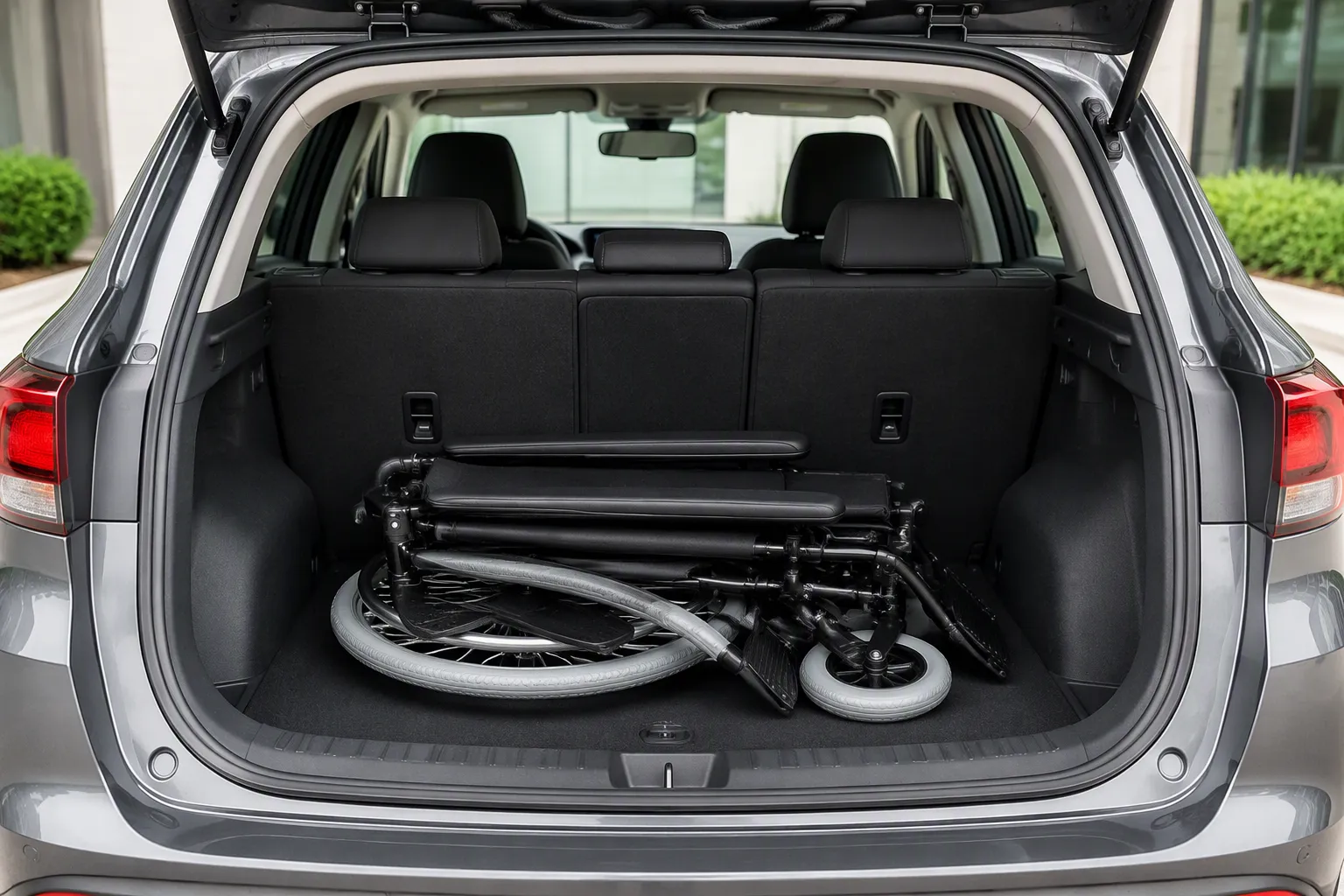
The short answer: It depends on your vehicle and your folding wheelchair dimensions. Here is exactly how to find out if it will fit in the trunk of a car. You do not need to guess or drive to a dealership. Grab a tape measure and five minutes. Measure your wheelchair and trunk. No jargon, no fluff—just practical help.
The Short Answer: It Depends on Two Things
A folding wheelchair fits in a car trunk only when two sets of numbers agree. The first set comes from the wheelchair itself. The second set comes from the vehicle. A person needs both measurements before making any decision.
Your Folding Wheelchair’s Folded Dimensions
Width, height, and length when collapsed
Every wheelchair has three folded dimensions. Width measures across the widest point after folding. Height measures from the lowest point to the tallest point. Length measures from the front tip to the back tip. These three numbers define the total space the chair occupies.
Removable parts that change the numbers
Footrests, armrests, and quick-release wheels often detach. Removing these parts reduces the folded dimensions significantly. A chair that measures 32 inches long might shrink to 28 inches after removing footrests. These adjustments matter for tight trunk compatibility.
Your Car Trunk’s Opening and Interior Space
The narrowest point of the trunk opening
The trunk opening is not a perfect rectangle. Hinges, struts, and taillight housings create narrow points. The smallest measurement across this opening determines what can pass through. A wide trunk with a narrow opening still blocks large items.
Floor length and width inside the trunk
Interior trunk space matters after the chair passes the opening. Floor length runs from the rear seats to the trunk lip. Floor width spans between wheel wells or any narrowing. These interior numbers confirm whether the chair sits flat once inside.
Why Cubic Feet Doesn’t Tell You Anything Useful
Volume vs. usable shape
Car manufacturers list trunk space in cubic feet. This number describes total volume. It does not describe usable shape. A trunk with 15 cubic feet of volume might have a tiny opening. The volume number says nothing about whether a wheelchair fits.
A deep trunk with a small opening still fails
A deep trunk offers plenty of interior room. A small opening prevents the chair from entering. The wheelchair never reaches that interior space. This scenario proves why volume alone fails as a measurement tool.
Many people wonder whether power wheelchairs can fit in car trunks. The same rules apply. Weight and dimensions determine the answer. Loading a power wheelchair into a car trunk requires even more careful measurement because these chairs are heavier and bulkier.
The Two Crucial Measurements You Need
A successful fit depends on two sets of numbers. The first set describes the wheelchair after folding. The second set describes the trunk in its real-world condition. A person must gather both sets before making any judgment about compatibility.
Your Wheelchair’s Folded or Disassembled Dimensions
The folded or disassembled dimensions of a wheelchair define the total space the device requires during transport. Three measurements matter: width, height, and length. Each one plays a distinct role in the fit calculation.
Width at the widest point when folded
Width measures across the chair at its broadest point after folding. The widest point often sits at the wheels, the seat frame, or the armrest mounts. A person should place the tape measure at the widest span and read the number. This width determines whether the chair slides through a narrow trunk opening.
Height from the lowest point to the tallest point
Height measures from the ground to the highest point of the folded chair. The tallest point is usually the top of the backrest or the push handles. This number matters when a trunk has a low ceiling or a sloping rear glass. A chair that stands too tall will not clear the opening.
Length from front tip to back tip
Length measures from the front edge to the back edge of the folded frame. The front tip is often the footrest area, and the back tip is the rear wheel or frame end. This measurement determines how deep the chair sits inside the trunk. A long chair may fit through the opening but stick out past the trunk lip.
Popular folding wheelchair models vary in their folded width and height. The table below shows real numbers from five common models.
| Model | Folded Width (in) | Folded Height (in) |
|---|---|---|
| JBH Ultra-light Electric Wheelchair D05 | 11.8 | 31.5 |
| Porto Mobility Ranger D09 | 13 | 29 |
| Journey Air 2026 | 12 | 28 |
| Easwe F10 Electric Wheelchair | 13 | 30 |
| 33 lbs Electric Wheelchair for Adults | 11 | 27 |
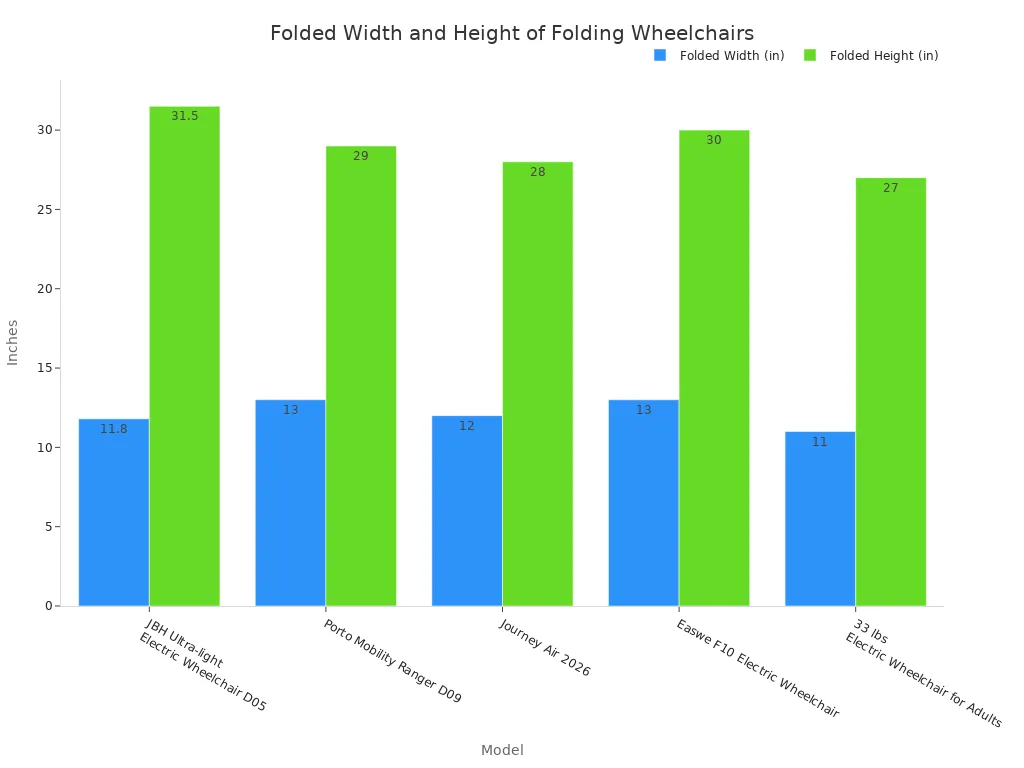
These numbers show a clear pattern. Folded widths cluster between 11 and 13 inches. Folded heights range from 27 to 31.5 inches. A person can use these ranges as a reference point when measuring a specific model.
Your Trunk’s Real-World Dimensions
A trunk has two distinct zones: the opening and the interior floor. Both zones impose limits on what the trunk accepts. A person must measure each zone separately.
Opening width between the narrowest points
The opening width is the horizontal distance between the narrowest points of the trunk mouth. Hinges, struts, and taillight housings often create these narrow points. A person should measure across the tightest span, not the widest. This number sets the hard limit for what passes through.
Opening height from the trunk floor to the top edge
The opening height is the vertical distance from the trunk floor to the top edge of the opening. The top edge is often the lip of the trunk lid or the rear glass line. A low opening height blocks tall items even when the width is generous. A person should measure at the center of the opening where the height is greatest.
Interior floor length and width
The interior floor length runs from the rear seats to the trunk lip. The interior floor width spans between the wheel wells or any narrowing. These numbers confirm whether the chair sits flat once inside. A short floor forces the chair to stick out. A narrow floor prevents the chair from lying flat.
Sedan trunks follow predictable patterns. The table below shows interior floor dimensions for common sedan types.
| Sedan Type | Floor Length (inches) | Floor Width (inches) |
|---|---|---|
| Standard 4-door | 36 | 41 |
| Mid-Size | 35 | 40 |
| Full-Size | 44 | 41 |
| Luxury | 41 | 42 |
| Typical Sedan (summary) | 36 | 41 |

These numbers reveal an important fact. Most sedan trunks offer 35 to 44 inches of floor length and 40 to 42 inches of floor width. A standard folding wheelchair measures 30 to 36 inches long. The interior floor usually provides enough room. The opening, however, often creates the real obstacle.
Which Number Matters Most
A person can compare many numbers, but one comparison decides the outcome. The smallest opening dimension must exceed the largest wheelchair dimension. This single rule answers the fit question.
The smallest opening dimension vs. the largest wheelchair dimension
The smallest opening dimension is the tightest measurement of the trunk mouth. It could be the opening width or the opening height, whichever is smaller. The largest wheelchair dimension is the biggest number among the folded width, height, and length. A person compares these two numbers directly.
If the smallest opening dimension is larger than the largest wheelchair dimension, the chair fits through the opening. The interior floor then determines how well the chair sits inside. If the smallest opening dimension is smaller, the chair cannot pass through. No amount of interior space helps in that case.
This rule simplifies a complex problem. A person does not need to calculate volume or estimate angles. A person needs two numbers and a simple comparison. The weight of the chair does not affect this calculation, though it matters for lifting the chair into the trunk. The space inside the trunk only matters after the chair clears the opening.
A folding wheelchair with a folded height of 31.5 inches will not fit through a trunk opening that measures 28 inches tall. The chair might fit if the person lays it on its side. That maneuver changes the effective height to the folded width, which is often 11 to 13 inches. A person should keep this option in mind during the measurement process.
The next step is to measure the wheelchair itself. A person needs a tape measure, a flat surface, and a few minutes of time.
How to Measure Your Folding Wheelchair Step by Step
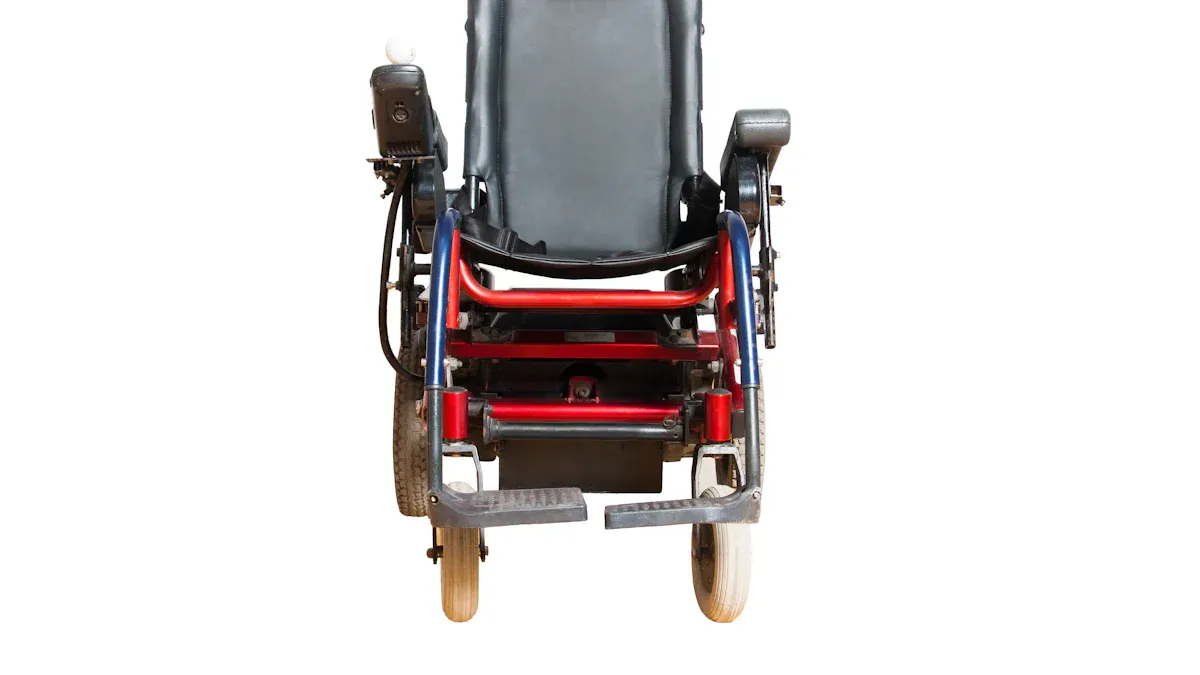
Accurate measurements start with proper preparation. A person should fold the chair completely before taking any numbers. This step ensures the measurements reflect the actual transport size.
Fold It Completely First
Remove footrests and armrests if detachable
Many folding wheelchair models feature detachable footrests and armrests. A person should remove these parts before measuring. Each removed component reduces the overall size. The chair becomes more compact and easier to fit through tight spaces.
Collapse the frame fully like a stroller
The frame must collapse completely. A person should push the seat fabric down and pull the sides together. The chair should lock into its most compact position. This step mimics the exact condition during transport. Wheelchairs fold for transport in this same manner every time.
Measure Width, Height, and Length
A tape measure and a flat surface make this process simple. A person should take each measurement twice for accuracy. The three numbers define the folded or disassembled dimensions of the chair.
Width across the seat or wheels when folded
Width measures across the folded chair at its widest point. The widest span often sits at the wheels or the seat frame. A person should place the tape measure across this span and record the number. This width determines whether the chair passes through a narrow trunk opening.
Height from the ground to the highest point
Height measures from the ground to the tallest point of the folded frame. The highest point is usually the top of the backrest or the push handles. A person should stand the chair upright and measure vertically. This number matters when a trunk has a low clearance.
Length from the front edge to the back edge
Length measures from the front tip to the back tip of the folded frame. The front tip is often the footrest mount, and the back tip is the rear wheel or frame end. A person should measure horizontally along the longest axis. This measurement determines how deep the chair sits inside the trunk.
Note the Largest Single Dimension
That number is what you compare to your trunk opening
The largest single dimension among width, height, and length becomes the critical number. A person should write this number down and keep it handy. This figure represents the biggest obstacle during loading. The total weight of the chair does not affect this comparison, though it matters for lifting. A person compares this largest dimension directly to the smallest trunk opening measurement. That single comparison answers the fit question.
How to Measure Your Trunk Step by Step

Accurate trunk measurements require the same care as wheelchair measurements. A person should gather a tape measure and a helper for this process. The numbers from this step determine whether the chair fits without folding the rear seats.
Open the Trunk All the Way
A person should open the trunk lid to its highest position. The lid must stay open without support during the measurement process. This step gives full access to the opening and the interior floor.
Check for hinges or struts that narrow the opening
Hinges and gas struts often intrude into the trunk opening. These components create narrow points that block large items. A person should inspect both sides of the opening for these obstructions. The narrowest point between these parts sets the true limit for the wheelchair.
Measure the Opening First
The opening is the gateway to the trunk of a car. A person should measure this area before checking the interior. Two numbers matter: width and height.
Width at the narrowest point
A person should extend the tape measure across the opening at its tightest span. Hinges, taillight housings, and struts often define this point. The measurement should run horizontally between the two narrowest obstacles. This number represents the maximum width that can pass through.
Height from the floor to the top edge
A person should measure vertically from the trunk floor to the top edge of the opening. The top edge is often the lip of the trunk lid or the rear glass line. A person should take this measurement at the center of the opening. This number represents the maximum height that can pass through.
Measure the Interior Floor
The interior floor determines how well the wheelchair sits once inside. A person should measure both length and width for this area.
Length from the rear seats to the trunk lip
A person should measure from the back of the rear seats to the inner edge of the trunk lip. This distance shows how deep the trunk extends. A longer floor provides more room for the chair to sit flat.
Width between wheel wells or any narrowing
A person should measure across the floor between the wheel wells. Many cars have humps or narrowing points in this area. A person should record the smallest width across the floor. This number confirms whether the chair lies flat inside the car.
Record the Smallest Opening Measurement
That is the number your wheelchair must pass through
A person should write down the smallest opening measurement on paper. This number represents the tightest point of the trunk mouth. The wheelchair must pass through this gap during loading. Any item wider or taller than this number will not fit.
The smallest opening measurement often differs from the largest opening measurement. Hinges, struts, and taillight housings create irregular shapes. A person should measure at multiple points across the opening. The tightest span becomes the critical number.
This number serves as the gatekeeper for the entire fit calculation. A person compares the largest folded wheelchair dimension to this smallest opening dimension. The comparison produces a clear yes or no answer. No other measurement matters until the chair clears this opening.
A person should record this number in inches for consistency. The wheelchair measurements also use inches. Matching units prevent confusion during comparison. A person should write the number in a visible location for easy reference.
The trunk opening height often creates the biggest obstacle. Many sedans have tall interior spaces but low opening heights. A person should measure the height at the center of the opening. The center usually provides the greatest vertical clearance.
The trunk opening width also matters for angled loading. A person might tilt the wheelchair to reduce its effective height. This maneuver requires sufficient opening width. A narrow opening prevents this technique.
A person should note both the opening width and the opening height. The smaller of these two numbers becomes the limiting factor. The wheelchair must fit through both dimensions simultaneously. A chair that fits the width but not the height will not pass through.
This measurement process takes only a few minutes. The resulting number provides certainty for the entire loading decision. A person no longer needs to guess or estimate. The number delivers a definitive answer.
A person should keep this number with the wheelchair measurements. The two sets of numbers work together. The comparison between them determines the final outcome. This simple step eliminates uncertainty about trunk compatibility.
Common Sizes and Which Cars Usually Work
Typical Folding Wheelchair Dimensions
The table below shows the typical folded dimensions for compact and standard models. These numbers provide a reference point for evaluating trunk space.
| Dimension | Compact Models | Standard Models |
|---|---|---|
| Height | 26-28 inches | 28-32 inches |
| Width | 12-14 inches | 14-16 inches |
| Length | 30-32 inches | 32-36 inches |
Compact models produce a smaller overall package. Their total weight tends to be lower. A trunk-compatible power wheelchair often falls into the compact category. The compact folded footprint makes these models easier to transport. Standard models take up more room.
Compact models: about 26 to 28 inches tall, 12 to 14 inches wide, 30 to 32 inches long
A compact model suits most vehicles. The size of the wheelchair fits within the opening limits of many sedans and hatchbacks. Users rarely need to fold the seats. The size of the vehicle matters less than the opening measurements.
Standard models: about 28 to 32 inches tall, 14 to 16 inches wide, 32 to 36 inches long
Standard units require more space. Their larger dimensions create obstacles. Some vehicles accept these models only after removing footrests or angling the unit.
Cars That Often Fit Without Folding Seats
Certain vehicle types accommodate a chair without requiring seat folding. These cars share common characteristics that improve trunk compatibility.
SUVs, hatchbacks, and crossovers with flat floors and tall openings
SUVs, hatchbacks, and crossovers offer generous openings and flat load floors. The tall opening height clears a standing chair with room to spare. The flat floor allows the unit to slide in without tilting. A compact unit tends to fit in car trunks of this type without modifications. The available cargo area suits most sizes.
Large sedans with wide, deep trunks
Large sedans provide significant trunk space. Their wide compartments accept a chair without seat folding. The deep floor accommodates the length of a standard model. Users with these vehicles often report successful fits.
Cars That Rarely Fit Without Folding Seats
Some vehicle types struggle to accommodate a standard unit. The rear opening prevents easy access even when the interior has room.
Compact sedans and coupes with shallow or narrow trunks
Compact sedans and coupes have limited cargo depth. Their shallow compartments lack the floor depth for a full-length unit. The narrow opening blocks wider models. A standard wheelchair model fit in the trunk of a car only with significant effort. The total weight of the unit also makes loading difficult in these smaller vehicles.
Small hatchbacks with sloping rear glass
Small hatchbacks feature sloping rear glass that reduces the opening height. The opening height measures less than the unit’s standing height. Users must lay the chair on its side. Power wheelchairs can fit in these vehicles only when the model is compact.
Trunk Shapes That Help or Hurt Your Chances
The shape of a vehicle’s cargo area determines whether a folding wheelchair fits or stays out. A person must look beyond cubic feet. The actual geometry of the opening and the interior floor tells the real story.
Trunk Shapes That Usually Work
Some vehicle configurations accept a wheelchair without modifications. These shapes share common design features.
Flat floor with no wheel well humps
A flat cargo floor provides the best surface for wheelchair loading. The unit slides straight in without tilting or lifting over obstacles. Wheel well humps create tripping points. They prevent the chair from sitting flat. A flat floor eliminates those problems.
Wide, rectangular opening like a hatchback
A wide, rectangular opening grants easy access to the cargo area. The following table compares hatchback and sedan rear openings.
| Vehicle Type | Rear Opening Characteristics | Height Consideration | Loading Implication |
|---|---|---|---|
| Hatchback | Generally has a larger rear opening | Roofline may slope toward the rear, reducing height near the hatch | Measure both opening height and interior height |
| Sedan | Trunk opening is often relatively narrow or low compared with trunk volume | Opening height may be limited even if trunk volume is large | A scooter may fit diagonally, but this should not be assumed without physically checking the loading path; measure the opening first, then the trunk floor depth |
A hatchback’s larger opening allows a person to slide a wheelchair in without angling. The wide mouth accommodates the folded width and height with space to spare. A sedan trunk may hold large volume but block access with a small opening.
Tall vertical clearance with a roofline that does not slope much
A tall opening lets a standing wheelchair enter upright. Vehicles with boxy rear designs offer this advantage. The roofline stays high all the way to the back. The chair stands at its full folded height without interference.
Trunk Shapes That Usually Do Not Work
Other vehicle shapes create obstacles. These designs require seat folding or disassembly of the wheelchair.
Shallow floors where the wheelchair sticks out past the opening
A shallow trunk floor forces the wheelchair to extend past the trunk lip. The chair must tilt or hang out of the vehicle. This position creates safety risks during travel. The trunk lid may not close securely.
Narrow openings that prevent angling the chair in
A narrow opening blocks the wheelchair even when interior space exists. The chair cannot pass through the gap. Angling the chair requires additional width. A tight opening removes that option entirely.
Sloping rear glass that cuts usable height
Sloping rear glass reduces the opening height near the hatch. A folding wheelchair with a typical 28-inch height may not clear the gap. The user must lay the chair on its side or fold the seats. This shape eliminates the chance of loading the chair upright.
The Golden Rule for Fit and What to Do If It Almost Works
A person now possesses two sets of numbers. The first set describes the folded wheelchair. The second set describes the trunk opening and interior. The final step requires one direct comparison. This comparison produces a clear answer.
Compare Your Smallest Opening to Your Largest Wheelchair Dimension
The golden rule is simple. A person compares the smallest opening dimension to the largest folded wheelchair dimension. The smaller number always loses. This single comparison determines whether the chair fits without folding the rear seats.
If the opening is bigger, it fits
A person looks at the smallest opening measurement. This number could be the opening width or the opening height. A person then looks at the largest folded wheelchair dimension. This number could be the folded width, height, or length. If the opening number is larger, the chair passes through. The wheelchair fits in the trunk of a car without any seat adjustments. The interior floor then determines how well the chair sits inside. A person can load the chair with confidence.
If not, you will need to fold the back seats
A person finds the opening number is smaller than the largest wheelchair dimension. The chair cannot pass through the opening in its current configuration. The rear seats cannot be folded in some vehicles, which creates a real problem. A person must then explore other options. These options include removing parts, angling the chair, or using an alternative storage location. The next sections cover each option in detail.
Quick Mental Checklist Before You Try
A person should run through a short checklist before attempting to load the wheelchair. This checklist prevents wasted effort and potential damage to the vehicle or the chair.
Measure both the wheelchair and the trunk
A person must measure both the wheelchair and the trunk. Guessing leads to frustration. A tape measure provides exact numbers. A person should write down the folded width, height, and length of the wheelchair. A person should also record the opening width, opening height, and interior floor dimensions of the trunk. These numbers form the basis of the fit decision. The key features to consider for trunk fit are the smallest opening dimension and the largest wheelchair dimension. A person who skips this step risks damaging the car or the wheelchair during a failed loading attempt.
Can you angle the chair in
A person should consider whether the chair can enter at an angle. Angling reduces the effective height of the chair. This technique works when the opening width allows diagonal entry. A person tilts the chair and slides one corner through first. The chair then rotates into the trunk space. This maneuver requires extra width at the opening. A narrow opening prevents this technique entirely. A person should test the angle with a dry run before committing to a full load.
Try removing footrests or quick-release wheels for extra inches
A person can remove detachable components for extra clearance. Footrests often add several inches to the folded length. Quick-release wheels reduce the folded width and height. Armrests may also detach on certain models. Each removed part shrinks the overall package. A person should remove these parts before measuring again. The new measurements may now pass the golden rule test. This step costs only a few minutes and often solves the problem.
What If It Almost Fits
A person finds the chair almost fits but not quite. The numbers are close but the chair still catches on the opening. Several strategies can close the gap. These strategies range from simple part removal to alternative storage locations.
Remove armrests or quick-release wheels for extra inches
Armrests and quick-release wheels offer the easiest gains. A person removes the armrests by pressing a release button or pulling a pin. Quick-release wheels detach with a single button press. These removals can reduce the folded width by two to four inches. The folded height may drop by a similar amount. A person should re-measure after each removal. The chair may now clear the opening. This approach preserves the use of the trunk and keeps the rear seats available for passengers.
Slide it in on its side if width allows
A person can lay the chair on its side during loading. This maneuver changes the effective height to the folded width. The folded width is often 11 to 16 inches. This number is much smaller than the folded height of 26 to 32 inches. A person needs enough opening width to accommodate the folded length or height. The chair then slides in sideways. This technique works well in trunks with wide but low openings. A person should protect the chair’s upholstery and the car’s interior surfaces during this process. A blanket or towel prevents scratches.
Consider the back seat as an alternative
A person can place the wheelchair in the back seat when the trunk fails. This option works when the rear seats cannot be folded and the trunk opening is too small. The back seat offers a larger opening through the rear doors. A person folds the chair and lifts it onto the seat. A seat belt secures the chair during travel. This approach keeps the trunk free for other cargo. A person should check the door opening width and the seat height before attempting this method. The back seat often provides more vertical clearance than the trunk.
A person may also consider external carriers when the trunk and back seat both fail. Several carrier types exist for different vehicle configurations. The table below summarizes the main options.
| Carrier Type | Mounting Location | Best For | Key Consideration |
|---|---|---|---|
| Car-top carrier | Vehicle roof | Manual wheelchairs | Requires vehicle roof support for the chair’s size and weight |
| Rear bumper carrier | Rear bumper | Most vehicles | Requires drilling holes but removes easily for trunk access |
| Hitch-mounted carrier | Rear hitch | Most vehicles with a hitch | Tips downward for loading and locks securely when mounted |
| Pickup carrier | Truck bed | Power chairs and heavy scooters up to 350 lbs | Uses an electric lift to store the folded wheelchair in the bed |
The BraunAbility Chair Topper is a rooftop wheelchair car rack designed for foldable manual wheelchairs. It lifts and stores the wheelchair in a weatherproof rooftop compartment, helping preserve cabin and trunk space. A handheld control operates the system. The Chair Topper folds, lifts, and stores the wheelchair in about 30 seconds. The system is mounted atop most vehicles. It uses an aluminum frame with a watertight plastic cover and is powered by the vehicle’s electrical system. It is intended for users who can transfer independently and is installed by a certified technician.
A person should also consider the total weight of the wheelchair and the carrier system. The combined weight affects vehicle handling and fuel economy. A person should check the vehicle’s roof load limit or hitch capacity before installing any carrier. Loading a power wheelchair into a car trunk or onto a carrier requires careful planning. Power wheelchairs can fit on some carriers, but the weight limit is often lower than for manual chairs. A person should verify the carrier’s weight capacity before purchase.
A person who needs to transport your wheelchair in a car regularly should weigh the convenience of each option. The trunk remains the easiest location when the chair fits. The back seat works as a backup. External carriers provide a solution when neither internal option works. Each approach has trade-offs in cost, effort, and vehicle compatibility. A person should choose the option that matches their physical abilities and daily routine.
The folding process itself takes only a moment. A person collapses the frame, removes detachable parts, and lifts the chair into position. The right storage solution makes this routine simple and repeatable. A person no longer needs to wonder whether the wheelchair will fit. The measurements provide the answer. The alternatives provide a path forward when the trunk says no.
Accurate measurement alone provides certainty. Vehicle specs listing trunk volume do not guarantee a fit.
If the trunk’s smallest opening dimension exceeds the wheelchair’s largest folded dimension, it will fit in the trunk of a car without folding the back seats.
This rule confirms whether the chair fits. If the vehicle cannot accommodate the wheelchair, a more compact folding wheelchair or a roof-mounted carrier with adequate weight capacity offers an alternative.
FAQ
Does a folding wheelchair fit in any car trunk?
No. A folding wheelchair fits only when the trunk opening is large enough. A person must measure the smallest opening dimension and the largest folded wheelchair dimension. If the opening is bigger, the chair fits. If not, the person must fold the rear seats or find another option.
What is the most important measurement for trunk fit?
The smallest opening dimension matters most. This number could be the opening width or the opening height. A person compares it to the largest folded wheelchair dimension. The chair passes through only when the opening number is larger. Interior trunk volume does not determine fit.
Can a person fit a wheelchair in a trunk without removing parts?
Yes, sometimes. A compact wheelchair with small folded dimensions may fit without any disassembly. A standard model often requires removing footrests or armrests. A person should measure the chair in its fully folded state first. Then remove parts only if the numbers demand it.
Which cars fit a folding wheelchair without folding the back seats?
SUVs, hatchbacks, and crossovers with flat floors and tall openings usually work. Large sedans with wide, deep trunks also fit many models. Compact sedans, coupes, and small hatchbacks with sloping rear glass rarely work. A person should measure the specific vehicle before assuming compatibility.
How does a person measure the trunk opening correctly?
A person opens the trunk fully and checks for hinges or struts. These parts create narrow points. The person measures the width at the tightest span. The person then measures the height from the trunk floor to the top edge. The smaller of these two numbers becomes the critical limit.
What can a person do if the wheelchair almost fits?
A person can remove armrests or quick-release wheels for extra inches. Angling the chair through the opening reduces its effective height. Laying the chair on its side changes the effective height to the folded width. The back seat offers another option when the trunk fails.
Does trunk volume in cubic feet predict wheelchair fit?
No. Cubic feet describes total volume, not usable shape. A deep trunk with a small opening still blocks the wheelchair. A person should ignore the volume spec and measure the opening and interior floor directly. The shape of the space matters more than the volume number.
Can a person use a roof carrier when the trunk fails?
Yes. A roof-mounted carrier offers an alternative for manual wheelchairs. The BraunAbility Chair Topper lifts and stores a foldable manual wheelchair in a weatherproof rooftop compartment. A person should check the vehicle’s roof load limit and the carrier’s weight capacity before purchase.