
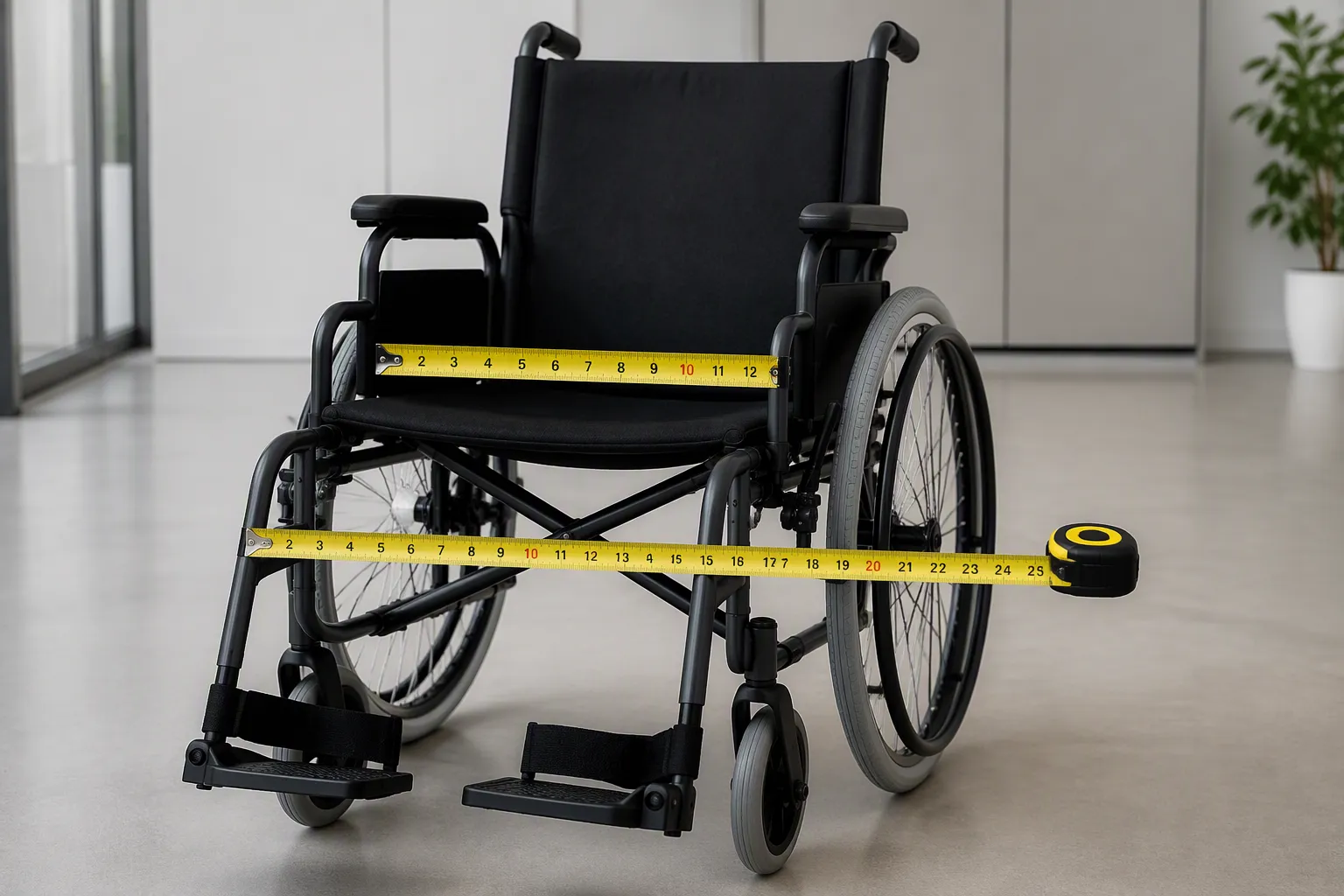
A wheelchair is wider than its seat width because the seat width measures only the seating area. The overall width includes the wheels, armrests, and frame. This extra width is a calculated necessity for stability, propulsion, and comfort. The average difference between seat width and overall width is about 8 inches.
| Seat Width (inches) | Overall Width (inches) | Difference (inches) |
|---|---|---|
| 16 | 24 | 8 |
| 18 | 25–26 | 7–8 |
| 20 | 28 | 8 |
Understanding why is a wheelchair wider helps users choose the right model and navigate tight spaces with confidence.
Why Is a Wheelchair Wider: Seat Width Versus Overall Width Explained
The confusion around why is a wheelchair wider than its seat often comes from mixing up two distinct measurements. Seat width versus overall width describes two different things. One measures the user. The other measures the entire device. A clear understanding of each measurement helps users make better choices.
What Exactly Is Seat Width?
Seat width is the horizontal distance between the inner edges of the seat frame. Manufacturers measure this distance across the widest part of the seat. They express this number in centimeters or inches. This measurement defines the usable space measured between the armrests. It directly relates to how well a user fits into the chair.
Measuring from armrest to armrest
The measurement from armrest to armrest gives the true seat width. A technician measures from the inside edge of one armrest frame to the inside edge of the other. This distance represents the actual space a user has for their hips and thighs. The typical seat width for an adult manual wheelchair ranges from 16 to 20 inches. A bariatric chair may offer 22 inches or more. A pediatric chair may offer 12 to 14 inches.
The user’s hip width as a guide
The user’s body determines the correct seat width. A proper measurement process follows several steps.
- Seat width is defined as the horizontal distance between the inner edges of the seat frame, measured across the widest part of the seat.
- The user sits upright in a firm chair with feet flat on the floor.
- A technician measures the widest point across the hips or thighs.
- The technician adds approximately 2 cm (about 1 inch) on each side for clearance.
- Users with thick clothing, pressure-relief cushions, or medical devices may need additional allowance. Users needing lateral support may need a narrower seat.
Manufacturers have refined this approach over time. The older method added 2 inches to the widest point of the user in a seated position. This allowed room for winter coats. The current method accounts for arm type and accessories. Removable arms are installed outside the seat frame. The chair width can match the user more closely. Fixed arms may require adding 1 to 2 inches. Special seating accessories like hip guides, abductors, and adductors may need extra width.
| Approach | Measurement Method |
|---|---|
| Older method | Add 2 inches to the widest point of the user in a seated position (usually hips) to allow for winter coats. |
| Current method | Have the user sit on a solid surface and measure their widest part (hips or thighs). Then consider arm type and accessories: removable arms are installed outside the seat frame so chair width can match the user; fixed arms may require adding 1–2 inches; special seating accessories like hip guides, abductors, and adductors may need extra width. |
What Makes Up the Overall Width?
The overall width of a wheelchair includes every component that extends beyond the seat. This total width is always larger than the seat width. The average wheelchair width is about 24 to 27 inches for a standard manual chair. The difference between seat and overall width is typically 6 to 8 inches.
Wheels and tires as the largest contributors
The rear wheels add the most to the overall width. These wheels sit outside the frame for stability. A standard rear wheel is 24 inches in diameter. The wheel and tire assembly adds 2 to 3 inches on each side. The frame and wheels together create the full width profile. The rear wheels also carry the handrims. These handrims add another inch or more on each side.
Armrests and side guards
Armrests and side guards also add width. Armrests provide support for the arms and shoulders. They attach to the outside of the seat frame. Side guards sit between the seat and the rear wheel. They protect the user’s clothing from dirt and moisture. These components add 1 to 2 inches on each side. Removable or flip-back armrests may add less width when folded away.
Frame rails and axle plates
The frame rails and axle plates form the structural base. The frame rails run along the bottom of the seat. The axle plates hold the rear wheels. These metal components add structural width. They also determine where the wheels sit. A wider frame provides more stability. A narrower frame improves maneuverability. Manufacturers balance these needs for each chair model.
Footrest clearance within seat width
The footrests sit within the seat width. They do not add to the overall width. The footrests hang below the front of the seat. They support the user’s feet and legs. The hanger brackets attach to the frame. These brackets stay within the seat width. This design keeps the front of the chair narrow. A narrow front helps the chair fit through tight spaces.
Why These Two Measurements Differ
Seat width and overall width serve different purposes. Seat width is for user fit. Overall width is for function. A chair must fit the user’s body. A chair must also provide stability and propulsion. These two goals require different dimensions.
Seat width is for user fit; overall width is for function
The seat width matches the user’s body. A proper fit prevents pressure sores and discomfort. It allows the user to sit for long periods. The overall width supports the chair’s mechanical needs. The wheels need space to turn. The handrims need clearance for the hands. The armrests need room for support. Each component adds width for a specific reason.
Analogy: a car’s cabin width versus its overall width with mirrors
Think of a car. The cabin width measures the space between the interior door panels. This space holds the driver and passengers. The overall width includes the side mirrors. The mirrors extend beyond the cabin. They help the driver see. They also make the car wider. A wheelchair works the same way. The seat width is the cabin. The overall width includes the mirrors, wheels, and armrests. Both measurements matter for different reasons.
Academic studies have examined how wheelchair width affects maneuverability and accessibility. The research defines wheelchair width as the unoccupied width. One major limitation is that accessories were not measured as part of the width calculation. The studies also assessed clear floor area and maneuvering clearances. For example, the 180-degree turn did allow participants to perform either a U turn or a K turn. These measurements connect overall width to the space required for maneuvering. The UDI study (Ringaert et al., 2001) measured power chairs and scooters. The BS8300 research provided data on clear floor areas and maneuvering trials.
| Study | Year | Country | Focus on Wheelchair Width | Examined Maneuverability & Accessibility |
|---|---|---|---|---|
| Bails | 1983 | Australia | Measured width as part of device dimensions | Included maneuvering and door use |
| Seeger et al. | 1994 | Australia | Measured width as part of device dimensions | Included body and device size; maneuvering inferences from standards context |
| Stait et al. | 2000 | UK | Measured wheelchair dimensions including width | Included overall dimensions and weight; referenced in maneuvering standards |
| Ringaert et al. | 2001 | Canada | Measured occupied wheelchair width | Included space requirements and maneuvering clearances |
These studies confirm one key point. The extra width of a wheelchair is not wasted space. Every inch serves a purpose. The wheels, handrims, and armrests all need room. The user needs a stable and safe chair. The overall width delivers that stability and safety.
The Role of Wheels and Handrims in Wheelchair Overall Width

The wheels and handrims drive the difference between seat width and overall width. These components extend beyond the frame for mechanical and ergonomic reasons. A user cannot push a wheelchair effectively without this extra space. The average wheelchair width reflects these design demands. Manufacturers cannot shrink the overall width without sacrificing performance.
Wheels Extend Beyond the Frame
The rear wheels and front casters define the widest points of most manual wheelchairs. These components sit outside the seat frame. This placement creates a stable base for the user. The space occupied by the wheels is not wasted. It is essential for balance and movement.
Rear wheels positioned outside the seat for stability
The rear wheels attach to axle plates on the outside of the frame. This position widens the base of support. A wider base prevents the chair from tipping sideways. The rear wheels carry most of the user’s weight. They must sit far enough apart to keep the center of gravity low. A standard rear wheel measures 24 inches in diameter. The wheel and tire assembly adds 2 to 3 inches on each side of the frame. This extra width creates a stable platform for daily use.
Front casters adding width at the front
The front casters also add width to the chair. These small wheels sit at the front of the frame. They swivel to allow turning. The casters typically measure 5 to 8 inches in diameter. They attach to the frame with forks and stems. The caster assembly adds 1 to 2 inches on each side. This width helps the chair track straight. It also prevents the front of the chair from tipping during turns. The front casters work with the rear wheels to create a stable footprint.
Handrim Clearance for Propulsion
The handrims are the metal rings attached to the rear wheels. Users push these rings to move the chair. The handrims require clearance for the hands to grip and push. This clearance adds to the overall width of the chair. Without proper clearance, users cannot propel the chair safely.
Space needed for hands to push without hitting thighs
The hands need space to move along the handrim. The user’s thumbs and fingers must fit between the handrim and the tire. A tight gap can trap the thumb during propulsion. This can cause impact injuries and skin damage. Ergonomic recommendations suggest checking the rim-to-tire clearance before purchase. This spacing ensures the thumb fits safely. The hands also need room to move without hitting the thighs. The user’s thighs sit inside the seat width. The hands move outside the seat width along the handrim. This motion requires extra space on each side of the chair.
Handrim diameter larger than seat width
The handrim diameter is larger than the seat width. The handrims attach to the outside of the rear wheels. The rear wheels sit outside the frame. This arrangement places the handrims well beyond the seat edges. The handrim diameter typically matches the wheel diameter. A 24-inch wheel has a 24-inch handrim. The handrim adds another inch or more on each side. This total width allows the user to grip and push effectively.
Ergonomic research provides clear recommendations for handrim design. These recommendations help prevent injuries and improve propulsion.
| Ergonomic Recommendation | Design Detail | Injury Prevention / Propulsion Benefit |
|---|---|---|
| Measure rim-to-tire clearance | Check the spacing between the handrim and the tire before purchase | Ensures the thumb fits safely, preventing thumb entrapment and impact injuries during propulsion |
| Use anatomical/ergonomic contours | Oval or teardrop profiles with a wider top surface and contoured thumb cradle that mimic a relaxed closed hand | Disperses pressure across the palm, reduces carpal tunnel pressure spikes, and maintains a neutral wrist posture (avoiding extreme extension and ulnar deviation) |
| Manage the friction paradox with dual-surface rims | High-friction strip on the top edge for pushing; smooth metal on the sides for braking | Preserves forward grip efficiency while preventing friction burns during downhill braking |
| Select profile based on user needs | Standard round (minimalist, intact hand function), ergonomic oval (chronic pain, daily commuting), coated/high-grip (quadriplegia, severe arthritis), dual-surface (hilly terrain) | Matches clearance and grip characteristics to the user’s hand function, reducing overuse injuries such as Carpal Tunnel Syndrome and rotator cuff tears |
| Verify compatibility before fitting | Match tab mounts (6-tab or Rivnut) and wheel diameter (24″, 25″, 26″) | Prevents improper mounting that could compromise safe handrim clearance and propulsion |
These ergonomic features require space. The handrims must extend beyond the seat to accommodate the user’s hands. This design adds to the total width of the chair. The extra width is a functional necessity, not a flaw.
Tilt and Camber Adjustments
Camber refers to the angle of the rear wheels. The wheels tilt inward at the top and outward at the bottom. This adjustment changes the overall width of the chair. Camber improves stability and turning performance. It also accommodates different propulsion styles.
Cambered wheels increasing width but improving turning
Cambered wheels increase the overall width of the chair. The wheels sit at an angle. The bottom of the wheels extends further out than the top. This angle widens the base of support. A wider base improves sideways stability. It also makes turning easier. The user can pivot the chair with less effort. Camber angles typically range from 0 to 6 degrees. A 3-degree camber adds about 1 inch to the overall width. A 6-degree camber adds about 2 inches. Users must balance the benefits of camber against the need to fit through doorways.
Accommodating different propulsion styles
Different users need different propulsion styles. Some users push with long, smooth strokes. Others use short, quick strokes. The camber angle affects how the hands meet the handrims. A slight camber helps the hands follow a natural arc. This reduces strain on the shoulders and wrists. Users with broad shoulders may need more camber. Users with narrow shoulders may need less. The camber adjustment allows the chair to fit the user’s body and movement patterns. This customization adds width, but it improves comfort and efficiency.
The wheels and handrims define the functional width of a wheelchair. The rear wheels provide stability. The front casters enable turning. The handrims allow propulsion. The camber adjusts performance. Each component adds width for a specific purpose. The next time someone asks why is a wheelchair wider than its seat, the answer lies in these mechanical and ergonomic demands. The extra width is not arbitrary. It is the result of careful engineering.
Stability and Safety: Why the Extra Overall Width Is Essential
A wheelchair must keep its user safe during daily movement. The extra width beyond the seat plays a direct role in that safety. Engineers design this wider overall width to prevent accidents and support the user’s body.
Preventing Tipping Over
Tipping remains one of the greatest risks for any wheelchair user. The design of the chair counteracts this risk through careful geometry.
Wider wheelbase lowering center of gravity
The rear wheels sit outside the frame. This placement creates a wide wheelbase. A wide wheelbase lowers the center of gravity. A low center of gravity keeps the chair grounded. The user can lean forward or sideways without tipping. This design choice explains why is a wheelchair wider than its seat. The extra inches provide a physical buffer against instability.
Sideways stability on slopes and uneven terrain
Sideways stability matters on ramps and rough ground. A narrow base tips easily on a slope. A wide base resists this tipping force. The chair stays upright when the user travels across a hill. Uneven terrain also tests stability. A wide base absorbs these shifts. The user maintains control on grass, gravel, and cracked pavement.
Weight Distribution and Balance
Weight distribution determines how well a chair performs. The overall width affects where the user’s weight rests.
Extra width shifting weight over the wheels
The extra width shifts weight over the wheels. The rear wheels carry most of the user’s mass. A wide stance places this mass directly above the axle. This alignment reduces strain on the frame. It also improves rolling efficiency. The average wheelchair width reflects this balance between stability and function.
Reducing risk of backward or sideways falls
A balanced chair reduces fall risk. Backward falls happen when weight shifts too far back. Sideways falls happen during sharp turns. The extra width counteracts both forces. The chair remains stable during quick movements. Users gain confidence in their daily mobility.
Enabling Safe Transfers
Transfers require a stable platform. The user moves from the chair to a bed, toilet, or car. This movement demands a solid base.
Stable platform for moving from wheelchair to bed or toilet
A stable platform prevents slips during transfers. The wide base keeps the chair from sliding. The user can push off the armrests with confidence. The chair stays in place during this weight shift. A narrow chair would move or tip during this process.
Armrest support without making the chair too narrow
Armrests provide critical support during transfers. They add width to the overall chair. This added width serves a dual purpose. It supports the user’s arms. It also maintains the stability of the overall structure. A seat that is too narrow cannot accommodate this support. The extra width creates a safe transfer zone.
The overall design of a wheelchair prioritizes safety at every turn. The extra width is not wasted space. It is a deliberate feature that protects the user.
Armrests and Side Transfers: Comfort and Accessibility in Wheelchair Design
Armrests serve two critical roles in wheelchair design. They support the user’s arms and shoulders during long periods of sitting. They also provide a stable point for transfers. These functions require added width beyond the seat frame. The average wheelchair width reflects this balance between comfort and accessibility.
Armrests Add Width but Improve Comfort
Armrests attach to the outside of the seat frame. This placement adds 1 to 2 inches on each side. The added width supports the user’s forearms and elbows. A padded armrest reduces pressure on the skin. It also improves posture during daily activities.
Padding and width for arm support
Armrest pads distribute weight across the forearm. A wider pad offers more surface area for support. Users with limited upper body strength benefit from this design. The padding material also affects comfort. Foam and gel pads absorb pressure better than hard plastic. These features require space. The wheelchair overall width increases to accommodate them.
Removable or flip-back armrests for transfers
Removable armrests lift out of the way during transfers. Flip-back armrests rotate backward to clear the path. Both designs reduce the effective width during side transfers. The user gains clear access to the seat surface. This flexibility improves safety and independence.
Space for Side Transfers
Side transfers require adequate clearance. The user slides sideways from the wheelchair to a bed or toilet. This movement demands a stable platform and open space.
Minimum width needed to slide sideways off the seat
Safety guidelines address the gap between transfer surfaces. A narrow gap eases the transfer process.
Specifically, in cases where the person is able to independently perform a transfer to and from a wheelchair, gaps wider than 8.9 cm between transfer surfaces at the same height make transfers increasingly difficult, particularly in the presence of an obstacle.
This finding highlights the importance of proper positioning. The wheelchair must sit close to the target surface.
Comparing fixed versus swing-away armrest designs
Fixed and swing-away armrests offer different trade-offs. The table below compares these two designs.
| Feature | Fixed Armrests | Swing-Away Armrests |
|---|---|---|
| Width added | 1–2 inches per side | Similar when locked |
| Transfer clearance | Requires lifting over | Rotates backward |
| Stability | High | Moderate |
| Convenience | Low | High |
Swing-away designs improve access for transfers. Fixed designs offer greater stability during use.
User Preferences and Customization
Users have different body sizes and mobility needs. Manufacturers offer adjustable armrests to meet these needs.
Adjustable armrest height and width
Adjustable armrests change height and lateral position. A user can raise or lower the pad for proper support. They can also move the armrest inward or outward. This adjustment changes the overall width of the chair. A wider setting improves comfort. A narrower setting improves maneuverability.
Trade-offs between overall width and convenience
Every inch of width affects navigation. A wider chair fits fewer doorways. A narrower chair may lack proper support. Users must weigh these factors. The average wheelchair width provides a useful reference point. Most standard chairs measure 24 to 27 inches across. This range fits most doorways and provides adequate support.
Practical Implications of Wheelchair Overall Width for Doorways and Home Design
A wheelchair user navigates a built environment designed for walking. The overall width dictates accessibility in ways that many people overlook. Home design and doorway dimensions directly affect daily mobility. Understanding these measurements helps users plan ahead.
Standard Doorway Widths Versus Wheelchair Widths
Doorways represent the first barrier in most homes. The relationship between door size and chair size determines whether a user can move freely.
Typical doorways are 32 inches wide
Most residential doorways measure 32 inches across. This width provides adequate clearance for an average person. It also meets common building standards for accessibility. Older homes may have narrower openings.
Most wheelchairs have overall widths of 24–27 inches
The typical overall width range for manual chairs falls between 24 and 27 inches. This range leaves only a few inches of clearance on each side. A user must approach doorways squarely. Angled approaches reduce the effective clearance.
Maneuvering Through Tight Spaces
Tight spaces demand careful technique. The wheelchair’s width determines how easily a user passes through.
Extra width from wheels requiring careful approach
The rear wheels extend beyond the seat. This extra width requires a straight approach. A user who angles the chair may catch a wheel on the door frame. The average wheelchair width leaves little room for error.
Turning radius versus straight-through clearance
Turning radius differs from straight-through clearance. A user needs more space to turn than to pass straight ahead. The 2010 ADA Standards for Accessible Design specify clear dimensions for both scenarios.
| Requirement | Minimum Dimension |
|---|---|
| Single wheelchair passage clear width | 32 inches at a point; 36 inches continuously |
| Wheelchair 180-degree turn space | 60-inch diameter clear space, or T-shaped space of 30 inches by 48 inches |
These dimensions help designers create accessible spaces. A user must know the clear opening of your tightest doorways before purchasing a chair.
ADA and Building Code Requirements
The Americans with Disabilities Act sets minimum standards for accessibility. These rules protect users and building owners alike.
Minimum 32-inch clear opening for a wheelchair
The ADA requires a minimum 32-inch clear opening for doorways. This measurement applies to the space between the door face and the latch-side stop. The door must open 90 degrees for this measurement.
| ADA Section | Applies To | Clear Width Requirement |
|---|---|---|
| §404.2.3 | Door openings generally | Minimum clear width of 32 inches; maximum 48 inches; measured between door face and latch-side stop with door open 90°, excluding door thickness and projecting hardware |
| §404.2.2 | Double-leaf (pair) doors | At least one active leaf must independently provide the 32-inch minimum clear width and meet maneuvering clearance; other requirements apply to both leaves |
How overall width affects compliance
A chair with a wider overall width may not fit through a compliant doorway. Common problems include:
- Improperly sized door leafs
- Protruding hardware reducing effective width
- Inadequate framing or stops
Remedies include replacing doors, adjusting frames, or modifying hardware. Complying with ADA door standards helps avoid costly penalties and lawsuits. The critical dimension for mobility and access is the clear opening, not the nominal door size.
Tips for Home Modifications
Home modifications improve accessibility for a wheelchair user. These changes range from simple hardware swaps to structural renovations. A homeowner can prioritize projects based on budget and urgency.
Widening doorways or using offset hinges
A standard doorway measures 32 inches across. A wheelchair with an overall width of 24 to 27 inches fits through this opening with little clearance. A user who needs more room has two main options.
Offset hinges offer a low-cost solution. These hinges replace standard hinges and swing the door clear of the frame. This change adds about 2 inches of clearance without major construction. The cost runs approximately $50 per door.
Full doorway widening requires framing modifications. A contractor removes the existing frame and rebuilds the opening to achieve a 36-inch clear opening. This project costs between $300 and $1,500 per doorway. Widening a residential doorway to at least 32 inches typically costs between $500 and $5,000 per doorway. The work may require removing and rebuilding walls.
| Modification Method | Description | Cost |
|---|---|---|
| Offset hinges | Adds ~2 inches of clearance without major construction | $50 |
| Full doorway widening | Requires framing modifications to achieve a 36-inch clear opening | $300–$1,500 per doorway |
Occupational therapists recommend several low-cost modifications. These changes improve safety and independence.
- Lever-style door handles ($15–$50 each): Replace round knobs with levers operable by a closed fist or forearm.
- Motion-activated exterior lighting ($30–$150 per fixture): Automatically illuminates the path from car to door.
- Handrails on both sides of exterior steps ($100–$300 per side): Provides maximum stability.
- Bed rails and safety handles ($30–$200): Helps users pull themselves to a sitting position.
- Motion-activated night lights ($15–$50 per unit): LED strips under the bed or along the hallway activate automatically.
- Bedside commode ($50–$200): Eliminates nighttime trips to the bathroom.
Planning for future mobility needs
A homeowner should plan for changing mobility needs. A wheelchair width may increase as a user’s condition changes. The overall width of a future chair may exceed the current model. Widening doorways and adding ramps now prevents costly renovations later.
A homeowner can phase modifications over time. Low-cost upgrades like grab bars and lever handles cost $25 to $500. High-cost structural changes like widening doorways or adding a first-floor bedroom cost $10,000 to $50,000 or more. Adding entryway ramps typically ranges from $1,500 to $3,500. These adjustments improve safety and foster greater independence.
A proactive approach saves money and reduces stress. A homeowner who plans ahead creates a safe and accessible living space for years to come.
Common Misconceptions About Why a Wheelchair Is Wider Than Its Seat
People often hold incorrect beliefs about wheelchair dimensions. These misconceptions lead to poor purchasing decisions and unrealistic expectations. Understanding the truth helps users and caregivers make better choices.
“A Wider Seat Means a Wider Chair”
Many people assume a larger seat creates a proportionally larger chair. This assumption is false.
Seat width and overall width are not directly proportional
A wider seat does not add the same amount to the overall width. The frame and wheels stay in similar positions. A chair with a 20-inch seat may measure 28 inches across. A chair with a 16-inch seat may measure 24 inches across. The difference between these two chairs is only 4 inches. The seat size changed by 4 inches. The overall width changed by 4 inches. This relationship seems proportional at first glance. However, the components outside the seat remain fixed. The wheels, handrims, and armrests add a consistent amount of width regardless of seat size.
Frame and wheel placement remain similar across seat sizes
Manufacturers use similar frame designs across different seat sizes. The rear wheels attach to axle plates at roughly the same position. The handrims extend outward by the same distance. The armrests add width in a predictable way. A user who needs a wider seat does not automatically get a much wider chair. The extra width comes mainly from the seat itself.
“Narrower Wheelchairs Fit Everywhere”
Some users believe a narrower chair solves all accessibility problems. This belief ignores important trade-offs.
Trade-offs in stability and propulsion effort
A narrower chair offers less stability. The wheelbase shrinks. The center of gravity rises. The user faces greater tipping risk. Propulsion also becomes harder. The hands have less room to grip the handrims. The user must use shorter, less efficient strokes. Fatigue increases. Shoulder and wrist strain grows.
Why ultra-narrow chairs are not always practical
Ultra-narrow chairs serve specific purposes. Athletes use them for racing. Some users with narrow body types benefit from them. However, most daily users need a balance between width and function. An ultra-narrow chair may fit through tight spaces. It may also compromise safety and comfort during normal use.
“The Extra Width Is Wasted Space”
Critics sometimes view the extra width as unnecessary. This view misunderstands the purpose of each component.
Every inch serves a purpose: wheels, handrims, armrests
The rear wheels provide stability. The handrims enable propulsion. The armrests support the arms and shoulders. Each component requires space to function. Removing this space would make the chair unusable.
Analogies to other mobility devices like bicycle handlebars
Consider a bicycle. The handlebars extend beyond the rider’s shoulders. This width provides control and leverage. A narrower handlebar would reduce steering ability. A wheelchair works the same way. The extra width delivers control, stability, and efficiency.
Survey data from the National Council on Disability reveals widespread confusion about wheelchair rules. Some wilderness managers believed their areas prohibited wheelchairs. In reality, wheelchairs are legally allowed. The real barrier is unsuitable terrain and narrow trail widths. The USFS limits trail width to 24 inches in wilderness areas. Standard wheelchairs need a minimum tread width of 32 inches. This gap creates a physical barrier, not a legal one. These findings show how misconceptions about wheelchair access persist. People confuse what is allowed with what is possible. The same confusion applies to why is a wheelchair wider than its seat. The extra width is not a design flaw. It is a functional requirement.
How to Measure Seat Width and Overall Width Correctly
Accurate measurements prevent costly errors. A user needs two numbers before buying a wheelchair. These numbers are seat width and overall width. Each measurement serves a different purpose.
Tools and Techniques
A few basic tools make the process simple. A measuring tape, level ground, and a helper improve accuracy.
Measuring tape, level ground, and assistance
A flexible measuring tape works best. The user sits on a firm, level surface. A helper reads the numbers while the user holds still. This approach reduces errors. A second measurement confirms the first.
Distinguishing between seat width and overall width
These two measurements describe different things. Seat width measures the space for the user’s body. Overall width measures the entire device. A person measuring wheelchair width must record both numbers separately.
Standard Measurement Points
Consistent measurement points produce reliable results. Manufacturers use standard locations for each dimension.
Seat width: inside edge of one armrest frame to the other
The user measures from the inside edge of one armrest frame to the inside edge of the other. This distance represents the usable seating space. The seat width typically ranges from 16 to 20 inches for adults.
Overall width: widest point, usually the rear wheels or armrests
The user measures the widest point of the chair. This point is often the rear wheels. The measurement runs from the outermost point of one wheel to the outermost point of the other. Some chairs measure wider at the armrests. The typical overall width falls between 24 and 27 inches.
| Measurement | Start Point | End Point |
|---|---|---|
| Seat width | Inside edge of one armrest frame | Inside edge of the other armrest frame |
| Overall width | Outermost point of one wheel | Outermost point of the other |
Why Accurate Measurements Matter
Precise numbers guide smart decisions. A wrong measurement leads to an ill-fitting chair or an inaccessible home.
Choosing a chair that fits the user and their environment
The seat must fit the user’s hips and thighs. The overall width must fit the user’s doorways and hallways. The average wheelchair width provides a useful reference. A chair that fits the body may not fit the home.
Avoiding costly mistakes in purchase or home renovation
A wrong chair purchase wastes money. A wrong renovation wastes even more. Proper wheelchair sizing prevents both problems. A user who measures the outside of one wheel and the outside of the other knows the true clearance needed. This knowledge saves time, money, and frustration.
The extra width of a wheelchair compared to its seat is a necessary design feature. It enhances stability, propulsion, comfort, and safety. Knowing the difference between seat width and overall width helps users make informed decisions about their chair and their living space. When measuring for a new wheelchair, always consider both the user’s body dimensions and the doorways and hallways they will navigate. The next time you see a wheelchair, remember that every extra inch of overall width has a function—not a flaw.
FAQ
How much wider is a wheelchair than its seat?
A wheelchair typically measures 6 to 8 inches wider than its seat. The rear wheels, handrims, and armrests extend beyond the seat frame. A 16-inch seat usually produces a 24-inch overall width. A 20-inch seat often yields a 28-inch overall width.
Why do manufacturers make wheelchairs wider than the seat?
Manufacturers add width for stability and propulsion. The rear wheels need space outside the frame to prevent tipping. The handrims require clearance for the hands to push. Armrests support the arms and shoulders. Each component demands room to function properly.
Can a wheelchair fit through a standard 32-inch doorway?
Most wheelchairs fit through a 32-inch doorway. A standard wheelchair measures 24 to 27 inches across. This range leaves 2 to 4 inches of clearance on each side. A user must approach the doorway squarely for safe passage.
Does a wider seat always mean a wider wheelchair?
No, seat width and wheelchair width are not directly proportional. The frame and wheels stay in similar positions across seat sizes. A 4-inch increase in seat width adds roughly 4 inches to the overall width. The components outside the seat add a consistent amount.
What happens if a wheelchair is too narrow?
A narrow wheelchair reduces stability and increases tipping risk. The wheelbase shrinks, and the center of gravity rises. Propulsion becomes harder because the hands have less room on the handrims. Users tire faster and face greater shoulder strain.
How do I measure the overall width of a wheelchair?
Measure from the outermost point of one rear wheel to the outermost point of the other. This distance represents the widest point of the chair. Armrests sometimes exceed the wheels. Record the larger number for accurate clearance planning.
Why do cambered wheels increase wheelchair width?
Cambered wheels tilt inward at the top and outward at the bottom. This angle widens the base of support. A 3-degree camber adds about 1 inch to the width. A 6-degree camber adds about 2 inches. The extra width improves turning and stability.
Is the extra width on a wheelchair wasted space?
No, every inch serves a specific function. The wheels provide stability. The handrims enable propulsion. The armrests support the body during sitting and transfers. Removing this width would compromise safety, comfort, and usability for the user.