
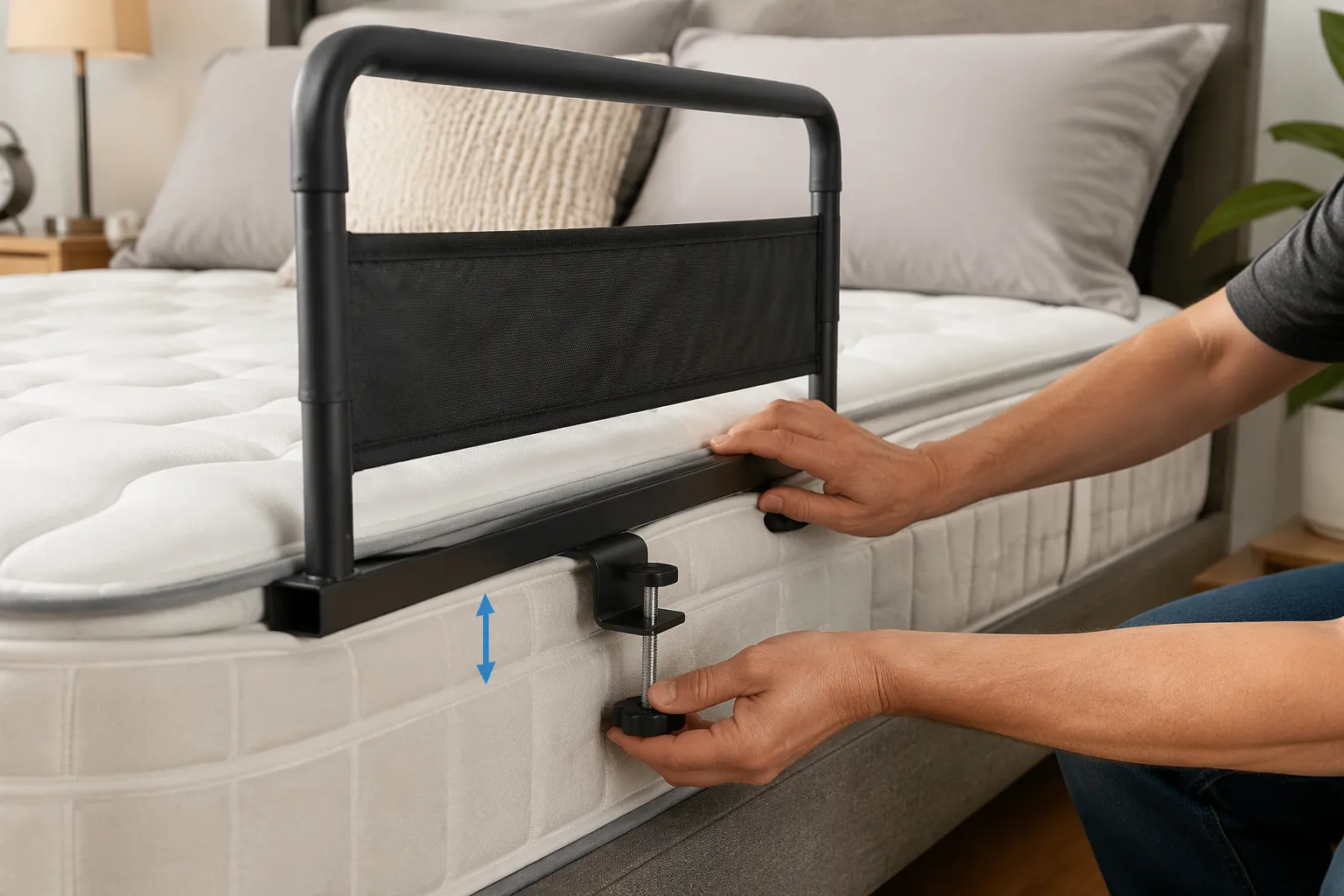
A portable bed rail loosens after a mattress is replaced because the new mattress differs from the old one in thickness, compressibility, size, or weight. The rail was fitted to the old mattress. A portable bed rail stays tight through pressure and a snug fit against the mattress, so any change in those dimensions breaks the fit. This problem is common and fixable, not a defect in the bed rail. The fix usually means adjusting the rail, adding a stabilizer, or confirming the new mattress is compatible.
Why a Portable Bed Rail Loosens After a Mattress Swap
How Bed Rails Stay Tight
Pressure and Friction
A portable bed rail holds its position through opposing forces. The rail presses against the near side of the mattress, and the anchoring system pulls against the far side. This opposing pressure secures the base of the rail at one location, whether the rail sits in the stowed position or the operating position above the sleeping surface. Patent documentation from Eureka PatSnap describes this mechanism in detail: the connecting wall of the seat apparatus acts as a counter member on the near side of the bed, while the far end of the loop acts as the opposing counter member. The two forces squeeze the mattress between them.
Friction adds a second layer of security. The vertical support members of the rail press against the general intersection of the mattress side and the sleeping surface. This contact point often carries a sheet or blanket, and the smooth surfaces slide easily against each other during adjustment. Once the user locks the rail in place, friction at this intersection resists sideways movement. The rail stays tight because pressure and friction work together.
The Mattress as an Anchor
The mattress itself functions as the anchor. The rail compresses a corner of the mattress at the intersection of the near side and the sleeping surface. This compression closes off gaps that might otherwise form between the mattress and the rail portion. The straight end member portion defines a plane with the vertical support members, and these components compressively engage the mattress corner. A firm, full mattress gives the rail a solid body to grip. A mattress that shifts, compresses, or flexes under load gives the rail nothing stable to hold.
What Changes When a Mattress Is Swapped
Thickness Differences
A new mattress rarely matches the old one in thickness. A rail designed for a 10-inch mattress may sit too high on a 14-inch model, and the anchoring straps may not reach the far side with enough tension. A thinner mattress creates the opposite problem. The rail sits too low, and the straps run out of adjustment range before they achieve a snug fit. Either mismatch allows the portable bed rail to loosen over time. The rail was fitted to the old mattress, and the new thickness alters the rail-to-mattress fit.
Firmness and Compressibility Differences
Mattress firmness directly affects rail performance. A soft or under-inflated surface allows the rail to sink and tilt. The barrier height drops, and the gap at the edge widens. A soft surface sinks away from the rail when a sleeper rolls toward it, and the gap between the rail and the mattress widens under load. A gap between the rail and the mattress creates the primary entrapment hazard. The gap widens when a soft mattress compresses or an air mattress shifts under weight. Soft mattresses compress under body weight and open spaces around the rail that do not exist on a firm surface. Wide stabilizing bases and reinforced anchors spread force across the mattress side and resist tilting when the foam compresses.
Vatocare reports a simple field test for mattress firmness. Safewise recommends pushing down on the mattress edge; the surface should not depress more than 2 inches. Many manufacturers describe a fist test: if the mattress edge compresses about 2 inches under roughly 12 lbs of pressure, it may be too soft for a rail. A softer surface lets body parts slide between the mattress and rail.
| Warning Sign | What It Indicates |
|---|---|
| Wobbling | Anchors are loose or the base is too narrow |
| Visible gaps | The mattress has shifted away from the rail |
| Inward tilting | The rail sinks into soft foam under pressure |
| Movement when pressed | The anchoring system cannot hold tension |
Size and Weight Differences
Length and width mismatches change how the rail spans the mattress. A rail built for a twin bed may not reach the far edge of a full-size mattress with enough strap length. A wider mattress leaves gaps at the edge where the rail cannot compress the corner. Weight matters too. A light mattress shifts when the sleeper moves, and the rail loses its anchor point. A heavy mattress resists the rail’s compression, and the straps cannot pull the rail tight against the side. Both extremes allow portable bed rails to loosen after a swap.
The stakes are high. The CPSC reports that 90% of injuries linked to adult portable bed rails involve entrapment of the head, chest, or neck. The agency has recalled more than 3 million adult portable bed rails since 2021, with 18 deaths tied to those products. The FDA defines specific hazard zones around a bed rail. Zone 2, the gap under the rail between the mattress and rail, must stay less than 4-3/4 inches to prevent head entrapment. Zone 4, the gap under the rail at the ends, poses a neck entrapment risk, and the rail end angle should exceed 60 degrees. A loose rail opens these zones.
| Zone | Location | Hazard | FDA Recommended Space |
|---|---|---|---|
| Zone 1 | Within the rail | Open space between rail perimeters can trap a head | Less than 4-3/4″ |
| Zone 2 | Under the rail | Gap between mattress and rail can trap a head | Less than 4-3/4″ |
| Zone 3 | Between rail and mattress | Oversized space can trap a head | Less than 4-3/4″ |
| Zone 4 | Under the rail at the ends | Gap poses a neck entrapment risk; rail end angle should exceed 60 degrees | Less than 2-3/8″ |
| Zones 5, 6, 7 | Rail placement | Installer must resolve these zones regardless of rail design | — |
A mattress swap changes the thickness, compressibility, size, or weight that the rail was fitted to. Any one of these changes can loosen the rail. The next sections explain how each attachment mechanism reacts to these changes and how to restore a secure fit.
Mattress Thickness and Compressibility

Why Thickness Matters
Rails Designed for a Range
Manufacturers build portable bed rails for a specific mattress thickness range. A typical model fits mattresses from about 8 to 14 inches deep. The anchoring straps and support legs carry a limited adjustment span. A rail works best near the middle of that range. The instructions list the compatible range for a reason. A buyer should check that range before pairing a rail with a new mattress.
Too Thin or Too Thick
A mattress thickness outside the range creates immediate problems. A thick mattress pushes the rail upward. The support legs no longer reach the frame or the far side of the bed. The straps stretch to their limit and lose tension. A thin mattress creates the reverse effect. The rail sits low, and the anchor points have nothing solid to grip. Both cases let the bed rail loosen during use. A mattress topper is added on top of an existing mattress, and this change also shifts the effective thickness. The rail then needs a fresh adjustment.
How Compressibility Affects Grip
Soft Mattresses and Sinking Rails
A soft mattress compresses under the rail’s pressure. The support legs sink into the foam. The barrier height drops, and the gap under the rail widens. A sleeper who rolls toward the rail pushes the foam down further. The rail tilts inward and loses its firm contact point. Memory foam and pillow-top designs show this problem most often. A wide stabilizer base helps spread the load across a larger surface.
Firm Mattresses and Slipping Rails
A firm mattress resists compression. The rail cannot press into the surface and lock itself in place. The contact point stays shallow, and the rail slides along the edge. Innerspring and latex models behave this way. Friction alone cannot hold the rail steady. A non-slip pad under the anchor points restores grip on a hard surface. The user should also recheck strap tension after the first night of use.
How the Bed Rail Attachment Mechanism Reacts

Strap and Anchor Systems
Straps That Rely on Mattress Weight
Strap systems pull the rail tight against the mattress and hold tension through the weight of the bed. The straps run under the mattress and connect to an anchor plate on the far side. A heavy mattress presses the straps flat and keeps them from creeping. A lighter replacement mattress gives the straps less to grip, and the tension slowly releases. Users should re-tighten every strap after a swap and check the buckle grip.
Anchors That Need a Firm Edge
Anchor plates need a firm, square edge to bite into. A soft or sagging mattress edge rolls away from the plate, and the anchor loses its hold. Caring Village notes that soft, air, and specialty mattresses change shape with use, so the fit needs regular re-checking. A firm edge keeps the anchor seated and the rail steady.
Clamp and Bracket Systems
Clamps Sized for a Mattress Range
Clamps grip the mattress and the frame together at a fixed opening. Each clamp carries a rated range, often 8 to 14 inches. A new mattress outside that range leaves the clamp jaws too wide or too narrow. The clamp cannot close on the corner, and the rail wobbles. Users should measure the new mattress depth and compare it to the clamp rating before installation.
Brackets That Need a Stable Base
Brackets bolt to the frame or slide between the mattress and the foundation. These mounts need a flat, stable base to stay square. A thick mattress lifts the bracket off its seat, and a thin one leaves the bracket hanging. Either way, the bracket rocks and the rail loosens.
Slip-In and Pressure-Fit Rails
Reliance on Mattress Compression
Slip-in rails and under-mattress rail bases depend on compression to stay put. The base slides between the mattress and the box spring, and the mattress weight pins it down. Caring Village warns that most basic and swing-away rails require a box spring for this anchor. A soft mattress compresses and creates gaps that raise entrapment risk. Many manufacturers describe a fist test: if the mattress edge compresses about 2 inches under roughly 12 lbs of pressure, it may be too soft for a rail.
Why a New Mattress Breaks the Fit
A new mattress changes the compression force at the base. A soft or sagging surface reduces that force, and the rail shifts. A thick mattress lifts the base off the foundation. Users should confirm the rail’s rated thickness range and re-check the fit over time. After installing, check that no gap is wide enough to trap a head or body along the rail, mattress, or frame.
Mattress Size and Weight Factors
Length and Width Mismatches
Rails Spanning the Wrong Distance
A rail’s anchoring straps and support arms carry a fixed span. A twin-size rail cannot reach the far edge of a full-size mattress with enough strap length. The straps run out of adjustment before they build tension. The rail then sits loose against the near edge. A wider mattress also changes the angle of the support arms. The arms splay outward, and the base loses its square seat. Users should measure the new mattress length and width and compare those figures to the rail’s stated fit range.
Gaps at the Mattress Edge
A size mismatch opens gaps along the mattress edge. The rail cannot compress a corner it does not reach. A gap between the rail and the mattress edge creates an entrapment zone. The FDA sets a limit of less than 4-3/4 inches for the gap under the rail. A rail that spans the wrong distance leaves a wider opening. The sleeper can slip into that space during the night. A proper fit closes the gap and keeps the rail pressed against the mattress corner.
Weight and Stability
Lighter Mattresses That Shift
A light mattress moves under the rail’s pressure. The anchoring straps pull against a body that slides across the foundation. Each movement releases a little tension. The rail drifts out of position over several nights. Air mattresses and thin foam models show this problem most often. A non-slip pad under the anchor points adds grip. A stabilizer bar also spreads the load and reduces shifting.
Heavier Mattresses That Resist the Rail
A heavy mattress pushes back against the rail’s compression. The straps cannot pull the rail tight against a dense, unyielding side. The contact point stays shallow, and the rail slides along the edge. Innerspring and latex models behave this way. The user should recheck strap tension after the first night. A wider anchor plate distributes force across a larger area and improves the hold.
Weight and size work together. A light, oversized mattress shifts and leaves gaps. A heavy, undersized mattress resists compression and lets portable bed rails slide. Both conditions loosen the fit after a swap. The next section covers the repair steps for a loose bed rail.
How to Fix a Loose Portable Bed Rail
A loose rail does not mean the product has failed. The fix follows a clear path: recheck the installation, adjust the rail for the new mattress, and add support where needed. Each step takes only a few minutes and restores the snug fit the rail had with the old mattress.
Recheck the Installation
The first step is a full recheck of the existing setup. A mattress swap disturbs the rail’s position, and even a small shift can release tension. The caregiver should start with the straps and clamps before touching any other part of the rail.
Re-tighten Straps and Clamps
The caregiver should push gently on the rail in multiple directions. The rail should not wobble, shift, or lift from the base. If it does, the caregiver should recheck the base rail seating under the mattress, adjust the feet for full floor contact, tighten all locks and clamps, and re-tighten the safety or frame strap. This pressure test from Elderly Guide takes under a minute and reveals most installation problems.
Straps loosen with use, and a new mattress accelerates that process. The caregiver should pull each strap until it feels firm and confirm that every buckle locks flat. Clamps need a firm grip on the mattress corner. A clamp that slides by hand needs a tighter setting or a different position. The caregiver should tighten all straps and retention systems before the first night on the new mattress.
Confirm Correct Positioning
Position matters as much as tension. The rail should sit flush against the mattress side with no gap at the corner. The caregiver should confirm that the rail lists the mattress thickness range it fits and that the new mattress matches that range. The safety strap or retention system must stay attached and secured to the bed frame. The caregiver should follow the manufacturer’s installation instructions and recheck the rail regularly, since rails can shift or loosen over time.
A tight sheet can bow a mattress and open a corner gap, according to the Federal Register. The caregiver should use sheets that fit loosely enough to avoid compression and recheck the gap after changing bedding. Proper installation includes bedding that does not interfere with the rail or its retention system.
Adjust for the New Mattress
The rail needs a fresh adjustment after any mattress change. Vatocare notes that a new mattress brings a new thickness, a new firmness, and a new fit against the rail. The caregiver should treat the rail as a new installation and reset every adjustable part.
Reset the Rail Height and Depth
The rail height should match the new mattress surface. A thick mattress lifts the rail, and the barrier may sit too low relative to the sleeping surface. A thin mattress drops the rail, and the barrier may sit too high. The caregiver should adjust the height so the top of the rail sits at the recommended level above the mattress. The depth setting controls how far the rail reaches across the mattress. A wider mattress needs a deeper reach to compress the far corner. The caregiver should reset both settings and test the fit by hand.
Re-seat Anchors Under the Mattress
Anchor plates and under-mattress bases need a fresh seat after a swap. The caregiver should lift the mattress and place each anchor flat against the foundation. A wrinkled sheet or a trapped strap under the anchor reduces grip. The caregiver should smooth the surface and pull the anchor tight before lowering the mattress. The weight of the mattress then pins the anchor in place. A re-seated anchor restores the opposing pressure that holds the rail steady.
Add Support and Stability
Some mattress and rail combinations need extra help. A stabilizer bar or a non-slip pad can close the gap between a good installation and a secure one. The caregiver should add support only after completing the recheck and adjustment steps.
Stabilizer Bars and Mattress Boards
A stabilizer bar spreads the rail’s force across a wider area of the mattress side. The wider base resists tilting on soft foam and reduces the sinking that opens gaps. A mattress board serves a similar purpose. The board sits between the mattress and the foundation and gives the anchors a flat, firm surface to grip. Both accessories help when the new mattress is softer or thicker than the old one. The caregiver should confirm that the accessory fits the rail model and does not interfere with the retention system.
Non-Slip Pads and Wear Checks
A non-slip pad under the anchor points adds friction on hard mattress surfaces. The pad keeps the anchor from creeping and helps the rail hold its position through the night. The caregiver should also inspect the rail for wear during each adjustment. Frayed safety straps, cracked plastic parts, loose or bent rails, and worn padding all weaken the hold. Elderly Guide recommends replacing damaged parts immediately. The caregiver should inspect strap tension weekly and re-tighten push pins and clamps every few months or after heavy use.
A matched mattress and rail set keeps the mattress snug and prevents the slow drift that opens gaps over time. The caregiver should check the rail manual and the mattress label before setup. Safe installation depends on that match, and no amount of adjustment can fix a mattress outside the rail’s rated range.
Choosing a Compatible Mattress for Bed Rail Safety
Match the Rail’s Specifications
Check the Thickness Range
The rail’s manual lists the mattress thickness range it supports. A buyer should measure the new mattress depth and compare that figure to the listed range. Federal rules give manufacturers some tolerance in testing. The Code of Federal Regulations, 16 CFR § 1270.2, states:
(8) In addition to complying with section 7.1 of ASTM F3186-17, comply with the following:
(i) Mattress thickness ranges used for testing shall be up to 1.5 in. (38 mm) larger or smaller than the range specified by the manufacturer. Test personnel shall choose a mattress and product setting configuration that provide the most severe condition for each test requirement in the standard.
A mattress near the edge of that tolerance leaves little margin. A buyer should stay within the stated range for reliable grip.
Check the Size and Weight Limits
Compatible mattress sizes and thickness ranges vary by model. A twin rail will not secure a queen mattress. The buyer should confirm the rail’s length, width, and weight limits before purchase. Manufacturers design each rail for specific bed sizes, and a mismatch leaves gaps at the edge. A buyer should also confirm the rail fits the bed frame, since most rails and mattresses are sold separately.
Test the Fit Before You Rely on It
The Push Test
A caregiver can test the fit with a simple push. The Federal Register describes a laboratory version of this check for portable bed rails:
- Assemble the rail in any misassembled configuration the instructions warn against.
- Secure the rail on a flat surface with clamps placed 4 to 6 inches from the leg intersection.
- Apply 10 lbs of downward force with a 1/2-inch disc to the top horizontal bar over 5 seconds, hold for 10 seconds, then release.
- Repeat the test for every misassembly configuration.
At home, the caregiver pushes the rail from several points and watches for movement. A secure rail does not shift, wobble, or move under hand pressure.
A Quick Bed Rail Safety Check
A short routine confirms bed rail safety after installing a bed rail. The caregiver should:
- Push the barrier gently from several points and check that it stays aligned.
- Repeat the inspection after changing sheets, moving the bed, or noticing restless sleep.
- Keep pillows, duvets, and soft toys away from the barrier.
- Stop using the rail if it slips or leaves a gap until the setup is safe.
The mattress type matters here. A hybrid mattress or a mattress overlay raises the sleeper’s resting height relative to the top rail, per Vivid Care, so the caregiver should recheck that distance. Safe installation depends on a matched rail and mattress, and the buyer should confirm compatibility with the manufacturer before ordering.
When to Stop Using a Loose Bed Rail
A loose bed rail is not a minor annoyance. It is a warning sign. A caregiver should stop using the rail the moment it fails a push test or shows visible damage. A rail that will not hold tension cannot protect anyone.
Signs of Wear and Damage
Loose Fasteners and Worn Screw Holes
Fasteners work loose with repeated use. A screw that spins in its hole no longer grips. A strap buckle that slips under load cannot hold tension. The caregiver should check every connection point during each inspection. A fastener that will not tighten signals a worn mounting point. Replacing the part is safer than forcing the screw back into a stripped hole.
Cracked Plastic, Bent Metal, or Torn Mesh
Structural damage ends a rail’s service life. A caregiver should look for rust around welds and joints, cracking paint or coating, loose fixings, bent components, and missing labels, according to one equipment safety guide. A cracked housing or a bent support arm weakens the whole frame. Torn mesh or padding exposes sharp edges. Any of these defects means the rail should come out of service.
Why a Safe Bed Rail Matters
Gap and Entrapment Risks
A loose rail opens dangerous spaces. Kern Medical Supply lists several causes of entrapment, including loose or worn rails that detach from the frame, mattresses that are too small or too thin, skipped maintenance, and misused accessories such as foam overlays. The FDA and the Hospital Bed Safety Workgroup identified seven entrapment zones, and most reported deaths involve the head, neck, or chest in zones 1 through 4. A person can become trapped between the rail and mattress, and that position can restrict breathing. Misaligned rails also give way when someone leans on them, which raises the fall risk. Sharp edges on old equipment add bruises and cuts.
Wear and tear can compromise the integrity and function of bed components, rendering them potentially unsafe. Over time, mattresses become soft and compressed and side rails and enablers can become loose, wobbly, and improperly positioned.
Checking the Fit Regularly
Routine checks keep a safe bed rail safe. The caregiver should push the barrier from several points and watch for movement. A rail can loosen or shift over time, so the check belongs in the daily routine. A mattress that appears shifted or a space between the rail and the mattress wider than expected deserves immediate attention. Staff or the manufacturer should hear about any loose rail, unusual gap, or shifted mattress. Regular inspection of straps and fasteners catches small problems before they grow.
A portable bed rail loosen after a mattress swap because the new mattress changed the thickness, compressibility, size, or weight the rail was fitted to. The fix path starts with a recheck and adjustment of the installation. A stabilizer bar helps when the fit stays loose. The owner should then confirm the new mattress matches the rail’s specifications.
A tight, stable rail is a bed rail safety matter, not just a comfort one. The caregiver should recheck the fit whenever a mattress changes. They should verify the rail is secure before each use and consult the instructions for their specific model. Proper installation and routine checks keep a safe bed rail safe.
FAQ
Why does a portable bed rail loosen after a new mattress goes on?
The rail was fitted to the old mattress. A new mattress changes thickness, firmness, size, or weight. The rail relies on pressure and a snug fit. Any change in those dimensions releases tension. The rail then shifts or wobbles during use.
Is a loose bed rail a defect in the product?
No. A loose rail usually signals a fit mismatch, not a manufacturing fault. The rail performed correctly with the old mattress. The new mattress changed the conditions the rail was set for. A recheck and adjustment typically restores a secure hold.
How tight should the straps feel after a mattress swap?
Each strap should feel firm with no slack. Every buckle should lock flat. A caregiver should push the rail from several points and watch for movement. A rail that shifts by hand needs more tension or a new anchor position.
Can a mattress topper cause the same problem?
Yes. A topper adds effective thickness on top of the mattress. The rail then sits lower relative to the sleeping surface. The barrier height drops and the gap widens. The caregiver should reset the rail height and recheck the fit after adding a topper.
What should a caregiver do if the rail still wobbles after adjustment?
The caregiver should add a stabilizer bar or a mattress board. These accessories spread force across a wider area and give anchors a firm surface. The caregiver should also confirm the mattress sits within the rail’s rated thickness and size range.
How often should a caregiver check the rail’s fit?
A caregiver should check the fit before each use. A quick push test takes under a minute. The caregiver should also recheck after changing sheets, moving the bed, or noticing restless sleep. Routine checks catch small problems early.
When should a caregiver stop using the rail?
The caregiver should stop using the rail after a failed push test or visible damage. Warning signs include loose fasteners, cracked plastic, bent metal, and torn mesh. A rail that will not hold tension cannot protect the sleeper.
Does mattress firmness affect rail safety?
Yes. A soft mattress lets the rail sink and tilt, which widens the gap at the edge. A firm mattress resists compression, so the rail slides along the surface. Both conditions raise entrapment risk. A matched mattress and rail set keeps the fit secure.