
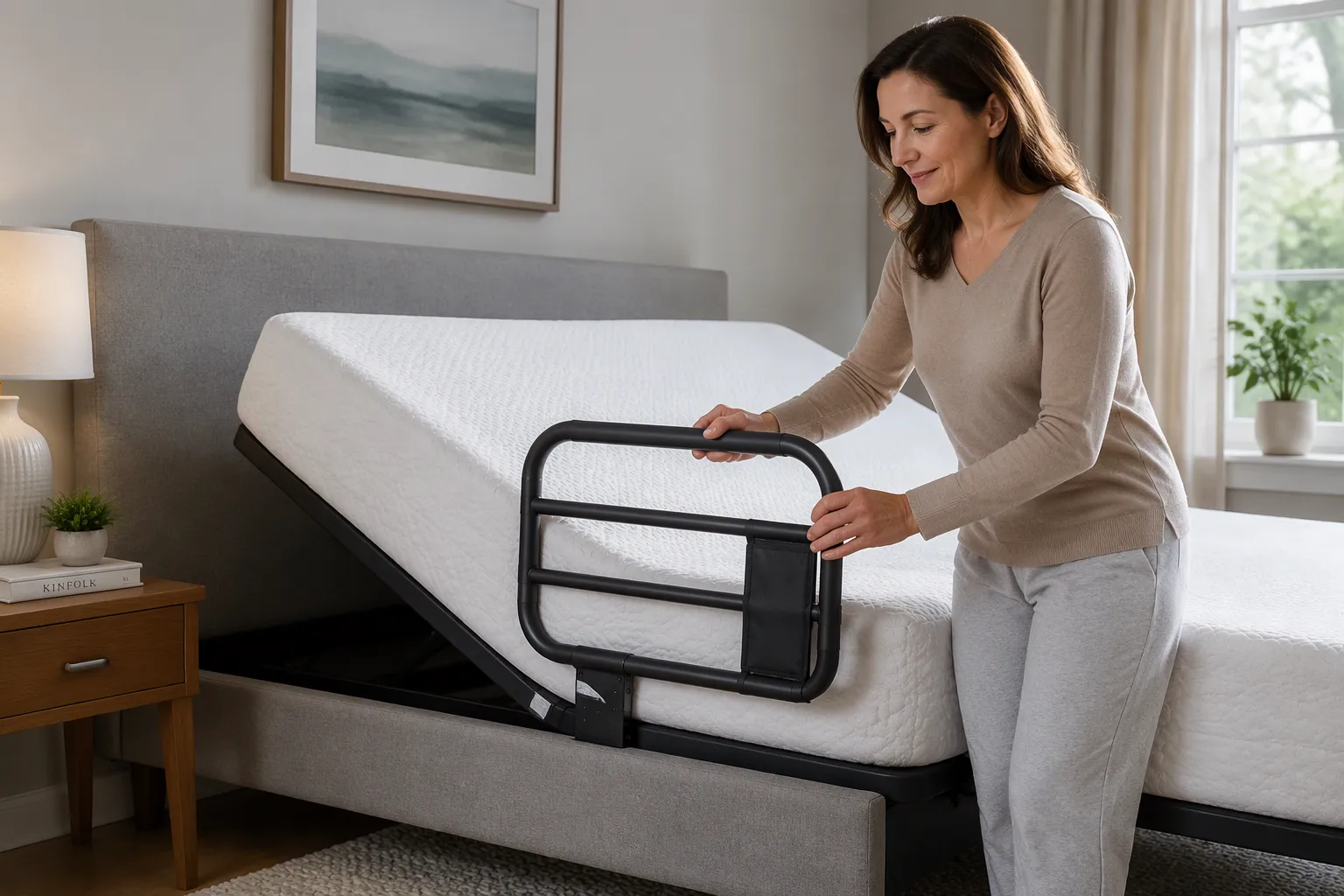
Yes, a bed rail used with adjustable bed base setups can work, provided the rail attaches to a stable, non-moving part of the bed or to the floor. The one rule that matters most: never mount the rail to the articulating platform, hinges, or motorized sections. As Asks Samie notes, a rail must match the bed frame, mattress movement, and base design. The right rail type plus a secure attachment makes the setup safe.
The Short Answer: Bed Rail Used With Adjustable Bed Base
A bed rail used with adjustable bed base setups succeeds or fails on one factor: the attachment point. The rail must connect to something that does not move when the bed moves. That single principle separates a safe, stable installation from a loose, dangerous one.
When It Works
Rail Attached to the Stationary Frame
The outer frame of an adjustable bed stays fixed while the head and foot sections rise and lower. A rail bolted to this outer frame moves with the bed as a whole, not with the articulating platform. The user grabs a solid object, and the rail stays put through every position change. This approach works well on bases with a wooden perimeter frame, because screws bite into wood and hold tight. Home Med Equip notes that Stander adjustable bed rails fit Tempur-Pedic and other adjustable beds when the platform is made of wood rather than metal. A metal platform offers no reliable surface for screws, so the installer needs a different mounting strategy.
Rail Standing Independently on the Floor
A floor-standing rail touches the bed at no point, or only lightly at the mattress edge. Its legs rest on the floor beside the bed, and its own frame carries the user’s weight. The adjustable bed moves freely underneath and never pushes against the rail. This design suits almost every adjustable base on the market, because the base needs no modification and no drilling. The floor does the load-bearing work, and the bed keeps its full range of motion.
When It Doesn’t Work
Rails Clamped to the Moving Platform
A clamp fixed to the head section travels upward when the head section rises. The clamp can slip, twist, or crush the platform edge over time. Worse, the user may grab the rail during a position change and pull against a moving part. The clamp carries force in a direction the designer never intended. Rails for adjustable beds avoid this problem by design. The Clamp-Rail from Rails for Adjustable Beds fixes only to the outer frame of a bed base, according to the manufacturer, and it does not interfere with or impede any moving parts of the profiling bed mechanism. That description draws the line clearly: outer frame yes, articulating platform no.
Rails That Block the Bed’s Range of Motion
Some rails sit low and close to the mattress edge. When the head section rises, the mattress pushes into the rail. The motor strains against the obstruction, and the rail bends or the platform stalls. A rail that limits the bed’s travel defeats the purpose of an adjustable base. The user loses the elevated positions that support breathing, digestion, and leg circulation. Any rail that contacts the mattress during articulation belongs on a different bed.
Why the Attachment Point Decides Everything
Moving Parts Versus Fixed Parts
An adjustable bed has two zones. The fixed zone includes the outer frame and the floor beneath the bed. The moving zone includes the head platform, the foot platform, the hinges, and the lift arms. A rail mounted in the fixed zone experiences only the user’s weight and a steady reaction from the floor or frame. A rail mounted in the moving zone experiences the motor’s force, the platform’s travel, and the user’s weight all at once. The fixed zone is the only zone that offers predictable, safe performance.
Stress on Hinges and Motors
Every motorized adjustable bed carries a rated load. The motor lifts the mattress, the bedding, and the user. A clamped rail adds an off-axis load that the motor and hinge were never designed to carry. Over months of use, that extra load wears the hinge pins and strains the lift mechanism. A rail attached to the stationary frame or standing on the floor adds no load to the motor at all. The bed’s mechanism stays within its design limits, and the rail stays stable. This is why the attachment point, not the rail’s price or padding, decides whether the setup is safe.
How an Adjustable Base Moves and Why It Matters
An adjustable bed changes shape. The frame stays still while the sleeping surface folds and lifts. A rail installer must understand this motion before choosing a mounting point.
Head and Foot Sections
Articulating Hinges
The head and foot sections pivot on hinges. These hinges sit between the platform panels and bend as the sections rise. Each hinge carries the mattress load across a narrow joint. A rail mounted near a hinge adds force to a part already under stress. The hinge flexes, the mounting point loosens, and the rail grows unstable.
Motorized Lift Mechanisms
Electric motors drive the platform upward and downward. The motor pushes a lift arm, and the arm raises the platform panel. This mechanism moves slowly and quietly, yet it generates real force. A rail clamped to the platform travels with the lift arm. The motor then carries the rail’s weight on every cycle. Over time, this extra load shortens motor life and strains the lift components.
What a Standard Rail Can Interfere With
The Folding Mattress Platform
A standard rail often sits close to the mattress edge. The folding platform changes the mattress profile as it articulates. The mattress surface shifts, bunches, and presses outward. A low rail can catch this moving surface. The platform then pushes against the rail, and the motor works harder to complete its cycle.
Clearance Around the Frame
Adjustable bases need clear space around the outer frame. The platform panels swing through an arc during articulation. A rail that intrudes into this arc blocks the bed’s travel. The installer should trace the platform’s path through its full range and keep the rail outside that zone.
The Safe Attachment Zones
The Stationary Bed Frame
The outer frame never articulates. It holds the motors, the hinges, and the platform panels in place. A rail bolted to this frame stays fixed relative to the bed. The user grips a solid object, and the motor carries no extra load. This zone offers the strongest and most predictable mounting surface on most adjustable beds.
The Floor Beside the Bed
The floor provides the simplest safe zone. A floor-standing rail rests on its own legs and touches the bed lightly or not at all. The adjustable base moves freely above and beside it. No drilling, no clamps, and no contact with moving parts. This option fits nearly all adjustable bases without modification.
Bed Rails for Adjustable Beds: Which Types Work

Three rail designs dominate the market, and each one earns its place on a different kind of bed. The mounting method separates them. A shopper who understands how each type attaches can match the rail to the base with confidence.
Floor-Standing Bed Rails
How They Stand Independent of the Bed
A floor-standing rail carries its own weight on legs that rest directly on the floor. The frame rises beside the mattress and offers a grip surface at the user’s hand height. Nothing on the rail connects to the bed frame, the platform, or the mattress foundation. The user pushes down on the rail, and the floor pushes back. The bed never feels that force.
This independence gives the design a wide margin of safety. The rail cannot slip because no clamp holds it in place. It cannot crush a platform edge because it touches no platform. The installer sets the leg width, checks the fit against the mattress side, and tightens the frame. The whole job takes minutes and leaves the bed unmodified.
Best Fit for Most Adjustable Bases
Floor-standing models suit nearly every adjustable base on the market. The base keeps its full range of motion because the rail sits outside the articulation path. A user can raise the head section, lower the foot section, and return to flat without the rail interfering at any point. This versatility explains why floor-standing designs appear at the top of most recommendation lists for bed rails for adjustable beds.
The design also protects the bed’s warranty. Many manufacturers void coverage when screws or clamps alter the frame. A floor-standing rail leaves no marks and no hardware behind. Owners of premium bases should weigh this point carefully before choosing any other style.
Bolt-On Bed Rails
Attaching to the Stationary Frame
A bolt-on rail fastens to the outer frame with screws or bolts. The outer frame holds still while the platform articulates above it. The rail therefore moves only when the whole bed moves. The user grips a solid object, and the motor carries no added load.
This method delivers the most rigid connection of the three types. A bolted rail does not shift, rattle, or work loose under daily use. The installer drills pilot holes, drives the screws, and checks the tightness after the first week. A properly bolted rail can serve for years without adjustment.
Checking Frame Compatibility First
Frame compatibility decides whether a bolt-on rail will work at all. Adjustable bases vary in design and construction, so rail compatibility can differ by model. The installer should confirm several points before drilling any holes.
- Check that the platform the mattress sits on is made of wood, not metal, to accommodate screwing the base of the bed rail into the wood platform with the included screws.
- Confirm that the rail’s mounting hardware secures the rail to the base platform without restricting head, foot, or overall movement of the base.
- Note that many traditional bed rails are incompatible because they rely on clamping mechanisms that interfere with moving components and overall functionality of the base.
- Be aware that attaching bed rails to a Tempur-Pedic adjustable base may void the warranty.
- Contact the bed’s manufacturer for a solution when the platform is not wood.
Only a limited number of bed rails are designed for safe use with adjustable bases. A buyer should verify the fit before purchase rather than after delivery. A metal platform offers no reliable surface for screws, and a forced fit can leave the rail loose under real weight.
Clamp-On Bed Rails
When Clamping Is Safe
A clamp-on rail grips the bed structure with a pressure clamp instead of screws. The design works well on fixed beds with solid side rails. The clamp bites into a rigid edge, and the rail stays put. On a standard bed frame, this method offers quick installation and easy removal.
Safety depends on the clamp’s target. A clamp fixed to a stationary outer frame can hold firm, provided the frame offers a flat, rigid surface. The installer must test the clamp under load and recheck it after the first few uses. Even then, the clamp carries the user’s weight through friction alone, so the margin for error is smaller than a bolted or floor-standing design.
When to Avoid Clamping
Clamping fails on an adjustable bed for one reason: the clamp has no fixed surface to grip. The platform moves, the hinges flex, and the lift arms travel. A clamp fixed to any of these parts rides along with the motion. The rail then pulls against the motor and the hinge pins on every cycle.
The risks extend beyond hardware wear. A bed assist rail for hospital bed frames typically clamps onto the bed’s side rails or slides between the mattress and box spring, and the mounting hardware differs by bed type. Rails built for a standard home bed frame won’t grip a hospital-style frame the same way, and forcing an ill-fitting rail on can leave it loose enough to fail under real weight. Entrapment is the risk nobody mentions until it happens. The FDA has documented cases where gaps between the mattress and rail trap a limb, a head, or a torso, sometimes fatally, which is why the agency publishes specific hospital bed dimension guidelines covering gap size and rail spacing.
A rail that doesn’t match FDA gap standards can create the exact injury it was bought to prevent.
Weight capacity deserves the same respect. Someone leaning their full body weight into a rail rated for half that load is a failure waiting to happen. Many traditional bed rails are incompatible with adjustable beds because they rely on clamping mechanisms that interfere with moving components and overall functionality of the base. For this reason, clamp-on rails are not sold by some suppliers because they are also not as safe. A shopper comparing rails for adjustable beds should treat the clamp style as a poor match for any motorized base and choose a floor-standing or bolt-on design instead.
Manufacturer-Specific and Universal Options
A buyer faces a fork in the road when shopping for bed rails for adjustable beds. One path leads to rails the bed maker approves for its own base. The other path leads to universal rails that fit a broad range of beds. Each path offers real advantages, and each one demands a different kind of homework before purchase.
Rails Approved by the Bed Maker
A manufacturer-approved rail carries the bed maker’s blessing. The maker designed the base, tested the rail on that base, and confirmed the fit through the full range of motion. The rail’s mounting points line up with the frame’s structure. The hardware matches the frame material. The warranty stays intact because the maker sanctioned the installation.
This route removes most of the guesswork. The buyer orders the rail from the same company that sold the bed, and the two products arrive as a matched pair. Installation instructions cover the specific base model. Customer support knows both products. If a problem arises, one company owns the solution.
The tradeoff comes in cost and selection. Manufacturer-specific rails often cost more than universal models. The maker may offer only one or two rail styles, which limits the choice of height, length, and padding. Some bed makers offer no rail at all. A buyer who owns a base from such a company must look elsewhere.
The warranty question deserves careful attention. Many adjustable bed makers void coverage when aftermarket hardware alters the frame. A manufacturer-approved rail avoids that risk entirely. A buyer who values warranty protection should start the search with the bed maker’s own accessory catalog.
Universal Rails for Adjustable Beds
Universal rails promise a fit across many bed brands and models. The best of them earn that promise through a smart mounting design. Home Med Equip reports that the best and most secure adjustable bed rails need an anchor. All bed rails made for adjustable beds are anchored to the bed frame using screws that drive the base of the rail into a wood platform. Installed correctly, they cannot fall off. Portable rails that clip on, slip over the side, or insert between the bed base and mattress can become loose or dislodged completely.
That anchoring principle separates the reliable universal rails from the risky ones. A screw-driven base bites into the wood platform and holds under load. A clip-on or slip-over design relies on friction and gravity, and both can fail when a user leans hard on the rail. Home Med Equip notes that clamp-on rails are not sold by some suppliers because they are not as safe and can interfere with moving components. A shopper should treat any universal rail without a screw-down anchor as a poor match for a motorized base.
Several universal models have earned a following among owners of adjustable beds. The table below compares five options from Stander and Flex-A-Bed, with prices and specifications drawn from Home Med Equip.
| Product | Price | Mattress Height | Rail Length | Notes |
|---|---|---|---|---|
| Click-N-Go Bed Rail Handle 8960 by Stander | $179.95 | 10″ – 12″ | 16″ – 20″ | 20″W handle; push button removes handle from base; fits most traditional beds and wood platform adjustable beds; includes pouch & cup holder |
| Wonder Click Bed Rail Handle 7960 by Stander | $199.95 | 10″ – 12″ | 16″ – 20″ | 20″W handle; includes pouch and cup holder; fits most traditional beds and wood platform adjustable beds; secures to bedframe |
| Click-N-Go Extendable Bed Rail 8965 by Stander | $209.95 | 10″ – 12″ | 21″ – 25″ / 26″ – 30″ | Length extends 23″ – 30″; push button removes rail from base; fits most traditional beds and wood platform adjustable beds; secures to bedframe with screws |
| Wonder Freedom Click Extendable Bed Rail 7965 by Stander | $249.95 | 10″ – 12″ | 21″ – 25″ / 26″ – 30″ | Length extends 23″ – 30″; includes pouch and cup holder; fits most traditional beds and wood platform adjustable beds; secures to bedframe with screws |
| Flex-A-Bed Adjustable Bed Side Rail | $299.95 (MSRP $360.00) | 8″ – 10″ / 10″ – 12″ / 12″ – 14″ | 26″ – 30″ | For use only with adjustable beds with plywood baseboard; rail lowers below top of most mattresses for exiting the bed; available as a pair or for only one side; installs via screws in base |
The table reveals a clear pattern. Every model that fits adjustable beds secures to the bed frame with screws. The Stander models fit wood platform adjustable beds, and the Flex-A-Bed rail requires a plywood baseboard. None of them clamps to a moving part. None of them slips between the mattress and the base. The mounting method matches the safety principle that governs every successful installation.
The Flex-A-Bed rail offers a feature the others lack. It lowers below the top of most mattresses, which lets the user exit the bed without climbing over a fixed bar. That design suits someone who wants a grab handle during the night but needs a clear path out of bed in the morning. The rail comes as a pair or as a single side, so a buyer can equip one side of the bed or both.
The Stander models differ mainly in length and features. The Click-N-Go handles measure 16 to 20 inches and suit a user who wants a compact grip near the pillow. The extendable versions reach 23 to 30 inches and cover more of the mattress edge. The push-button release lets the user lift the handle off its base for storage or travel. The pouch and cup holder add convenience for someone who keeps glasses, a phone, or medication within reach.
A buyer who weighs universal rails against manufacturer-specific ones should ask three questions. Does the rail screw into a wood platform or a stationary frame? Does the maker list the bed model as compatible? Does the rail clear the mattress through the full range of motion? A yes to all three points signals a sound match. A no to any one of them signals a rail that belongs on a different bed.
The keyword “used specifically with adjustable beds” matters here. A rail built for a fixed bed may look similar to one built for a motorized base, yet the mounting hardware differs. A shopper should read the product description for the phrase “adjustable bed compatible” or a list of approved base models. A generic bed rail without that language may clamp to a part that moves, and the installation can fail under real weight.
Universal rails also vary in mattress height range. The Stander models fit mattresses 10 to 12 inches tall. The Flex-A-Bed rail covers three ranges from 8 to 14 inches. A buyer should measure the mattress before ordering. A rail sized for a thinner mattress may sit too low on a thick one, and the user then reaches down instead of gripping a handle at hand height.
The choice between the two paths comes down to priorities. A buyer who owns a premium base and values warranty coverage should start with the bed maker’s approved rail. A buyer who wants more selection, a lower price, or a rail for a base with no maker-approved option should look at universal models with screw-down anchors. Both paths lead to a safe installation when the rail attaches to a fixed point and clears every moving part.
Safety and Stability for a Bed Rail With an Adjustable Bed

Secure Attachment
Checking for Movement and Wobble
A secure adjustable bed rail must not shift under load. The installer should grip the rail and push down firmly after mounting. Any wobble signals a loose connection or a poor mounting surface. A rail bolted to the stationary frame should feel rigid. A floor-standing model should sit flat on all four legs. The user should repeat this test after the first week of use, because hardware can settle.
Keeping the Rail Clear of Moving Parts
The rail must never touch the articulating platform, the hinges, or the lift arms. The installer should run the bed through its full range and watch for contact. A rail that brushes the mattress during articulation will push against the motor. Safe use with adjustable bases depends on this clearance check. A bed rail with an adjustable bed works only when the rail stays outside the moving zone.
Weight Capacity
Matching the Rail Rating to the User
Weight capacity is a hard limit, not a suggestion. Slumbersource warns that someone leaning their full body weight into a rail rated for half that load is a failure waiting to happen. The buyer should match the rail rating to the heaviest user, not the average one. A caregiver who pulls on the rail adds force beyond the user’s body weight.
Reading the Manufacturer’s Limits
Manufacturers publish weight limits for every model. Bischoff Medical lists several rails at 300 pounds, including the Mobility Rail 5850, the Stable Rail 5800, and the Endurance Hand Bed Rail with Floor Support. A buyer should read the label before purchase and confirm the rating covers the intended user.
| Product | Weight Capacity |
|---|---|
| Mobility Rail – 5850 | 300 lbs |
| Stable Rail – 5800 | 300 lbs |
| 30” Safety Bed Rail – 8050 | 300 lbs |
| BedCaddie – 2085 | 300 lbs |
| PT BedCane – 2100 | 300 lbs |
| Endurance Hand Bed Rail with Floor Support | 300 lbs |
Gap and Entrapment Risks
Keeping Gaps Within Recommended Sizes
Gaps between the mattress and the edge of the bed rail create a serious hazard. The FDA publishes dimension guidelines for hospital bed rails, and those standards apply to home setups as well. A gap wide enough to admit a head or torso raises the risk of entrapment. The installer should measure every gap and compare it to the published limits.
Checking the Rail-to-Mattress Fit
The space between the rail and the mattress changes as the bed articulates. A rail that fits snugly in the flat position may open a gap when the head section rises. The installer should check the fit in every position. A tight fit protects bed rails safe for the elderly and reduces entrapment between the bed and the rail. Proper fit also helps prevent injury from falling out of bed. Safety depends on this final check, because a user who can slip through a gap may fall out of bed or become trapped. The risk of entrapment drops when the rail sits close to the mattress in all positions.
Mattress and Bed Height Factors
Rail Height Relative to the Mattress
A rail must rise far enough above the mattress surface to give the user a real grip. A rail sized for an 8-inch mattress on a 14-inch pillow-top barely clears the surface and provides no barrier at all, according to Mattress Stores Los Angeles. The same source advises measuring the mattress depth first. That measurement runs from the top of the foundation to the top of the mattress, including any topper in use. The rail must then extend meaningfully above that line.
Adjustability makes this fit achievable. Step2Health notes that bed rails with adjustable height settings can be customized to match the mattress or bed frame height. This ensures optimal support and ease of use, allowing individuals to enter and exit their beds comfortably. A platform bed with a thick mattress illustrates the point. The user adjusts the feet of the rail to align with the mattress height for optimal support and accessibility.
A buyer can follow a simple sequence before ordering:
- Measure the mattress depth from the foundation top to the mattress top, topper included.
- Compare that figure to the rail’s listed height range.
- Confirm the rail extends several inches above the mattress surface in the flat position.
Adjusting for Raised and Lowered Positions
An adjustable base changes the mattress height at the head and foot sections. The head section rises, and the mattress surface climbs with it. A rail fixed at one height may sit too low in the raised position or too high in the flat position. The installer should set the rail height with the bed in its most common position, then test the others.
Height also affects safety. A rail that sits too low offers no barrier, and the user can roll over it. A rail that sits too high leaves a gap beneath it, and that gap raises the risk of entrapment. The installer should check the rail-to-mattress gap in every position and keep it within the FDA dimension guidelines. A rail with adjustable height or adjustable feet gives the installer room to correct the fit as the bed moves through its range.
Choosing the Right Adjustable Bed Rail
Adjustability
Height and Length Options
Height and length settings decide how well a rail serves its user. A rail with adjustable height lets the installer align the grip with the mattress surface. Length options matter for coverage along the mattress edge. A short handle suits a user who needs a steady grip near the pillow. A longer rail covers more of the bed side and offers a wider barrier. Buyers should measure the mattress depth first, then confirm the rail’s range covers that figure with room to spare.
Fit With the Bed’s Full Range of Motion
A rail must clear the mattress in every position the base can reach. The head section rises, the foot section lowers, and the mattress profile changes along the way. The installer should run the bed through its full travel and watch for contact. A rail that touches the mattress during articulation pushes against the motor. The best bed rail for your adjustable bed stays outside the moving zone at every angle.
Material and Build Quality
Steel Versus Aluminum Frames
Steel frames carry heavy loads and resist bending under a user’s full weight. They cost more and weigh more, yet they hold their shape for years. Aluminum frames weigh less and cost less, which suits travel and storage. Aluminum flexes more under load, so a buyer should check the weight rating before choosing it. Both materials work when the frame is thick enough for the rated load.
Padding and Grip Surfaces
Padding protects the user’s hands and softens contact with the body. A textured grip surface keeps the hand from sliding during a transfer. Buyers should check that the padding covers the full grip area and stays fixed in place. Loose padding can twist under load and reduce control.
Cost and Value
Budget-Friendly Options
Lower-cost bed rails can still deliver safe service. A basic steel rail with a screw-down anchor covers the essentials. Buyers should confirm the weight rating, the mounting method, and the mattress height range before purchase. A low price never justifies a clamp that grips a moving part.
When Paying More Makes Sense
Higher prices buy features that matter for daily use. Extendable length, push-button release, and rails that lower below the mattress top all add convenience. A buyer who needs the best and most secure adjustable bed rails should look for screw-down anchors and a listed compatibility with the base model. Premium rails also protect the bed’s warranty when the maker approves them. Shoppers should confirm the bed rails fit on your adjustable bed before ordering, because a poor match wastes money at any price.
Ease of Installation and Storage
Installation effort and storage flexibility shape daily satisfaction with a rail. A buyer should weigh both factors before purchase, because a rail that takes an hour to assemble or fills a closet may not suit the household.
Tool-Free Versus Fixed Assembly
Tool-free designs reduce setup time and frustration. Lunderg reports that its bed support rails for elderly people arrive partially pre-assembled and require no tools. The user connects the top and bottom parts with push pins and secures the rail to the bed. That approach contrasts with competitor products that ship with hard-to-follow instructions and many small pieces.
Fixed assembly demands more from the installer. Bolted rails need pilot holes, a drill, and a careful tightness check. The payoff comes in rigidity. A bolted rail holds firm for years and rarely needs adjustment. A tool-free rail installs in minutes, yet the push-pin joints can loosen over time. The installer should recheck every connection after the first week of use.
A buyer should match the assembly style to the household. Someone who moves the bed often or rents a home may prefer a tool-free design. A long-term installation in a fixed bedroom favors the bolted approach.
Folding and Storage Features
Storage matters when the rail comes off the bed. Folding rails collapse into a compact shape and fit in a closet or behind a door. Removable handles detach from a fixed base, which lets the user clear the bedside path during the day. These features help in small bedrooms and guest rooms.
Portability is a separate question. Lunderg notes that installed rails are not easy to move or adjust once mounted. A buyer who needs a rail for travel should look at portable adjustable bed rails instead of a fixed model. A folding rail serves storage well, yet it still mounts to the bed and stays there.
The buyer should confirm three points before ordering. Does the rail fold or detach for storage? Does the maker list the folded dimensions? Does the design allow removal without tools? Clear answers to these questions prevent a bulky rail from crowding a small room.
Installing Rails for Adjustable Beds Safely
Preparing the Bed
Testing All Positions First
The installer should run the adjustable bed through every position before attaching anything. The head section rises, the foot section lowers, and the platform folds through its full travel. This dry run reveals the moving zone and the fixed zone. The installer can then mark the safe attachment points on the stationary frame. A few minutes of testing prevents hours of rework later.
Clearing the Attachment Area
The mounting surface must sit clean and clear. The installer removes bedding, pillows, and any stored items near the frame. Dust and debris weaken a bolted connection. The installer should also confirm that no cables or motor components cross the mounting area. A clear workspace protects the hardware and the bed’s wiring.
Attaching the Rail Correctly
Following the Manufacturer’s Instructions
Every rail ships with its own installation guide. The guide lists the correct hardware, the torque settings, and the approved mounting points. The installer should read it fully before drilling any hole. Rails for adjustable beds often carry model-specific instructions, and a skipped step can compromise the fit. When the guide conflicts with guesswork, the guide wins.
Tightening and Rechecking Hardware
A loose bolt undermines the strongest rail. The installer tightens every screw and bolt to the maker’s specification. A second pass catches fasteners that settled during the first tightening. The installer should mark each bolt and recheck it after the first week of use. This habit keeps bed rails firm under daily load.
Testing After Installation
Running the Bed Through Its Full Range
The bed must articulate freely after the rail goes on. The installer raises the head, lowers the foot, and returns the bed to flat. The rail should stay clear of the mattress at every angle. Any contact signals a mounting problem. The installer adjusts the rail position until the platform moves without obstruction.
Checking Stability With Weight Applied
A static push test comes next. The installer leans body weight into the rail and watches for movement. The rail should hold firm with no wobble and no flex at the mounting point. A caregiver can repeat the test from a seated position. Bed rails work safely only when properly used and installed, and this test confirms both conditions.
The final check covers gaps. The installer measures the space between the rail and the mattress in every position. A gap that grows during articulation raises the entrapment risk. Safety depends on a tight, consistent fit. Anyone who plans to add bed rails to an adjustable bed should complete this full test sequence before the first night of use.
Yes, a bed rail used with adjustable bed base setups works when it attaches to a stationary frame or the floor. Shoppers comparing bed rails for adjustable beds should favor floor-standing, bolt-on, or maker-approved designs. Avoid clamping any bed rail to moving parts. Check weight capacity and gaps, and follow installation instructions closely; Consumer Reports warns that installation errors can create a risky gap. These bed rails hold firm when installed correctly. Test the setup in every position before daily use, and recheck the fit whenever someone plans to add bed rails.
FAQ
Can a person use any standard bed rail on an adjustable bed?
No. A standard rail often clamps to the mattress platform. That platform moves during articulation. The installer needs a rail that mounts to the stationary frame or stands on the floor. A bed rail used with adjustable bed base setups must clear every moving part.
Which rail type works best with an adjustable base?
Floor-standing rails fit nearly every adjustable base. They touch no moving part and need no drilling. Bolt-on rails work well on wood perimeter frames. Manufacturer-approved rails offer the safest match when the bed maker sells one.
Is clamping a rail to the head section ever safe?
No. The head section travels upward during articulation. A clamp fixed there slips, twists, or strains the motor. Clamping suits fixed beds with rigid side rails. Motorized bases demand a different mounting method.
Will a bed rail void the adjustable bed warranty?
It can. Many makers void coverage when aftermarket hardware alters the frame. A manufacturer-approved rail avoids that risk. Buyers should check the warranty terms before drilling any hole.
What gap size creates an entrapment risk?
The FDA publishes dimension guidelines for hospital bed rails. Those standards apply to home setups. The installer should measure every gap between the rail and the mattress. A gap wide enough to admit a head or torso raises serious risk.
How much weight should a rail support?
The rail rating must cover the heaviest user. Many models carry a 300-pound limit. A caregiver who pulls on the rail adds force beyond body weight. Buyers should read the manufacturer’s label before purchase.
How does a person test the installation?
Run the bed through its full range of motion. Watch for contact between the rail and the mattress. Push body weight into the rail and check for wobble. Recheck the hardware after the first week of use.
Do bed rails for adjustable beds cost more?
Prices vary widely. Basic steel models start near $180. Premium rails with extendable length or lowering features reach $300 or more. Screw-down anchors and listed base compatibility matter more than price.