
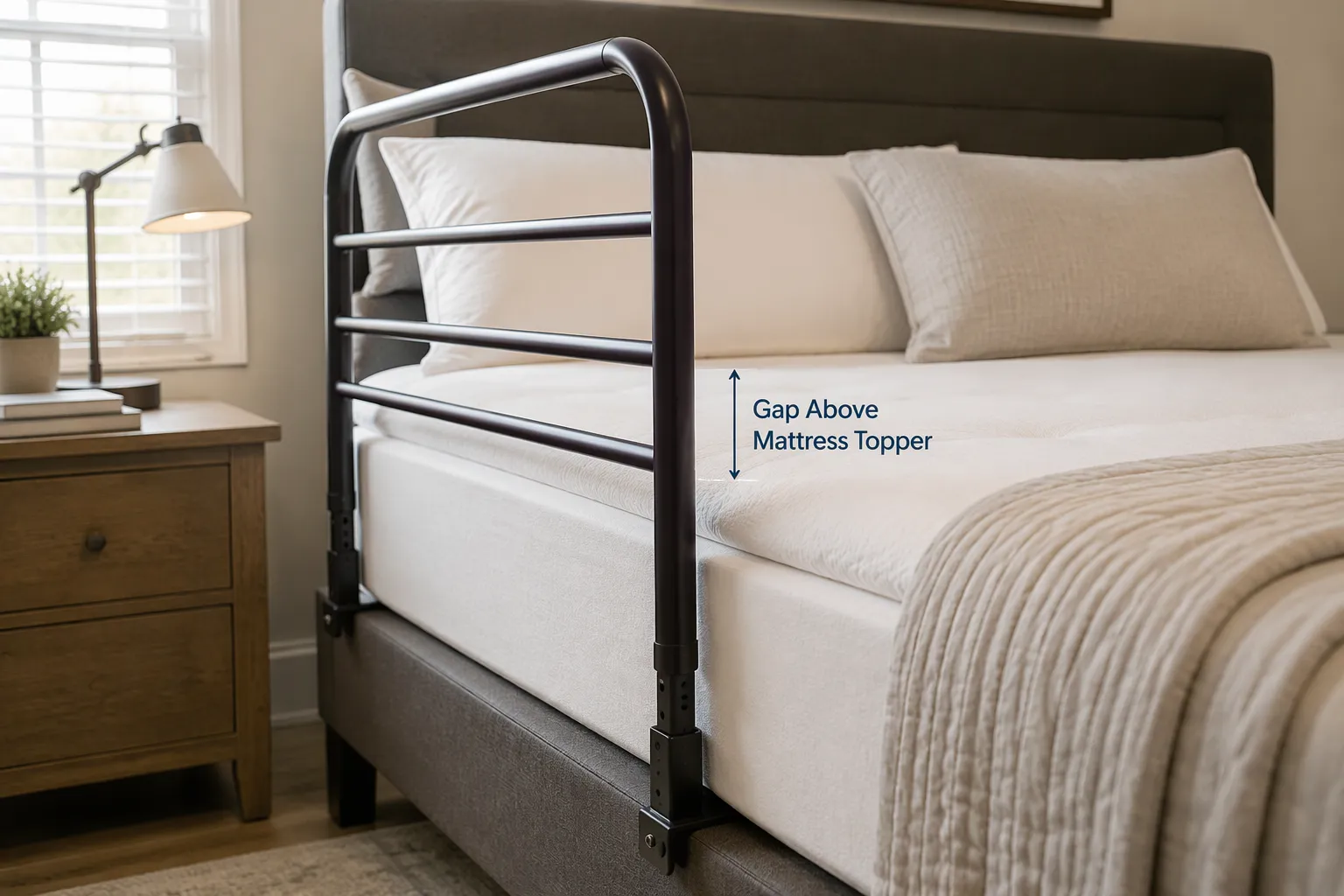
A bed rail should sit about 5 to 7 inches above the top of the mattress topper. This range provides enough height to prevent rolling out, yet stays low enough for easy entry and exit. A thick mattress topper raises the sleep surface, so the rail’s effective height shrinks unless the user adjusts it. Five inches is the widely recognized minimum safety standard. When considering how tall should a bed rail be, treat 5 to 7 inches as the reliable starting target. Measure the mattress height after adding the topper, and confirm the rail clears the mattress by this margin.
The Short Answer: 5 to 7 Inches
Most safety guidance points to a simple target. A bed rail should sit 5 to 7 inches above the sleep surface. This figure assumes the sleeper lies on the finished surface, including any mattress topper. The range gives caregivers a practical window. It balances protection with usability. Anyone asking how tall should a bed rail be can treat this band as the starting point.
Why This Height Range Works
The 5-to-7-inch window is not arbitrary. It reflects two competing needs. A safety bar must stop a sleeper from rolling out. It must also let that sleeper get in and out without struggle. Five inches marks the floor for safety. Seven inches marks the ceiling for comfort. Any point inside this band serves most sleepers well.
Enough Height to Prevent Falls
A guard needs enough clearance to catch a rolling body. Five inches provides that catch. The barrier acts as a physical stop at the edge of the mattress. A sleeper who rolls toward the edge meets resistance before the body clears the bed. Research from AllCare Store notes that some fall-prevention guides recommend 8 to 12 inches above the mattress for elderly users at high risk. That higher figure suits specific clinical settings. For general home use, 5 inches remains the recognized minimum. The extra elevation in the 5-to-7 range adds a margin of protection for restless sleepers.
Low Enough for Easy Entry and Exit
A side guard that sits too high becomes a hurdle. Older adults and children need to swing their legs over the barrier or slide past it. Seven inches keeps the guard low enough for most people to manage this movement. A taller barrier forces the user to climb. That climbing motion creates its own fall risk. The 5-to-7 range respects the need for clear access. A caregiver can help a sleeper in and out without lifting over a tall obstacle.
When to Aim for the Higher End
Not every sleeper needs the same protection. Some situations call for the upper part of the range. A 7-inch guard offers more security for sleepers who move a lot at night. Caregivers should assess the sleeper’s habits before choosing a setting.
Taller or More Active Sleepers
A taller person has a higher center of gravity. That body mechanics fact means a taller sleeper can roll over a low barrier with less effort. Active sleepers who roll, sit up, or climb also need more containment. Luvlap, a maker of adjustable bed rails, advises parents to raise the guard as a child becomes more mobile. The same logic applies to adults who toss and turn. A 7-inch setting gives these sleepers a stronger barrier. The extra inch or two matters when a body carries more momentum toward the edge.
Very Soft or Deep Toppers
A soft pad compresses under body weight. That compression lowers the effective clearance of the guard. A sleeper who sinks into a deep foam layer sits lower than the pad’s surface suggests. The barrier then stands taller relative to the sunken body. This effect can work in two directions. A very soft pad may let the body sink away from the guard, which reduces protection. A deep pad also raises the starting surface, which shrinks the visible barrier. Caregivers should aim for the higher end when the pad is soft or thick. Prius Healthcare USA warns that adding a topper without checking the effective mattress height can compromise an otherwise safe bed system. A 7-inch target offsets the loss from compression.
When the Lower End Is Fine
The lower end of the range serves many sleepers well. A 5-inch guard meets the safety minimum. It also keeps the bed easy to use. Several conditions make this lower setting the better choice.
Older Children and Independent Sleepers
Older children who get in and out of bed on their own need a guard they can clear. A 5-inch barrier lets them swing their legs over without help. Independent sleepers value that freedom. The guard still provides a reminder at the edge. It catches a rolling body during sleep. It does not block a conscious exit. This balance suits children past the toddler stage and adults who move about at night.
Firmer, Thinner Toppers
A firm, thin pad adds little elevation. It also compresses very little under weight. The sleep surface stays close to the mattress top. A 5-inch guard above this surface provides full protection. The sleeper does not sink away from the barrier. The guard does not need extra clearance to compensate for lost grip. A thin pad of one or two inches barely changes the math. The standard 5-inch minimum applies without adjustment.
Why a Thick Mattress Topper Changes the Math

A mattress topper adds comfort, yet it also alters the geometry of the bed. The pad lifts the sleeper closer to the top of the rail. That shift reduces the protective margin without any visible change to the frame. Caregivers must recalculate the setup whenever they add or replace a topper.
The Topper Raises the Sleep Surface
A thick topper can add two to four inches of loft. The sleeper now rests on a higher surface. The rail stays fixed to the frame at its original position. This mismatch creates a shorter barrier than the manufacturer intended.
How Effective Rail Height Shrinks
Effective height equals the distance from the sleep surface to the rail’s upper edge. A three-inch topper removes three inches from that distance. A rail that once stood eight inches above the mattress now stands five. The barrier still meets the minimum, yet the margin for error disappears.
The Gap Between Rail and Topper
A soft topper compresses under body weight. The sleeper sinks toward the mattress, and the body moves away from the rail. This movement widens the gap between the body and the barrier. A wide gap weakens the rail’s ability to catch a rolling sleeper.
The Safety Standard Behind the Number
Federal rules anchor the five-inch figure. The Federal Register documents the toddler bed standard with precise language:
(iii) 6.5.2 The upper edge of the guardrails shall be at least 5 in. (130 mm) above the sleeping surface when a mattress of a thickness that is the maximum specified by the manufacturer’s instructions is used.
The same Federal Register preamble explains that regulators rejected a nine-inch guardrail because a six-inch crib mattress would leave only three inches of barrier. ASTM F 1427-07, the bunk bed standard, requires a five-inch barrier above the top of the mattress. The final rule kept the five-inch provision.
The 5-Inch Minimum Rule
Five inches represents the floor for safe containment. The Federal Register states that the Commission proposed this minimum to help prevent falls from the bed. A topper that eats into this clearance pushes the setup below the standard.
Entrapment and Gap Concerns
The FDA warns that entrapment events occur in openings between bed rails and mattresses, under rails, and between split rails. Elderly and frail users face the highest risk. The Federal Register describes four tested zones under ASTM F3186-17:
- Zone 1 testing addresses head-first entry into fully bounded openings within the rail structure.
- Zone 2 testing addresses head-first entry under the rail into an opening between the compressed mattress and the rail.
- Zone 3 testing addresses head entry into a gap between the rail’s inner surface and the compressed mattress.
- Zone 4 addresses neck-first entrapment between the rail and the compressed mattress at the rail ends.
A mattress that is too thick can cause a rail to fail the structural integrity requirement, which mandates four inches of clearance above the mattress.
What Happens When the Rail Is Too Low
A short barrier creates two problems. Both affect safety during sleep.
Rollout Risk
A low rail cannot stop a rolling body. The sleeper’s momentum carries the body over the edge. A thick topper worsens this risk because the body starts higher and travels farther.
Reduced Sense of Security
Ocodile notes that a rail must be high enough to form a safe barrier yet low enough for a child to peek over. Sleep Advisor explains that height adjustments let parents select the amount of security required for a child’s age and size. A rail that sits too low offers little reassurance to the sleeper or the caregiver.
Factors That Affect the Ideal Mattress Height
Several variables shift the ideal rail height. Caregivers should weigh each one before settling on a setting. The question of how tall should a bed rail be has no single answer for every bed.
Topper Thickness and Firmness
A mattress topper changes the sleep surface in ways a tape measure alone cannot show. Both its loft and its softness matter.
Measuring the Actual Added Height
Place the topper on the mattress and let it expand for a full day. Then measure from the mattress top to the topper surface. This figure reveals the true mattress thickness at rest. Add the mattress height plus your foundation, platform frame, or base height to find the total sleeping surface height. A thick topper can add several inches to the sleeping surface height.
How Much the Topper Compresses
Soft foam sinks under a body. A firm topper holds its shape. A compressible topper reduces the effective height of the barrier. Test the compression with a firm hand press before trusting the measurement.
The Sleeper’s Needs
Every sleeper brings different habits and abilities to bed. The right height depends on who sleeps there.
Age and Mobility
Young children need a barrier they cannot climb over easily. Older adults need one they can clear without strain. Limited mobility calls for a lower rail. A higher setting suits sleepers who cannot control their movements.
Sleep Habits and Restlessness
Restless sleepers roll with force. They need more clearance above the mattress topper. Calm sleepers do fine with the minimum. Watch nighttime movement for a week before choosing.
Bed and Frame Type
The base under the mattress alters the math. Each frame style changes the total bed height when combined with the mattress and topper.
Adjustable Beds
An adjustable bed raises the head or feet. The rail must move with the mattress. Check the height at every position. A rail that fits flat may sit too low when the head elevates.
Platform and Standard Frames
A platform frame sits low. A standard frame with a box spring sits higher. Measure the mattress height plus your foundation to get the frame + mattress figure. Add the bed frame height for the total bed height. Compare that total bed height against the rail’s mounting range. A low platform may need a taller rail to reach the target.
How to Measure the Right Height
Accurate measurement turns a rough guess into a reliable setup. Caregivers should measure the finished sleep surface, not the bare mattress. This step matters most when a thick mattress topper sits on the bed. A careful measurement answers the question of how tall should a bed rail be for that specific bed. The process takes only a few minutes and a tape measure.
Step-by-Step Measuring
A consistent method produces a trustworthy number. South Shore Fine Linens recommends a simple sequence for measuring mattress depth. The same approach works for checking rail clearance above a topper.
Finding the True Sleep Surface
Start with a clean, bare bed. Strip the bed completely. Remove sheets, blankets, and anything else that changes the loft. Check the base next. If the frame blocks the bottom edge of the mattress, shift the mattress enough to expose the full depth. Lay a straightedge across the highest point. Set it flat across the top of the mattress. Measure straight down. Take the tape from the bottom of the mattress straight up to the underside of the straightedge. Write the number down right away. Memory fails when comparing products later.
The topper belongs in this measurement when it stays on the bed every night. South Shore Fine Linens advises measuring with the topper in place if it remains on the bed. A thick protector that changes the profile should also count. An accessory that comes off regularly can stay out of the math. Bedding specialists note that toppers and pads belong in the final height used for sheets. The same logic applies to rail clearance. The sleeper rests on the finished surface, so the measurement must reflect that surface.
Practical rule: Measure the height you actually sleep on, not the lower edge you happen to see from the side.
This rule keeps the measurement honest. A quick glance from the side often misses the true sleep surface. The eye catches the mattress edge, not the compressed topper under a body. A tape measure removes that error.
Measuring From Topper to Rail Top
The second measurement captures the barrier itself. Extend the tape from the topper surface straight up to the top edge of the rail. Hold the tape vertical for an accurate reading. Record the distance between the mattress surface and the top rail. This figure reveals the real protection level. A rail that looks tall from across the room may sit short once the topper enters the picture.
Compare the result against the target range. The gap should measure 5 to 7 inches. A reading below 5 inches signals a problem. The setup lacks adequate clearance for safe containment. A reading above 7 inches may make entry and exit harder. Adjust the mounting position or choose a different rail when the number falls outside the band.
Checking the Fit After Installation
A measurement on paper does not guarantee a safe fit. The installed rail must hold its position under real conditions. Two quick checks confirm the setup works as intended.
The Press-Down Test
A soft topper changes shape under weight. The press-down test simulates that change. Press a firm hand into the topper near the rail. Hold the pressure for a few seconds. Watch how far the surface sinks. Then check the remaining clearance above the compressed spot. The rail must still clear the sunken surface by the target margin. A topper that compresses deeply may pull the effective height below 5 inches. In that case, raise the rail or reduce the topper thickness.
Repeat the test along the length of the rail. Compression varies across a mattress. A worn spot near the center may sink more than the edges. Check each section the sleeper might contact during the night.
Confirming a Snug Gap-Free Fit
Gaps create entrapment hazards. The FDA warns that openings between rails and mattresses pose serious risks, especially for frail users. Run a hand along the junction where the rail meets the mattress. Feel for any space between the rail’s inner face and the compressed mattress. A snug fit leaves no room for a limb or head to slip through. Push the mattress tight against the rail if a gap appears. Tighten the mounting hardware to hold the position.
Check the ends of the rail as well. The FDA lists rail ends as a common entrapment zone. A rail that stops short of the headboard or footboard leaves an open corner. Fill that corner or reposition the rail to close the opening. A gap-free fit protects the sleeper and gives caregivers peace of mind.
How to Adjust a Rail That Sits Too Low

A rail that falls short of the target range needs correction before the next sleep. Caregivers can try several fixes in sequence. Some adjustments take only a few minutes. Others require a new product or a change to the sleep surface.
Simple Fixes First
The mounting hardware offers the fastest path to more clearance. Check the current position before buying anything new.
Repositioning the Rail Mount
Many rails offer two or more mounting slots along the bracket. Moving the rail to a higher slot adds an inch or more of clearance. Loosen the fasteners, slide the rail upward, and lock it into the new position. Measure the distance from the topper surface to the top edge again. Repeat the move until the rail reaches the 5-to-7-inch band.
Tightening and Stabilizing Hardware
A loose bracket lets the rail sag away from the mattress. That sag reduces the effective height and opens a gap at the edge. Tighten every bolt and clamp with the correct tool. Push the rail toward the mattress to seat it firmly. Shake the rail gently to confirm it holds its position. A stable mount keeps the barrier at its measured height all night.
When to Change the Setup
Some beds cannot reach the target with the current equipment. A different rail or a thinner topper solves the problem.
Choosing a Taller Rail
Manufacturers publish a fit range for each model. Compare that range against the measured mattress height plus the topper. A rail with adjustable height settings covers more setups. Look for a model rated for thick mattresses. Swap the old rail for the taller unit, then install a bed rail at the highest safe setting.
Rethinking the Topper Thickness
A very deep topper eats several inches of barrier clearance. A thinner topper of two inches or less restores much of that margin. The sleeper keeps most of the comfort and gains a safer setup. Weigh the trade-off between plushness and protection. A medium thickness often balances both needs.
Choosing the Right Rail for a Thick Topper
A careful buyer matches the product to the bed. The right features make the difference between a secure setup and a constant struggle. Shoppers should review a few key specifications before they commit.
Features to Look For
Two features carry the most weight. Each one directly affects how well the barrier performs above a raised sleep surface.
Adjustable Height Settings
A fixed rail offers one position. That limitation becomes a problem when a mattress topper adds loft. Adjustable models let the user raise or lower the barrier as the bed changes. Look for a model with several locking positions. This feature lets the user hit the 5-to-7-inch target after the topper goes on. A rail with only one setting may sit too low once the pad compresses.
Sturdy Anchoring and Fit Range
A secure mount keeps the barrier at its measured height. Check the clamp style and the anchor points. Models that slide under the mattress or strap to the frame tend to hold firm. The product listing should state a fit range for mattress height. Compare that range against the measured thickness of the mattress plus the topper. A rail rated for thick beds will clear the target zone.
Matching the Rail to Your Bed Setup
The frame and the sleep surface both shape the choice. Buyers should confirm compatibility before checkout.
Rails Designed for Thick Mattresses
Some bed rails come built for deep mattresses. These models offer taller posts and longer anchor straps. They suit beds with a thick pad on top. A standard rail may run out of adjustment room on a deep setup. Shoppers should pick a model rated for the total bed height they measured.
Compatibility With Toppers and Frames
Not every rail works with every base. Adjustable beds need rails that move with the platform. Platform frames need clamps that grip a thin edge. Mattress toppers add softness that can shift under the rail. Confirm the rail’s grip style suits the frame and the pad. A quick check of the fit range prevents a return later.
Aim for 5 to 7 inches of rail above the topper surface, with 5 inches as the minimum. A thick mattress topper raises the sleep surface, so caregivers should always measure the height after the topper sits in place. Press down on the topper and confirm the rail still clears the surface by the target range. If the height falls short of the top of the mattress standard, adjust the mount or upgrade the rail. Safety and comfort both depend on this final check.
FAQ
Does a mattress topper count toward the 5-inch minimum?
Yes. The 5-inch minimum applies to the finished sleep surface. A topper raises that surface. The rail must clear the topper by 5 inches, not the bare mattress. Measure after the topper sits in place.
Can a caregiver use a pool noodle instead of a proper rail?
A pool noodle offers soft padding at the edge. It does not anchor to the frame. It compresses under body weight. It cannot meet the 5-inch clearance standard. A certified rail provides a fixed barrier and a secure mount.
How often should a caregiver recheck rail height?
Recheck the height after every bedding change. A new topper, a flipped mattress, or a washed pad can shift the surface. A quick tape measure check takes seconds. A monthly inspection catches loose hardware before it becomes a hazard.
What gap size between rail and topper signals danger?
Any gap wide enough to admit a limb or head poses a risk. The FDA lists rail-to-mattress openings as a common entrapment zone. Push the mattress tight against the rail. Tighten the mount. Close every opening along the rail’s length and ends.
Do adjustable beds need a different rail height?
Yes. An adjustable bed changes the mattress angle. The rail must move with the platform. Check clearance at every head and foot position. A rail that fits flat may sit too low once the head elevates. Confirm the mount follows the frame.
Can a sleeper use a rail on only one side of the bed?
One rail protects one edge. The open side stays unprotected. A sleeper who rolls toward the open edge faces full fall risk. Use rails on both sides when the sleeper moves in any direction. Match each rail to the same height target.
Does rail height change for a crib mattress versus an adult bed?
Yes. Crib and toddler standards set their own guardrail rules. Adult bed rails follow different guidance. The 5-inch minimum appears in both contexts. Always check the product’s rated fit range against the measured mattress plus topper height.
What should a caregiver do if the rail cannot reach 5 inches?
Remove the topper or switch to a thinner pad. Choose a taller rail rated for deep mattresses. Never accept a barrier below the minimum. A short rail offers little protection. Fix the setup before the next sleep.