

Commode armrests often sit too low for standing. Manufacturers engineer them for seated stability and lateral transfers, not for push-up leverage. Standard dimensions prioritize tip resistance, safety, and compatibility with average seat heights over optimal standing height. This creates a deliberate design compromise, not a defect. Many users notice commode armrests too low during standing up from the toilet. This mismatch is predictable. The low height favors seated support and side access. Understanding this intent points directly to practical fixes.
Armrests Are Built for Stability, Not Push-Ups
The Real Job of a Commode Armrest
A commode armrest serves a purpose quite different from what many users assume. Designers build these components to keep a seated person safe and centered. They do not build them as standing aids. This distinction explains much about why commode armrests too low for standing up feel like a design flaw, even though they perform their intended job well.
Lateral support and fall prevention
The primary function of a commode armrest is lateral support. A user who sits down or shifts weight sideways needs a physical boundary that prevents a fall. Armrests on both sides of the seat create a contained space. This containment matters most during transfers from a wheelchair or a bed, when a person moves sideways onto the commode. The armrest acts as a guardrail during this lateral motion. It stops the body from sliding off the seat edge. It also gives the hands something to grip if balance wavers during the transfer itself.
Boundaries that keep the user centered
Beyond fall prevention, armrests define the seating area. They give the user tactile feedback about position. A person who sits slightly off-center feels the armrest against one side and naturally adjusts. This centering function supports good posture during seated use. It also reduces the chance of leaning too far in one direction. For users with limited trunk control, these boundaries provide essential orientation cues. The armrest height that serves this role best sits close to the natural resting position of the forearms. That position is lower than most people realize.
Why Push-Up Leverage Is a Secondary Role
Manufacturers do consider standing up when they design commode armrests. They simply treat it as a secondary concern. The forces involved in seated support and the forces involved in standing differ in direction, magnitude, and timing. Designers prioritize the seated phase because that phase carries the highest fall risk.
Gripping versus pushing: two different forces
A commode armrest primarily supports gripping and bracing forces. A user presses down lightly or holds on for balance. Standing up requires a different force pattern entirely. The user must push down hard and drive the body upward. A note.com analysis of handrail forces illustrates this distinction clearly.
| Force type | Handrail position | How force is applied when standing | Effect / risk |
|---|---|---|---|
| Pushing force | Side handrail (frame-type armrests at the side of the body, at the toilet seat position) | The user tends to stand up by pushing on the handrail to lift the body; the forward-leaning movement becomes smaller | Center of gravity may remain behind the user after standing up, causing unsteadiness and risk of falling backward |
| Gripping / pulling force | Front handrail | The user tries to stand by pulling the front handrail toward the body | Requires a stable, sufficiently heavy handrail with a base plate, since lightweight floor-standing handrails are easily moved or tilted by this pulling force |
This table reveals an important truth. Side armrests at seat height encourage a push-up motion. That motion can leave the center of gravity behind the feet. The result is unsteadiness after standing. A higher push point would allow a more forward-directed effort. Standard armrest height does not provide that point.
How seated support goals pull the height downward
Seated comfort and safety pull armrest height downward. A user who sits for several minutes needs forearm support without shoulder elevation. Raised shoulders create tension and fatigue. Lower armrests also keep the elbows close to the body, which improves stability during seated use. Designers therefore set armrest height to match a relaxed seated posture. That height serves the seated phase well. It serves the standing phase poorly. The same dimension cannot optimize both phases, so designers choose the phase with greater fall risk.
The Gap Between User Expectation and Design Intent
Users approach a commode with a mental model shaped by other objects. They see two side rails and interpret them as handles. This interpretation feels obvious and natural. It also creates disappointment when the rails do not function as expected.
Why armrests feel like handles
Armrests look like handles because they share visual features with grab bars. They are horizontal, rigid, and positioned at hand level when seated. The brain reads these cues and predicts a pushing function. A sed-med.com article clarifies the distinct roles of different bathroom supports. As the article explains:
A grab bar is a fixed handhold mounted to a wall; a toilet safety frame is a free-standing unit with armrests on both sides of the toilet; a riser — also called a raised toilet seat — adds height to the existing seat without changing anything about support. Three different jobs: grip, a stable point to push up from, and reduced distance to stand.
This passage highlights the core mismatch. A commode armrest performs the grip and boundary job. Users expect it to perform the push-up job. The visual similarity between armrests and grab bars reinforces this false expectation.
The mismatch that makes them feel too low
The feeling that commode armrests sit too low arises from this expectation gap. A user leans forward and presses down on the armrests. The push point sits below the natural power zone of the arms. The user must generate arm leverage from a disadvantaged position. The effort feels excessive. The movement feels awkward. Nothing is broken. The armrest simply does not offer the height that a sit-to-stand motion demands. Users who push up with your arms from a standard armrest often report that the seat feels lower than expected. The seat height may be correct. The armrest height is the real source of the problem. This low push point forces the shoulders into an inefficient angle. The body then compensates with extra effort or with a rocking motion. Both compensations increase fatigue and reduce confidence during seated to standing transitions.
Standard Dimensions Keep Armrest Height Fixed and Low
How Armrest Height Is Actually Set
Tied to average seat heights
Manufacturers derive armrest height from average seat dimensions. A standard toilet bowl places the seat surface at roughly 15 to 17 inches. Designers position the armrest a few inches above that surface. This offset matches the resting forearm of an average seated adult. The calculation works well for the middle of the population. It ignores the edges of the curve.
Fixed rather than user-specific
Most commode frames offer no height adjustment at all. The armrest welds or bolts to the frame at one set position. A buyer cannot tune the armrest to personal proportions. This fixed geometry keeps production simple and keeps the product affordable. It also means the armrest height serves an average body, not the individual user.
The Role of Safety Guidelines and Standards
Stability and tip-resistance requirements
Safety standards treat the commode as a support structure. Test protocols load the frame from the side and from above. A lower armrest keeps the push point close to the frame’s center of mass. This geometry reduces the tipping moment during seated use. Higher armrests raise the push point and increase leverage against the frame. Engineers therefore favor a conservative position.
Why guidelines favor lower, conservative heights
Regulators write standards for the weakest user in the riskiest moment. That moment is a lateral transfer or a seated weight shift, not a stand-up. A low armrest protects against falls in those scenarios. The guidelines accept reduced standing leverage as a reasonable trade. Standing convenience never drives the standard.
Compatibility Across Toilets and Commodes
Fitting varied bowl and frame heights
A commode must fit many bowl shapes and frame designs. Toilet height varies across models and across installations. A raised toilet seat adds two to four inches on top of the bowl. The armrest must clear that added height without blocking side access. One universal armrest position accommodates the widest range of setups.
Why one universal height wins over ideal height
A single fixed height simplifies inventory, installation, and replacement parts. Manufacturers could offer many armrest positions. Each variant would add cost and confuse buyers. The market settles on one compromise height. That height works acceptably across most configurations. It rarely matches any single user’s ideal push point.
One Height Cannot Fit Every Body
Seat Height Changes the Math
Tall seats make armrests feel lower
Seat height directly changes the distance between the armrest and the user’s hands. A taller seat lifts the body upward. The armrest stays fixed to the frame at its original position. This geometry shrinks the vertical gap between the forearm and the push point. Users then reach downward to find leverage. The relative height of the armrest drops with every inch added to the seat.
Raised seats and the standing gap
A raised toilet seat adds two to four inches on top of the bowl. This accessory solves one problem and creates another. The added toilet height shortens the sit-to-stand distance for the legs. It also widens the gap between the seated body and the armrest. A user who adds a raised toilet seat often discovers that the armrests now sit well below a comfortable push position. The standing gap grows, and the push-up effort rises with it.
Body Size and Proportions Matter
Torso length and arm length differences
Two users of identical height can experience the same commode very differently. A long torso places the shoulders high above the seat. Long arms reach farther down to the armrest. Short arms on a long torso struggle to find any useful push angle at all. Manufacturers cannot capture this variation in a single fixed dimension.
Why a tall user loses leverage first
A tall user carries more body mass above the seat. That mass must travel a longer distance during standing up. The armrest sits proportionally lower relative to the shoulders. The push angle becomes shallow and inefficient. Tall users therefore notice the low armrest before shorter users do.
Strength and Mobility Differences
How much push-up force users actually need
Push-up force requirements vary widely across users. A strong user needs modest arm assistance to rise. A weak user depends on the armrest for most of the lift. The same fixed height serves the strong user adequately and fails the weak user entirely. Designers cannot measure individual strength at the factory.
Why designers cannot optimize for the strongest push
A frame built for the strongest push would carry heavy reinforcement and a high push point. That design would raise tipping risk for everyone else. Designers instead target a moderate load and a conservative height. This choice protects the broadest group of users. It leaves the weakest users to seek additional support elsewhere.
Higher Armrests Create Other Problems
Interference with Lateral Transfers
Sliding transfers from bed or wheelchair
A higher armrest blocks the path a user needs for a sideways transfer. Many users slide from a bed or a wheelchair onto the commode. This motion requires open space at the side of the seat. An armrest that rises above the seat surface becomes a physical barrier. The user must lift the body over the rail or abandon the sliding method entirely. Both outcomes reduce safety and increase effort.
Why side access matters more than push height
Side access serves every transfer, every day. Push height serves only the stand-up moment. Designers weigh these two needs and protect the more frequent one. A low armrest keeps the side path clear. A high armrest closes that path. For a user who transfers laterally several times a day, the closed path creates a larger burden than a low push point ever could.
Increased Tipping Risk
Higher push points and leverage on the frame
A raised armrest moves the push point farther from the frame’s base. This added height increases the leverage a user applies during standing. The frame must resist a larger tipping moment. Lightweight commodes may shift or rock under this load. The risk grows for heavier users and for frames without floor anchoring.
Why stability wins over standing convenience
A tipped commode causes a fall. A low armrest causes effort. Designers rank the fall as the greater harm. They therefore accept the standing inconvenience and protect the frame’s stability. This trade-off explains why manufacturers resist raising armrests on standard frames.
Comfort and Clearance Trade-Offs
Arm position during seated use
A taller armrest lifts the forearms away from a relaxed position. The shoulders rise to meet the new height. This posture creates tension during longer seated periods. Users with limited shoulder mobility may find the position uncomfortable or unsustainable.
Why taller armrests can feel restrictive
High armrests also narrow the usable seating space. They press against the ribs or hips of larger users. The user feels boxed in rather than supported. A raised toilet seat compounds this effect by lifting the body closer to the armrest line. The combination of added height and a raised toilet seat can leave almost no clearance for the arms. Users then lose the lateral support they need for balance.
When Commode Armrests Too Low Become a Real Safety Issue
Signs the Height Is Working Against the User
Leaning forward without effective push
A user leans forward to rise and presses down on the armrests. The hands sink below the natural power zone of the arms. The push produces little lift. The user rocks forward and back to build momentum. This rocking motion signals that the armrest height fails the standing task. Repeated rocking drains energy and erodes confidence during standing from the toilet.
Relying on the frame or nearby fixtures instead
A user who cannot push effectively from the armrests often reaches for other objects. The hands find the commode frame, a nearby sink, or a towel bar. These fixtures carry no rating for body weight. A towel bar can tear from the wall under a sudden load. This substitution pattern reveals that the armrests or a grab bar should carry the load instead. When users bypass the armrests, the equipment has stopped doing its job.
Who Feels the Problem Most
Taller and heavier users
Tall users carry more mass above the seat, and that mass travels a longer path during standing up. The armrests sit proportionally lower relative to their shoulders. Heavier users need more push force to lift their bodies. Both groups lose arm leverage first. They notice commode armrests too low before anyone else does.
Users with limited arm or grip strength
Weak arms depend on a favorable push angle. A low push point forces the shoulders into an inefficient position. The user cannot generate enough force to rise. This group needs the most support and receives the least from a fixed low height.
Why the Problem Is Easy to Underestimate
The difference between support and leverage
An armrest provides support when it keeps a seated body centered. It provides leverage when it converts a downward push into upward lift. A low armrest delivers the first function well and the second poorly. Users and caregivers often confuse the two. The product feels sturdy, so they assume it aids standing. Sturdy support does not equal useful leverage.
Why “low” is relative to the user, not the product
No absolute number defines a low armrest. The same height suits a short user and fails a tall one. A raised toilet seat lifts the body and shifts the relationship again. The problem lives in the fit between body and product, not in the product alone. This relativity explains why the issue escapes notice in reviews and showroom tests.
Practical Solutions for Commode Armrests Too Low
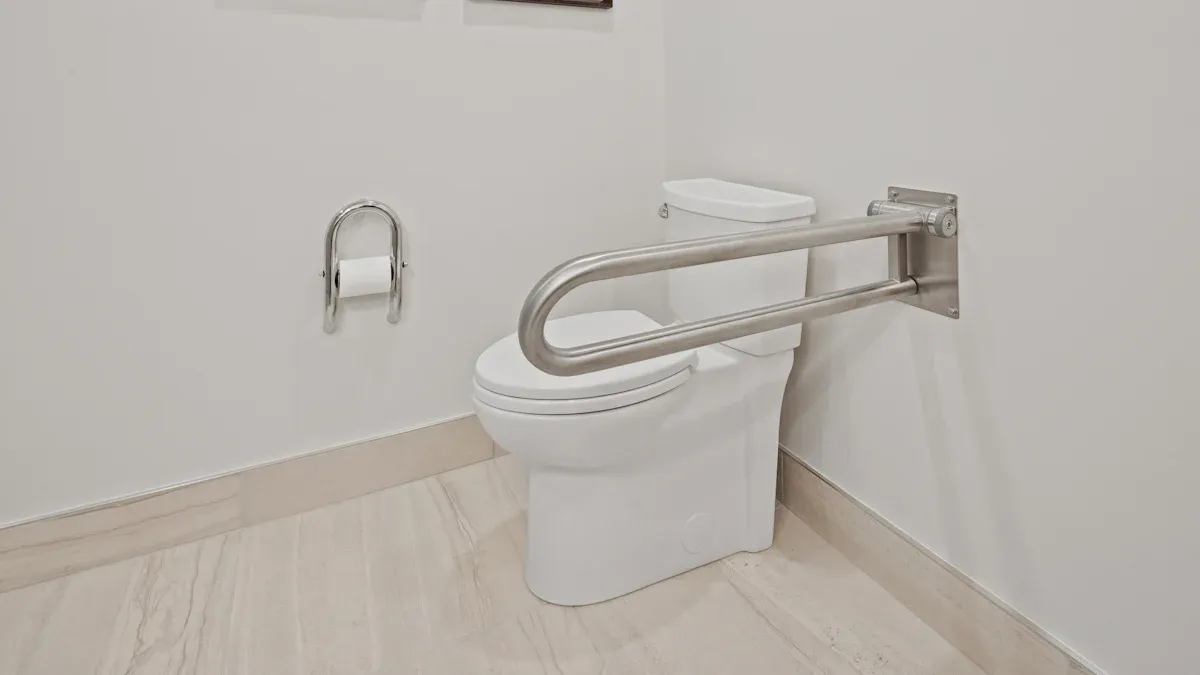
The problem of commode armrests too low has several practical answers. Each option addresses a different part of the fit between body and equipment. Some solutions adjust the product. Others adjust the surrounding setup. A few bring in professional guidance. The right combination depends on the user’s body, transfer style, and daily routine.
Adjustable Armrest Designs
Height-adjustable commode frames
Adjustable armrests offer the most direct fix for commode armrests too low. These designs let the user or caregiver raise the push point to a comfortable level. The Etac Rolling Shower Commode Chairs, listed by Hovertech International, carry armrests that adjust in both height and width by 2.375 inches in each direction. That range covers a meaningful slice of the gap between a seated forearm and a standing push point. A taller user can raise the armrest toward shoulder level. A shorter user can lower it for relaxed seated support. Width adjustment adds a second benefit. It lets the frame accommodate broader hips or narrower frames without pressing against the ribs.
Height-adjustable frames cost more than fixed models. They also carry more moving parts. A buyer should weigh these factors against the daily benefit of a better push angle. For a user who struggles with standing up, the added range often justifies the price.
What to check before adjusting
A user should confirm several details before turning an adjustment knob. First, check the adjustment range against the user’s measured arm height. A range that stops short of the needed point solves nothing. Second, verify that the frame locks firmly at each setting. A loose collar can slip under load during a sit-to-stand movement. Third, confirm that the raised position does not block lateral transfers. An armrest that rises above the seat surface can close the side path a sliding transfer needs. Fourth, check the weight capacity at the highest setting. Some frames rate lower capacity at full extension. Fifth, test the new position during a supervised trial. A setting that feels right while seated may feel wrong during the actual push.
Add-On and Aftermarket Options
Armrest pads and risers
Add-on pads and risers offer a low-cost path to a higher push point. A thick pad raises the hand position by an inch or more. A riser block lifts the entire armrest assembly. These products attach to existing frames without tools in many cases. They suit users who already own a commode and want a modest improvement. Pads also add cushioning, which helps users who press down hard during standing up.
These add-ons carry limits. A thick pad can make the armrest feel unstable if it shifts under load. A riser must fasten securely to the frame. A loose riser creates a tipping hazard worse than the original low height. Buyers should choose products with firm attachment hardware and a weight rating that matches the user. A padded riser works best as a modest correction, not as a substitute for a properly adjustable frame.
Stand-alone support frames beside the commode
A stand-alone support frame places a stable push point where the user needs it. These frames sit beside the commode and offer a raised bar at a comfortable height. The user can push from this bar instead of the low armrests. This setup separates the standing task from the seated support task. The commode armrests continue to provide lateral boundaries. The stand-alone frame provides the leverage.
This option suits users who need a high push point but cannot replace their commode. It also helps users who want a toilet safety frame or grab bar within reach of the seated position. A wall-mounted grab bar near the toilet can serve the same purpose. The user should confirm that any wall fixture carries a weight rating for body weight. A towel bar or a loose fixture cannot carry this load safely.
Matching the Setup to the User
Aligning seat height with armrest height
Seat height and armrest height must work as a pair. A raised toilet seat lifts the body and changes the gap to the armrests. A user who adds a raised toilet seat should recheck the armrest position afterward. The added toilet height may push the armrests too low for a comfortable push. In that case, the user needs adjustable armrests or a stand-alone frame to restore the gap.
A seating assessment measures both values together. Vivid Care describes the standard approach in its guide to seating assessments.
| Measurement | How to measure | Goal |
|---|---|---|
| Floor to Seat Height | Measure from the top of the seat to the floor or footplate | Client can comfortably support themselves with their feet resting flat |
| Arm Height | Measure from the top of the seat to the top of the armrest | Client’s shoulders should be relaxed with their arms resting comfortably on the armrests |
This table shows why the two measurements belong together. A seat that sits too high shortens the leg push and raises the body above the armrests. A seat that sits too low forces a deeper squat. Either error changes the armrest’s effective height. A user who wants easier sit-to-stand function should measure both values before buying any accessory.
Solace Health offers practical guidance for the fitting process. Its fitting advice covers several points.
- Armrests should support relaxed elbows. Too low and the user slouches. Too high and the shoulders rise, which creates tension.
- Fit issues should be reported early to avoid long-term discomfort. Early correction prevents complications such as pressure injuries or poor alignment.
- Regular reassessments track changes in weight, posture, or usage. A reassessment every 6 to 12 months, or sooner if discomfort, skin irritation, or posture changes appear, helps ensure continued safety and proper function.
- Fittings are conducted by professionals such as occupational therapists, physical therapists, durable medical equipment specialists, or certified wheelchair fitting specialists.
These points apply directly to commode setup. A raised seat with armrests needs the same careful fit as any other seating product. A raised seat with arms that sits at the wrong height creates the same slouching or shoulder tension. Users should treat the armrest height as a fit variable, not a fixed feature.
When to consult an occupational therapist
An occupational therapist can resolve fit problems that resist home adjustment. This professional measures the user’s body, observes the transfer, and recommends specific equipment. Vivid Care notes that a specialist seating assessment is typically conducted by an occupational therapist, physiotherapist, or seating specialist. Users can contact a local healthcare provider or a specialist seating company to arrange an assessment.
A consultation makes sense in several situations. A user who has fallen during a transfer should seek assessment before resuming the routine. A user whose needs have changed, such as after weight loss or a decline in strength, should request a reassessment. A user who cannot find a commercial product that fits should ask for a custom recommendation. A caregiver who notices the user reaching for unsafe fixtures should arrange a professional visit.
The therapist can also advise on the full setup. That advice may cover a raised toilet seat with arms, a stand-alone frame, or a combination of products. The goal is a setup that supports the user’s primary transfer style. A user who transfers sideways needs clear side access. A user who stands with arm assistance needs a high push point. Some users need both, and a therapist can balance the trade-offs.
A well-matched setup can make the sit-to-stand movement easier and safer. It can also help standing from the toilet without reliance on unsafe fixtures. The right combination of adjustable armrests, add-on support, and professional guidance turns a frustrating product into a workable one. Users who address commode armrests too low with these tools regain confidence during daily transfers.
Shopping Tips for Armrest Height and Toilet Height
Key Specs That Predict Standing Fit
Armrest height range versus seat height
A buyer should compare two numbers before purchase: the armrest height range and the seat height. SeniorLivingReady notes that seat height is one of the most important measurements. A commode that sits too low makes standing difficult, and one that sits too high prevents proper foot placement. The ideal setup lets the user sit with knees at or slightly below hip level. The armrest should then sit within easy reach without forcing the shoulders upward. A raised seat with arms changes both values at once, so the buyer must check the combined result.
Weight capacity and frame stability
Weight capacity is a safety specification, not a target. SeniorLivingReady advises buyers to verify the manufacturer’s stated limit and never estimate it. A user who drops heavily onto the seat or pulls hard on one armrest places unusual force on the frame. Buyers should also test for flex, rocking, or loose components. A stable frame matters as much as a generous rating.
Questions to Ask Before Buying
Is the height adjustable?
Adjustability decides whether the product can match the user’s body. Carex recommends commodes with adjustable armrests and adjustable backs for greater customization. A fixed frame serves an average body. Adjustable armrests serve the actual user.
Does it support lateral transfers?
Transfer style determines the arm design. Independent Living Superstore suggests buyers confirm whether one or both armrests move aside, whether the release locks securely, and whether the frame stays stable under sideways weight. A user primarily needs a handhold for standing can choose fixed arms. A user who slides from a bed or wheelchair needs drop arms or removable arms.
Balancing Standing Needs with Seated Safety
Where each design fits best
Equip2Adapt maps each design to a specific need. A freestanding safety frame or raised seat with handles suits balance problems. A standard raised toilet seat suits height needs alone. An over-the-toilet commode chair suits inconsistent bathroom access. A powered lift suits significant standing difficulty. The difference between a raised toilet seat and a toilet lift lies in the power source and the lifting support each provides.
Prioritizing the user’s primary transfer style
The primary transfer style should drive the purchase. Fixed arms suit a user who stands and pivots. Drop arms suit lateral transfers. Handle-equipped raised seats with armrests work best when the user can push evenly through both arms. SedMed notes that grab bars offer balance support, not lifting support. A buyer who needs lift should pair a raised toilet seat with arms with a frame or lift assist. Matching the design to the daily routine beats chasing an ideal height.
Low armrests reflect deliberate design intent, standardized dimensions, and the reality that one height cannot fit every body. Higher armrests trade standing leverage for transfer access and tip resistance. Readers facing this problem have practical options: adjustable armrests, add-on supports, and professional assessment. A raised toilet seat with arms can help, and matching toilet height to the user matters. A raised toilet seat changes the standing gap, so users should recheck armrest height after adding one. Correct toilet height and proper support restore confidence during daily transfers. A raised toilet seat paired with the right frame completes the setup.
FAQ
Are low commode armrests a manufacturing defect?
No. Manufacturers set armrest height deliberately. They prioritize seated stability, lateral transfers, and tip resistance over standing leverage. A low armrest performs its intended job well. The height only feels wrong during a push-up motion. Users should treat the gap as a fit issue, not a product flaw.
Can a user raise the armrests on a standard commode?
Most fixed frames offer no adjustment. A user can add pads or risers for a modest lift. A stand-alone support frame beside the commode provides a higher push point. Height-adjustable commode frames offer the most reliable fix. Buyers should confirm the frame locks firmly at each setting.
Do grab bars work better than commode armrests for standing?
Grab bars serve a different purpose. A wall-mounted grab bar provides a fixed handhold for balance and leverage. Commode armrests provide lateral boundaries and seated support. Many users benefit from both. A user should confirm any wall fixture carries a weight rating for body weight.
Why do armrests feel lower after adding a raised toilet seat?
A raised toilet seat lifts the body two to four inches. The armrests stay fixed to the frame at their original position. This geometry widens the gap between the hands and the push point. Users should recheck armrest height after adding a raised seat. Adjustable armrests or a support frame can restore the gap.
Should taller users choose a different commode design?
Tall users lose arm leverage first. Their shoulders sit higher above a fixed armrest. A height-adjustable frame lets them raise the push point toward a comfortable level. A stand-alone support frame offers another option. A tall user should measure arm height before buying any fixed model.
When should a user consult an occupational therapist?
A user should seek assessment after a fall during a transfer. A change in weight, strength, or posture also warrants a reassessment. A therapist measures the body, observes the transfer, and recommends specific equipment. Professional guidance helps when commercial products fail to fit.
Does armrest height matter for lateral transfers?
Yes, but in the opposite direction. A higher armrest can block a sliding transfer from a bed or wheelchair. Side access matters more than push height for these users. Drop arms or removable arms keep the side path clear. A user should match the arm design to the primary transfer style.