
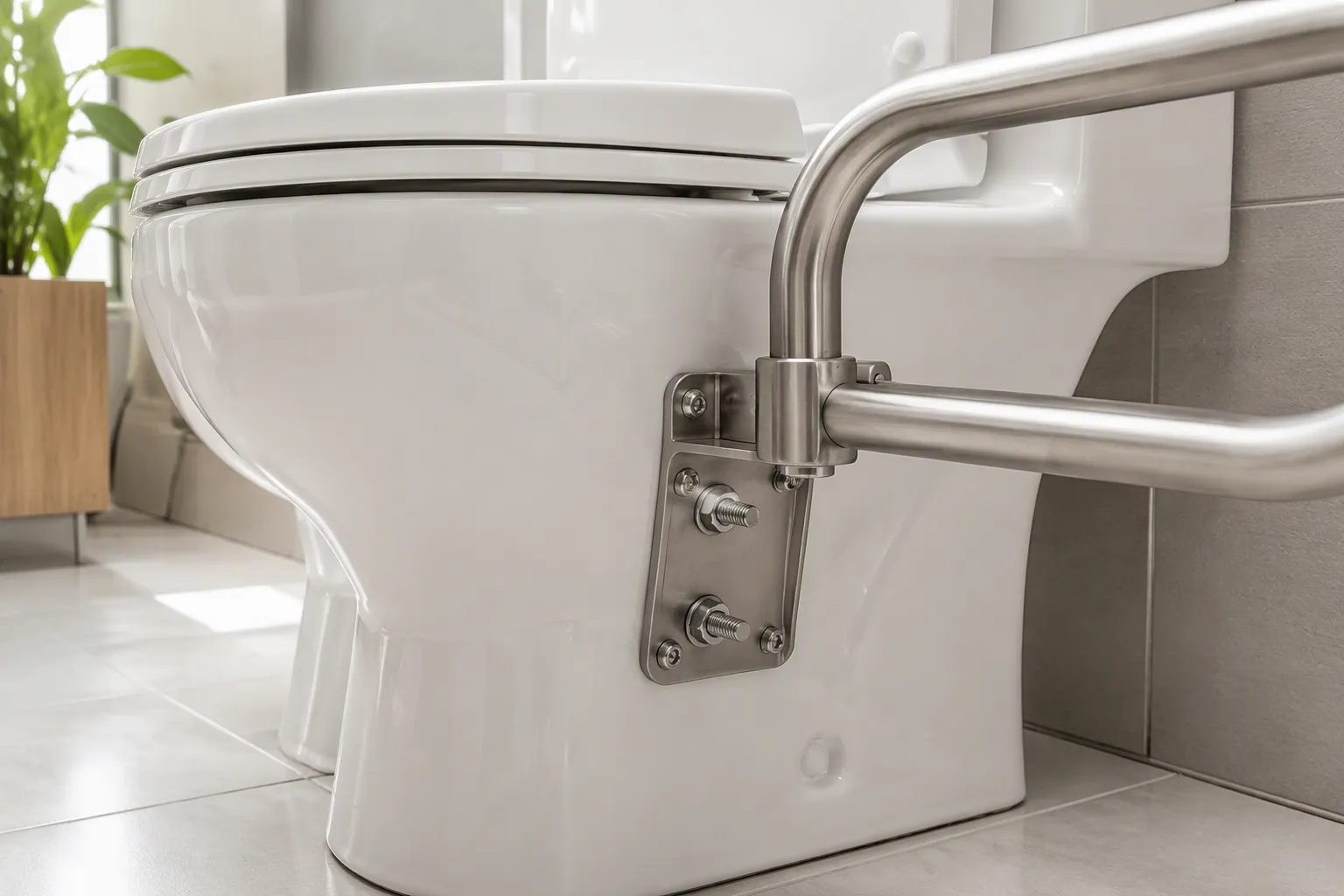
No, toilet safety rails do not put too much force on toilet bolts when properly installed. Most toilet safety rail designs transfer the user’s weight to the floor or the seat mounting points, not directly to the bolts. Problems only arise from poor installation, worn bolts, or the wrong rail type for the toilet. A toilet safety rail installed with the right setup is a safe addition, not a risk to the fixture. A raised toilet seat with handles offers similar support, and both options keep the toilet safety benefit intact.
How Force Travels From Rails to Bolts
A toilet safety rail adds a layer of security to the bathroom routine. Understanding the physics behind these devices helps users see why they work safely. The path that force takes from the rail to the fixture determines whether the hardware experiences stress or relief.
Vertical Load vs. Lateral Load
Force arrives at a toilet in two primary directions. Each direction affects the fixture differently. The distinction matters for anyone concerned about hardware longevity.
What Vertical Load Means for the Toilet
Vertical load pushes straight down. A person sitting on the toilet seat generates this type of force. The seat, bowl, and floor all share this downward push. Toilet safety rails that mount to the floor redirect vertical load away from the fixture entirely. The floor absorbs the force, and the toilet experiences minimal stress. Even rail designs that attach to the seat rely on the seat’s existing weight-bearing capacity. The vertical component of a user’s weight rarely challenges the mounting hardware.
Why Lateral (Tipping) Force Matters More
Lateral force pushes sideways or pulls at an angle. This type of force creates leverage on the mounting points. A person who grabs the rail and leans to one side generates lateral load. The rail acts as a lever arm, and the bolts become the fulcrum. This tipping force places far more stress on the connection points than vertical load alone. The longer the lever arm, the greater the force at the base. A rail that extends far from the toilet amplifies lateral forces. Users who pull themselves up with a sideways motion create the most demanding scenario for the hardware.
Where the Weight Actually Goes
The destination of the user’s weight depends on the rail design. Different mounting strategies send force along different paths. Knowing these paths helps users choose the right product for their situation.
Floor-Mounted Rails That Bypass the Toilet
Floor-mounted rails stand independently of the toilet. These frames have their own legs that rest directly on the bathroom floor. The user’s weight travels through the rail frame and into the floor. The toilet itself carries none of the load. This design offers the greatest protection for the fixture’s mounting hardware. The bolts experience no added stress from the rail because the rail never connects to them. Freestanding frames work well for users who want maximum stability without touching the toilet’s structural components.
Toilet-Mounted Rails and the Flange Connection
Toilet-mounted rails attach directly to the fixture. Some clamp onto the seat mounting area. Others bolt through the same holes that hold the toilet to the floor. These rails transfer force to the flange connection at the base. The flange is the metal or plastic ring that secures the toilet to the floor drain. When weight is applied to a toilet-mounted rail, the force travels through the rail, into the mounting points, and down to the flange. The bolts that hold the toilet to the flange must resist this added load. Quality installation ensures the flange and bolts handle this force without issue.
Why the Bolts Are Stronger Than They Look
Toilet bolts appear small and unassuming. Their actual strength comes from the system they form with the flange and the toilet base. This system distributes force across multiple components.
The Role of the Floor Flange
The floor flange anchors the entire toilet assembly. This ring sits atop the floor and connects to the drain pipe below. The flange provides a solid mounting surface for the bolts. When a toilet safety rail transfers force to the bolts, the flange absorbs and spreads that force into the floor structure. A properly secured flange creates a rigid foundation. The bolts bolt tightly onto the porcelain base and thread into the flange below. This connection creates a clamp that holds the toilet firmly in place. The flange’s broad contact area with the floor prevents concentrated stress points.
How Bolts Share the Load With the Base
Two bolts typically secure a toilet to the flange. These bolts work as a pair. When force pushes down on one side of the toilet, the bolt on that side experiences tension while the other bolt experiences compression. The porcelain base between them acts as a stiff spacer. This arrangement creates a moment-resisting connection. The bolts do not carry the entire load alone. The porcelain base, the flange, and the floor all participate in resisting force. Raised seats bolt tightly to the same mounting points and follow the same principles. The combined strength of these components far exceeds the demands of normal rail use. This shared load path explains why properly installed rails rarely cause problems.
When Toilet Safety Rails Put the Most Stress on Bolts
Not every movement places equal demand on the mounting hardware. Certain actions generate far more stress than others. Users who understand these high-stress moments can adjust their habits and protect their fixture.
Standing Up vs. Sitting Down
The transition from sitting to standing creates the most demanding load scenario. Sitting down generates mostly vertical force, which the toilet handles well. Standing up involves a complex motion that combines vertical and lateral components.
The Push-Off Moment
A user pushes down on the rail to rise. This push rarely travels straight down. The force arcs forward and outward as body weight shifts from seated to standing. This motion produces a lateral component that travels through the bowl’s mounting bolts and into the floor. The mounting bolt assembly was engineered primarily for vertical seated loads, not for repeated multi-directional lateral cycles from daily arm-assisted transfers. Manufacturers rate their products for static capacity under controlled conditions. Long-term bolt performance under off-center loading falls outside those tested parameters. A raised toilet seat with handles follows the same force path during this push-off moment.
Side-to-Side Shifting
Users sometimes shift their weight from one side to the other while seated. This movement creates alternating tension and compression on the bolts. The toilet safety rail acts as a lever, and the bolts become the pivot point. Repeated side-to-side motion works the bolts loose over time. This shifting motion places more cumulative wear on the hardware than steady downward pressure.
Off-Center and Pulling Forces
Forces that arrive at an angle or from a distance create the greatest leverage on the mounting points. These off-center loads challenge the bolts more than centered weight.
Reaching and Leaning Forward
A user who reaches for toilet paper or leans forward to grab a nearby surface shifts weight away from the center of the toilet. This forward lean creates upper body leverage against the rail. The bolts on the front side of the flange experience increased tension. A toilet seat with handles offers a stable grip point for this forward reach, which reduces the need to lean far from center.
Pulling the Rail Toward You
Some users pull on the rail rather than push. This pulling motion creates standing leverage that directs force away from the toilet base. The bolts must resist this outward pull. Floor-mounted rails bypass this problem entirely because they anchor to the floor at multiple points around the bowl. Users who rely on pulling motions benefit most from a freestanding frame that keeps force off the toilet. Proper support from a well-matched rail reduces the temptation to pull at awkward angles.
Factors That Affect Bolt Stress
The mounting bolts on a toilet face different levels of demand depending on several variables. Material quality, installation technique, fixture design, and floor construction all influence how much stress the hardware must absorb. Users who understand these factors can make informed choices about their bathroom setup.
Bolt Quality and Condition
The material and condition of the mounting bolts determine their ability to resist repeated loading. A toilet safety rail adds force to these bolts during every use. Bolts in good condition handle this added demand without difficulty. Worn or low-quality bolts may fail under the same conditions.
Brass vs. Plastic Bolts
Brass and plastic represent the two most common bolt materials in residential toilets. Each material offers distinct advantages and drawbacks. Their performance under stress differs significantly.
Brass bolts provide substantial tensile strength and resist deformation under load. A brass bolt delivers roughly 380 MPa of tensile strength. Plastic bolts offer only about 50 MPa under the same measure. This difference means brass bolts tolerate far more force before failing. Brass also handles humidity well, lasting 15 or more years in typical bathroom conditions. Plastic bolts tolerate humidity for only 3 to 5 years before degrading.
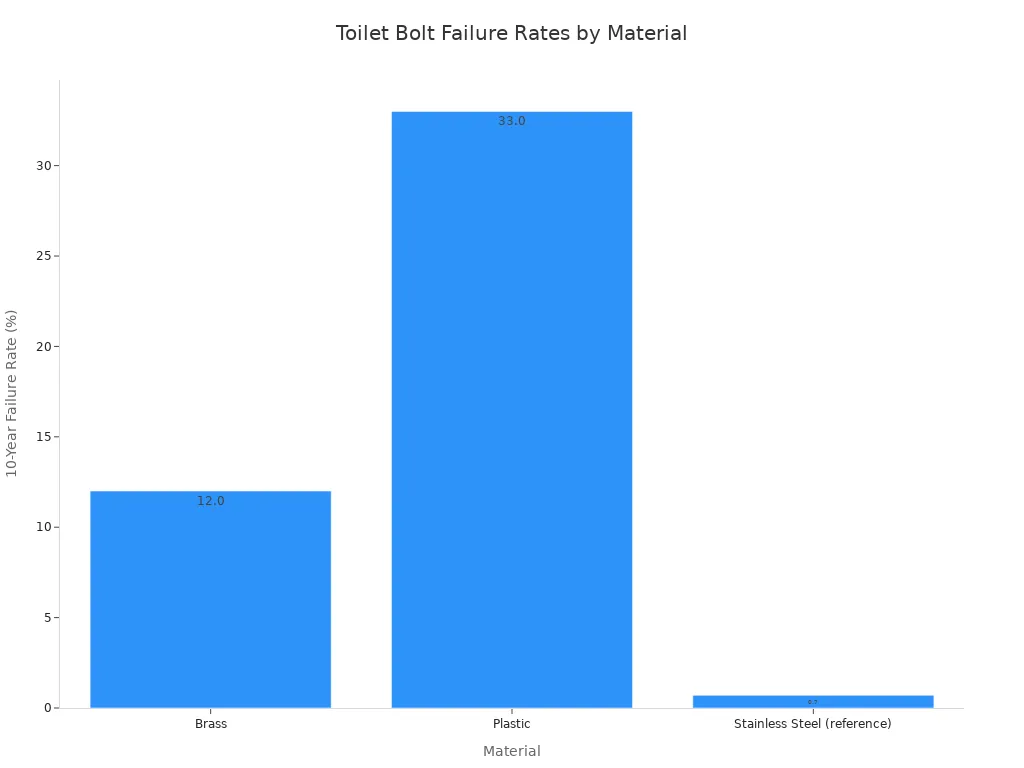
| Material | 10-Year Failure Rate | Average Lifespan | Primary Failure Mode |
|---|---|---|---|
| Brass | ~12% | 8–12 years | Stress fractures |
| Plastic | ~33% (nearly one-third) | Cracks form in under 18 months under >50 lbs twisting force | Cracking under prolonged stress |
| Stainless Steel (reference) | ~0.7% | 15+ years | Thread wear |
The failure rates tell a clear story. Nearly one-third of plastic bolts fail within ten years. Brass bolts fail at about 12 percent over the same period. Stainless steel bolts, though less common in residential settings, fail at less than 1 percent. Plastic bolts crack quickly under twisting force, which makes them a poor choice for any toilet that will carry a safety rail.
| Property | Brass | Plastic |
|---|---|---|
| Tensile Strength | 380 MPa | 50 MPa |
| Humidity Tolerance | 15+ years | 3–5 years |
| Corrosion Resistance | Moderate (copper-zinc patina weakens in acidic cleaners) | None — cracks instead of rusting |
Brass holds roughly 7.6 times the tensile strength of plastic. This gap explains why plastic bolts fail so much more often. A safety rail concentrates force on the mounting points. Plastic bolts cannot reliably handle that concentration over many years.
Rust, Corrosion, and Age
Even quality bolts degrade over time. Brass bolts resist rust but remain vulnerable to certain conditions. Hard water accelerates brass degradation. The Water Quality Association notes that brass loses zinc at roughly three times the normal rate in hard water. This loss weakens the bolt from the inside. Acidic bathroom cleaners also attack the copper-zinc structure of brass. The resulting patina may look harmless, but it signals material loss.
Plastic bolts do not rust. They crack instead. Ultraviolet light, heat cycles, and repeated stress all shorten the life of plastic hardware. A plastic bolt that looks fine on the surface may harbor internal cracks. These cracks grow with each loading cycle. The bolt may fail without warning.
Age affects every material. Bolts that have served for a decade or more deserve inspection. Rust stains, white powdery deposits, or visible cracks all indicate replacement is due. Users who plan to add a safety rail should replace old bolts first. New hardware costs little and provides a known starting point.
Installation Quality
Even strong bolts perform poorly when installed incorrectly. The quality of installation determines whether the mounting system shares force evenly or concentrates it on a single point. Careful installation protects both the fixture and the user.
Tightness and Washer Use
Proper bolt tension matters more than many installers realize. A bolt that is too loose allows the toilet base to shift. Movement works the bolt against the flange and enlarges the mounting hole. A bolt that is too tight crushes the porcelain or strips the threads. Either extreme weakens the connection.
Washers play a critical role in load distribution. A metal washer spreads bolt pressure across a wider area of the porcelain base. This wider contact area reduces the chance of cracking. Rubber washers add a sealing function and cushion the connection against vibration. Installers should use the washers supplied by the manufacturer. Mixing hardware from different kits can create uneven pressure.
The correct tightness allows the toilet to sit firmly without crushing the base. A torque wrench provides the most reliable result. Most manufacturers specify a target torque value in their instructions. Following that value prevents both under-tightening and over-tightening.
Proper Alignment With the Flange
The flange and the toilet base must align precisely. A misaligned toilet places uneven stress on the bolts from the start. One bolt may carry most of the load while the other sits nearly loose. This imbalance grows worse over time.
Installers should set the toilet straight onto the flange bolts before tightening anything. The bolt holes in the base should line up with the slots in the flange. Forcing a misaligned toilet into place stresses the porcelain and the bolts. A wax ring that sits off-center also allows the toilet to rock. Rocking motion transfers directly to the bolts.
Proper alignment also means the flange sits flush with the finished floor. A flange that sits too high or too low creates a gap under the toilet base. That gap allows flex with every use. Flexing motion fatigues the bolts and the porcelain over months of use.
Toilet Type and Floor Material
The design of the toilet and the material beneath it both affect how force reaches the bolts. Some fixtures handle added load better than others. Floor construction determines how well the mounting system absorbs and spreads force.
Floor-Mounted vs. Wall-Mounted Toilets
Floor-mounted toilets anchor through a flange at the base. This design provides a direct path for force to travel into the floor. The bolts, flange, and floor form a stable system. A safety rail that mounts to a floor-anchored toilet sends force through this established path. The system handles the load well when the hardware is sound.
Wall-mounted toilets hang from a carrier frame inside the wall. The bowl attaches to the wall, and the floor beneath stays clear. These fixtures do not use floor bolts in the traditional sense. A safety rail that clamps to a wall-mounted bowl transfers force to the wall carrier. The carrier is engineered for the bowl’s weight and normal use. Adding a rail changes the load pattern in ways the carrier may not have been designed to handle. Users with wall-mounted toilets should consult the manufacturer before adding any rail. A floor-mounted frame often suits these installations better.
Tile, Concrete, and Wood Subfloors
The subfloor beneath the tile determines how well the flange anchors. Concrete subfloors provide the most rigid base. A flange bolted into concrete resists movement and spreads force effectively. Tile over concrete performs nearly as well. The tile itself may crack under concentrated pressure, but the flange connection stays solid.
Wood subfloors flex under load. A flange mounted to wood moves slightly with every use. This movement transfers to the bolts and works them loose over time. Older homes with wood subfloors may need reinforcement around the flange. A flange repair ring adds stability and spreads force across a wider area.
Tile over wood combines the flex of wood with the brittleness of tile. The tile may crack around the flange if the wood beneath it moves. A safety rail adds load that can accelerate this process. Homeowners with this floor type should check for soft spots or movement before installing a rail. Any flex in the floor signals a need for reinforcement.
User Weight and Use Patterns
The person using the rail and the frequency of that use both shape the demands placed on the mounting hardware. A heavier user generates more force with every movement. Frequent use multiplies that force over time. These two variables interact in ways that matter for long-term fixture health.
How Weight Is Transferred Through the Rail
A user’s body weight does not arrive at the toilet bolts as a single, steady push. The weight travels through the rail in a dynamic pattern. Each movement redirects the force along a different path. A person who grips the rail and rises shifts weight from the seat to the rail and then to the floor or the mounting points. This transfer happens quickly, and the bolts experience a spike in load during the transition.
The rail acts as a lever arm during this transfer. A longer rail creates more leverage at the mounting points. A shorter rail keeps force closer to the base. The angle of the user’s grip also matters. A firm grip near the mounting point sends force more directly into the flange. A grip at the far end of the rail amplifies the load through the lever effect.
Manufacturers publish weight capacity ratings for their products. These ratings provide a useful starting point for matching a rail to the user. Most toilet safety rails on the market carry a capacity of 300 lbs (136 kg). Some minimal designs rate lower, at 250 lbs (113 kg). Raised seats with handles typically fall in the 250 to 300 lb range. A freestanding frame rated at 300 lbs keeps that entire load off the toilet fixture.
| Product | Category | Weight Capacity |
|---|---|---|
| Vaunn Deluxe Bathroom Safety Toilet Rail | Best overall | 300 lbs (136 kg) |
| Vive Health Stand Alone Toilet Rail | Best freestanding | 300 lbs (136 kg) |
| Moen Home Care Glacier Toilet Safety Bar | Best minimal | 250 lbs (113 kg) |
| Carex Toilet Safety Frame | Best adjustable | 300 lbs (136 kg) |
| Vive Health Toilet Safety Rail | Best portable | 300 lbs (136 kg) |
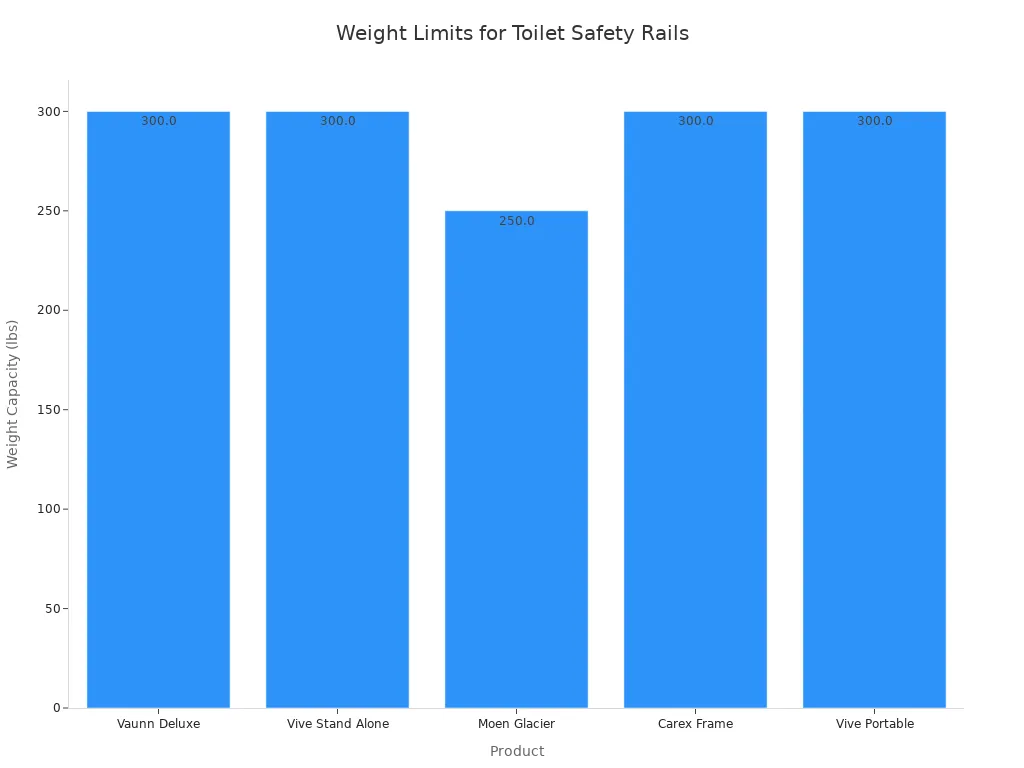
A user who weighs close to the rated capacity places more demand on the hardware than a lighter user. The margin between the user’s weight and the rated capacity provides a buffer. A 300 lb rail used by a 150 lb person has a wide safety margin. The same rail used by a 280 lb person operates closer to its limit. Users near the top of a rail’s rating should inspect their hardware more often.
High-Use vs. Occasional Use
Frequency of use determines how quickly wear accumulates on the mounting bolts. A toilet in a busy household serves multiple users throughout the day. Each use adds a cycle of loading and unloading to the bolts. A guest bathroom sees far fewer cycles. The difference in cumulative stress can be substantial over months and years.
High-use bathrooms may generate dozens of loading cycles each day. A household with an elderly family member who needs rail support for every bathroom visit creates a steady stream of force on the mounting points. The bolts experience repeated tension and compression. Small amounts of movement can enlarge the mounting holes over time. Regular inspection becomes essential in these settings.
Occasional use places far less cumulative demand on the hardware. A rail used by a visitor or a part-time resident may see only a few cycles per week. The bolts have time to settle between uses. Wear accumulates slowly. Occasional-use installations still need proper hardware and correct installation, but the inspection interval can stretch longer.
The pattern of use also matters. A user who grips the rail firmly and moves smoothly generates less stress than a user who jerks or pulls at awkward angles. Smooth, controlled movements distribute force more evenly. Sudden movements concentrate force on a single bolt or a single point on the flange. Users who can practice controlled transfers reduce the wear on their equipment.
Households with multiple users of different sizes and abilities face a mixed pattern. Each person grips the rail differently and moves with different timing. This variety spreads stress across the hardware in unpredictable ways. Regular checks catch any loosening before it becomes a problem. A simple monthly wiggle test on the rail and a visual check of the bolts provide good protection.
Choosing Toilet Safety Rails That Protect Your Toilet
The right rail protects both the user and the fixture. Selection depends on the mounting style, the toilet’s design, and the user’s needs.
Stand-Alone and Floor-Mounted Frames
Freestanding frames offer the strongest protection for toilet bolts. These units never touch the fixture, so the mounting hardware carries no added load.
When a Freestanding Frame Is the Best Fit
A freestanding frame suits users who need firm, two-handed support. It also works well for wall-mounted toilets and for fixtures with older hardware. Households with multiple users of different sizes benefit from this design.
How They Keep Force Off the Toilet Entirely
Free-standing toilet frames are independent units that sit around the toilet and are not physically attached to it. They typically have four legs with non-slip feet for stability. The user’s weight travels through the frame and into the floor.
Full-frame designs typically carry higher weight capacities because the load is distributed across a larger, floor-anchored structure rather than concentrated at two bolt points on a toilet seat.
Toilet-Mounted Rails
Clamp-on and bolt-on rails attach directly to the fixture. They offer a compact footprint and a familiar feel for many users.
Best Uses for Clamp-On and Bolt-On Rails
Clamp-on models fit most standard toilets and install without drilling. Bolt-on rails use the existing flange bolts for a firmer connection. Both styles suit users who want support close to the bowl. A toilet seat with handles follows a similar mounting logic and provides a simple alternative.
Checking Weight Ratings Before Buying
Consumers should avoid purchasing a toilet safety rail whose weight capacity is close to the user’s actual weight. A minimum capacity of 250 lbs is recommended, and for heavier users, heavy-duty rails rated for 300 lbs, 350 lbs, or even 500 lbs are available. A higher weight capacity is associated with greater perceived and actual stability.
| Product | Weight Capacity |
|---|---|
| Medline Toilet Support Frame | 250 lbs (not recommended for full weight bearing) |
| Drive Medical Stand Alone Toilet Safety Rail | 300 lbs |
| Vive Toilet Safety Frame | 300 lbs |
| Carex Safety Rails | 300 lbs |
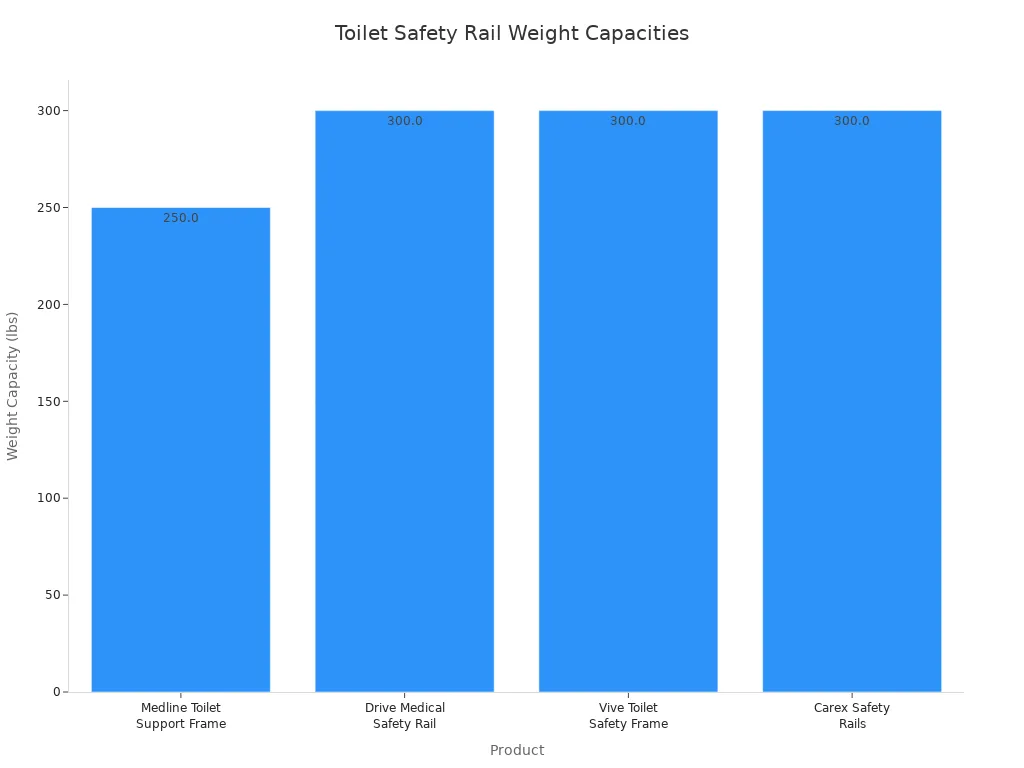
Shoppers should also note specific models. The Rise-Up Toilet Rail by Vive Health supports up to 450 lbs without wobbling. The Vaunn Medical Height Adjustable Toilet Rail holds up to 300 lbs. Whatever the material, check the weight rating and look for cracks or wear before use.
Matching the Rail to the Toilet
Fit determines how well a rail performs. A mismatched rail creates wobble and concentrates force on the bolts.
Fit Considerations for One-Piece and Two-Piece Toilets
Two-piece toilets have a visible seam between the tank and bowl. Most clamp-on rails fit these models without issue. One-piece toilets feature a seamless shell and often a lower profile. Buyers should confirm the rail’s clamp width matches the bowl shape.
Clearance and Seat Compatibility
A raised toilet seat with handles must clear the tank and nearby walls. The rail should leave room for the seat to close fully. Users should measure the space around the bowl before purchase. Proper clearance keeps the rail stable and prevents awkward reaching.
Safe Installation Step by Step

A careful installation protects both the user and the fixture. The process begins with a thorough inspection. It ends with hardware that holds the toilet securely in place.
Inspecting Before You Install
Installers should examine the existing hardware before adding any new equipment. This step reveals problems that could worsen under added load.
Checking Existing Bolts and the Flange
The installer removes the decorative caps and inspects each bolt. Rust, white mineral deposits, or visible cracks signal a need for replacement. The flange deserves the same attention. A flange with cracks or missing sections cannot anchor the bolts properly. New bolts cost little and provide a known starting point. Brass or stainless steel bolts offer the best durability for a toilet that will carry rails.
Spotting Cracks or Wobble
The installer should rock the bowl gently by hand. Any movement means the base doesn’t shift freely on a sound connection. Cracks in the porcelain near the bolt holes demand immediate attention. Soft spots in the floor around the flange also indicate trouble. A wobbling toilet needs repair before any rail goes on.
Installing for Even Force Distribution
Even force distribution depends on careful technique. The installer should treat every step as part of one system.
Following the Manufacturer’s Instructions
Each product ships with specific guidance for its mounting style. The installer should read those instructions fully before starting. Torque values, washer placement, and clamp positions all vary between models. Following the manufacturer’s sequence prevents uneven stress on the mounting points.
Tightening Without Over-Torquing
The installer tightens each bolt gradually in an alternating pattern. This approach keeps the base level and spreads pressure evenly. A torque wrench provides the most reliable result. Over-tightening crushes the porcelain and strips threads. Under-tightening allows movement that enlarges the mounting holes. The correct tension holds the fixture firm without damage.
When to Call a Professional
Some conditions exceed the scope of a routine installation. A professional evaluation protects the fixture and the user.
Damaged Flanges or Soft Floors
A cracked flange or a soft subfloor requires repair before installation. A plumber can replace a broken flange and reinforce the floor around it. These repairs create a stable base for any safety support. Skipping this step invites failure under load.
Wall-Mounted Toilet Installations
Wall-mounted toilets hang from a carrier frame inside the wall. The installer cannot inspect that frame easily. A professional can assess the carrier’s capacity and recommend the right approach. A freestanding frame often suits these fixtures best. It keeps force off the wall carrier entirely.
Maintenance Habits That Prevent Problems
A few simple habits keep a toilet safety rail secure and the mounting hardware sound. Regular attention catches small issues before they become expensive repairs.
Regular Bolt Checks
How Often to Inspect
A homeowner should check the bolts monthly in a busy bathroom. A guest bathroom needs a check every few months. A quick wiggle test on the rail reveals looseness right away. The user then inspects the bolt heads for movement or gaps under the washers.
Signs of Loosening or Wear
Rust stains, white mineral deposits, and visible cracks all signal trouble. A rail that shifts slightly during use also points to loose hardware. The user should tighten any loose bolt gradually and watch for repeat loosening. Repeated loosening often means the bolt or flange needs replacement.
Keeping Hardware Dry and Clean
Managing Moisture in the Bathroom
Moisture speeds corrosion on any metal bolt. A homeowner can run the exhaust fan during showers and wipe up standing water near the base. Properly installed bolts keep water from seeping around them. During routine cleaning, the user should inspect for toilet wobble or leak signs. A simple annual check of the bolt heads for rust or wear catches problems early.
Replacing Worn Parts Early
A rusted bolt will keep wearing down even after the surrounding area looks clean. Cleaning alone does not stop this process. A qualified maintenance professional should replace damaged metal parts with compatible components. Corrosion-resistant options include solid brass, stainless steel, or plastic, depending on the part. Many modern fill and flush valves use plastic bodies that will not rust.
Knowing When to Upgrade
Switching to Stronger Bolts
Plastic bolts crack under repeated stress. Brass or stainless steel bolts resist moisture and last far longer. A homeowner who plans to add rails or handles should upgrade the bolts first. This small investment protects the fixture for years.
Moving to a Floor-Mounted Rail
A toilet-mounted rail sends force through the bolts with every use. A freestanding frame keeps that force off the fixture entirely. Users who need firm, two-handed support benefit most from this switch. The safety benefit grows while the stress on the toilet drops to zero.
Weighing the Real Risks of Toilet Safety Rails
What Can Actually Go Wrong
Loose Bolts and Wobble
Loose bolts represent the most common issue with any toilet safety rail. Repeated loading gradually works the mounting hardware free. A wobbling rail signals that the bolts have lost tension. Worn rubber tips on freestanding frames also reduce grip and allow movement. Loose mounting hardware compromises frame security over time. Users should treat safety equipment as requiring periodic inspection, maintenance, and replacement like any assistive device.
Rare Cases of Flange Damage
Flange damage occurs far less often than loose bolts. A cracked or broken flange typically results from years of neglect or a pre-existing defect. Heavy lateral force on a toilet-mounted rail can accelerate wear on an already weakened flange. Soft subfloors contribute to this problem by allowing movement beneath the fixture. These cases remain uncommon when the hardware starts in good condition.
Why Properly Installed Rails Remain Safe
The Safety Benefit Outweighs the Risk
Standing up is where most toilet-related falls occur. A toilet safety rail provides a stable grip point during this vulnerable moment. The fall-prevention benefit far exceeds the small, manageable risk to the fixture. Users who skip rails because the seat alone feels adequate face a greater danger than any bolt stress. A toilet seat with handles offers similar protection for users who prefer a simpler setup.
Simple Precautions That Eliminate Concerns
A few practical habits address nearly every risk associated with toilet safety rails. Users can follow these steps to protect their fixture and themselves:
- Avoid the cheapest option, which often has unreliable feet, weak hinges, and seats that crack; choose secure locking-clamp designs over unlocked clip-on seats.
- Set the rail width so the user’s arms naturally fall on the handles when seated; too wide forces reaching, and too narrow removes leverage.
- Add a wall grab bar next to the toilet as the most important supplement to a raised seat plus rails.
- Choose floor-mounted or toilet-bolt-mounted rails for users who bear significant body weight, since clamp-on rails can shift under hard pushing.
- Perform a simple 5-minute inspection regularly to catch wobble, worn tips, or loose hardware early.
These precautions deliver reliable stability and keep the toilet bolts well within their capacity. Properly installed rails remain a safe, dependable addition to any bathroom.
Properly installed toilet safety rails do not overload toilet bolts. Quality bolts, correct installation, the right rail type, and routine checks form the core safeguards. The fall-prevention benefit of a rail far outweighs the small, manageable risk to the fixture. Readers should inspect their setup and choose a rail matched to their toilet and needs. This approach delivers dependable toilet safety and lasting support for every user.
FAQ
Do toilet safety rails really put stress on the mounting bolts?
A properly installed rail transfers most force to the floor or seat mounting points. The bolts carry only a small share of the load. Poor installation or worn hardware causes problems, not the rail design itself.
How much weight can toilet bolts safely hold?
Standard brass bolts handle several hundred pounds of static load when the flange is sound. Most rails rate for 250 to 300 lbs. Users near the top of that range should inspect hardware more often.
Will a safety rail loosen the bolts over time?
Repeated loading can work bolts loose gradually. Monthly wiggle tests catch this early. Tightening loose bolts promptly prevents mounting hole damage and keeps the rail secure.
Should I replace my bolts before installing a rail?
Yes. Old plastic or corroded bolts crack under added stress. Brass or stainless steel bolts cost little and provide a known starting point. Inspect the flange at the same time.
Are floor-mounted rails better for the toilet?
Freestanding frames keep all user weight off the fixture. They suit wall-mounted toilets and older hardware especially well. Toilet-mounted rails work fine when the bolts and flange are in good condition.
Can a rail crack the toilet base or flange?
Rarely, and usually only when pre-existing damage exists. A cracked flange or soft subfloor allows movement that concentrates force. Repair these issues before installing any rail.
How often should I check the rail and bolts?
Check monthly in busy bathrooms and every few months in guest bathrooms. Look for wobble, rust, or gaps under washers. Repeated loosening signals a need for new hardware.
Does a rail increase fall risk instead of reducing it?
No. A stable rail provides a firm grip during standing, when most bathroom falls occur. Proper installation and routine checks keep the rail dependable. The fall-prevention benefit far outweighs fixture concerns.