
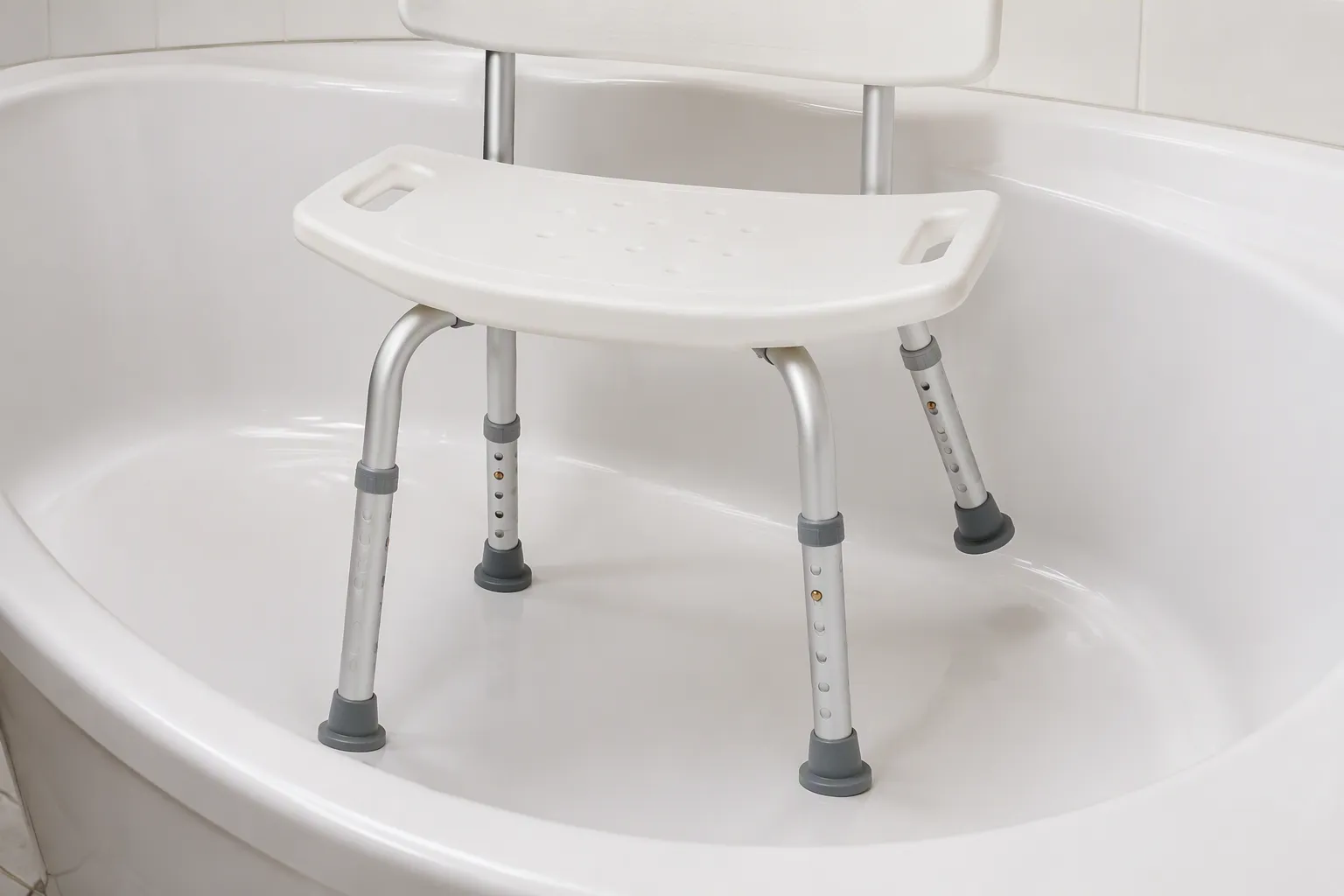
Shower chair feet sit unevenly because bathtub floors curve while most chair feet suit flat surfaces. The tub slopes toward the drain. No single flat plane exists for all four feet to rest on. Rounded corners and edges leave some feet hanging or floating. Shower chair feet sit unevenly for this reason. This uneven contact is a shape mismatch, not a defect in the shower chair or the tub.
Your Bathtub Floor Is Not Flat
A bathtub looks like a simple basin. The surface appears level at a glance. This appearance misleads many people. The tub floor actually contains multiple curves and angles. Each curve changes how a shower chair foot makes contact with the surface. Understanding these shapes explains why the feet rarely sit evenly.
The Slope Toward the Drain
Water needs to leave the tub after every shower. Gravity pulls water toward the drain. The tub floor must guide water in that direction. This need shapes the entire floor design.
Why Tubs Are Built With a Slope
Manufacturers build every bathtub with a gentle slope toward the drain. This slope allows water to flow out without pooling. Standing water creates mold, mildew, and slippery surfaces. A sloped floor prevents these problems. The slope is intentional and necessary. It serves a clear functional purpose. The same design that helps water drain creates problems for shower chair stability.
The slope gradient varies across tub types. Standard alcove and drop-in tubs typically feature a backrest slope gradient within a comfortable range of 10° to 20°, measured as the angle between the backrest and the vertical plane. This range represents the sweet spot preferred by most homeowners. It balances lumbar support with a relaxed recline. Walk-in tubs use a lower slope of 6° to 10°. This lower slope favors upright posture and safe entry over lounging. Steeper designs exceed 20° and feel like a chaise lounge. These steeper designs work well for soaking but poorly for reading. An upright feel corresponds to roughly 9.5°, or a 1:6 rise-over-run ratio. A relaxed recline corresponds to roughly 14°, or a 1:4 rise-over-run ratio.
| Bathtub Type | Typical Slope Gradient | Notes |
|---|---|---|
| Standard alcove / drop-in tubs | 10°–20° | Sweet spot for most homeowners; supports lumbar and neutral neck |
| Walk-in tubs | 6°–10° | Lower slope favors upright posture and safe entry over lounging |
| Steeper designs | >20° | Feels like a chaise lounge; good for soaking but poor for reading |
| Upright feel (reference) | ~9.5° (1:6 rise-over-run) | Fairly upright backrest angle |
| Relaxed recline (reference) | ~14° (1:4 rise-over-run) | Provides a more relaxed reclining position |
How the Slope Changes Foot Height
A sloped surface creates a height difference across any distance. The drain end of the tub sits lower than the back end. A shower chair placed lengthwise spans this height difference. The front feet rest on a lower point. The back feet rest on a higher point. Each foot needs a different effective leg length to reach the floor. Most shower chairs offer one fixed leg length for all four feet. This fixed length cannot match a sloped surface. One pair of feet touches the floor. The other pair hovers above it. The chair then rocks along the slope direction.
Rounded Corners and Edges
Bathtubs rarely have sharp interior corners. Manufacturers round these corners for comfort and safety. Rounded corners feel better against the body. They also clean more easily. These curves create additional challenges for shower chair feet.
Where the Floor Curves Upward
The tub floor does not meet the walls at a right angle. The surface curves upward near every edge. This curve forms a fillet or radius. The radius transitions the flat floor into the vertical wall. This transition zone occupies several inches near each side. A shower chair foot placed in this zone rests on a curved surface. The curve lifts the outer edge of the foot. Only the inner edge maintains contact. The foot effectively stands on a ramp instead of a flat plane.
Why Corner Feet Lose Contact
Corner feet face the worst conditions. Two curves meet at every corner. The floor curves upward toward both adjacent walls. This double curvature creates a bowl-like shape at each corner. A flat foot cannot match a bowl shape. The foot touches at one small point. The rest of the foot surface floats above the tub. This floating reduces friction and grip. The foot slides easily when weight shifts. Corner feet also sit higher than center feet. This height difference tilts the entire chair.
The Contoured Center
Many modern bathtubs feature contoured floors. These contours add comfort for bathers. They also complicate shower chair placement. The center of the tub often dips below the surrounding surface.
How Some Tubs Dip in the Middle
Ergonomic tub designs include a recessed seating area. This recess cradles the body during soaking. The center of the floor sits lower than the edges. This dip creates a shallow bowl shape. A shower chair placed in the center spans this bowl. The chair legs reach down toward the lowest point. The feet at the bowl’s edge rest on higher ground. The feet near the center rest on lower ground. This height variation across a short distance causes instability.
Why the Chair Rocks Front to Back
A contoured center creates a pivot point. The chair balances on the highest contact points. These points usually sit near the front and back edges of the dip. Weight shifts cause the chair to rock over these points. The chair tips forward when the user leans forward. It tips backward when the user leans back. This front-to-back rocking feels unstable and unpredictable. The user cannot find a secure resting position. Every movement triggers a new wobble.
The combination of slope, rounded corners, and contoured centers creates a complex surface. No flat shower chair frame can match this geometry. The next section explains why shower chair feet themselves contribute to the problem.
Your Shower Chair Feet Are Built for Flat Ground
Shower chair manufacturers design their products for flat bathroom floors. This design assumption works well in a walk-in shower with a level tile base. It fails inside a bathtub. The curved tub floor and the flat chair frame create an immediate conflict. Understanding how chair feet behave on curved surfaces reveals why stability becomes so difficult to achieve.
Flat Feet on a Curved Surface
A flat foot pad assumes a flat floor beneath it. This assumption holds true on most bathroom floors. A bathtub floor breaks this assumption immediately. The curved surface interacts with the flat foot in ways that reduce stability.
Why Flat Feet Only Touch at One Point
A flat disc pressed against a curved surface touches at a single point. Geometry dictates this outcome. Two surfaces with different curvatures cannot meet along their full areas. The flat foot pad has zero curvature. The tub floor has positive curvature. These two shapes intersect at one location only.
This single contact point carries the entire load for that leg. The rest of the foot pad hovers above the tub surface. A visible gap appears around the edges of the pad. This gap grows larger as the tub curvature increases. A foot placed near a rounded corner shows the largest gap. A foot placed near the center shows a smaller gap. No placement eliminates the gap entirely.
The contact point also shifts as the chair moves. Weight changes and small adjustments cause the contact point to migrate across the foot pad. This shifting contact creates unpredictable behavior. The chair never feels fully settled.
What Happens to the Other Three Feet
The first foot establishes a contact point on the curved surface. The remaining three feet must now find their own contact points. Each foot encounters a different part of the tub floor. The floor height varies across the tub. The floor curvature varies across the tub. Each foot therefore sits at a different effective height.
One foot might touch firmly while another hovers above the surface. A third foot might touch lightly with minimal pressure. The fourth foot might rest on a steeply curved section. This uneven distribution means the chair legs will sit flat only by coincidence. That coincidence rarely occurs in a real bathtub.
The result is a chair that contacts the tub at three points or fewer. Three points define a plane. A chair with only three contact points can still feel stable in one position. Any weight shift changes the geometry. The chair then rocks onto a different set of contact points. This rocking motion repeats with every movement.
Suction Cups and Their Limits
Many shower chairs include suction cups on their feet. These cups promise secure attachment to the tub floor. Suction cups work well under specific conditions. Curved tub surfaces violate those conditions.
Why Suction Cups Need a Smooth Flat Spot
A suction cup creates holding force through a vacuum seal. The cup presses against a surface and expels air from beneath. Atmospheric pressure then holds the cup in place. This mechanism requires a complete seal around the cup’s perimeter. Any gap in the seal allows air to enter. Air entry destroys the vacuum and releases the cup.
A smooth, flat, non-porous surface provides the ideal sealing condition. Glass, polished metal, and smooth plastic all work well. These materials allow the cup’s lip to conform perfectly to the surface. The seal remains intact under load.
Flat vacuum cups perform best on flat or slightly curved surfaces such as metal, glass plates, plastic sheets, and wooden boards. These cups offer good rigidity and stability. They handle high shear forces and withstand fast automated-handling forces and accelerations. Their rigid design does not adapt to significant curvature.
How Curvature Breaks the Seal
A curved tub floor prevents the suction cup lip from making full contact. The cup’s circular lip meets the curved surface at limited points. Gaps appear between the lip and the tub floor. Air flows through these gaps and into the space beneath the cup. The vacuum never forms or quickly fails.
Bellows suction cups offer better performance on uneven surfaces and curved parts. Their accordion-like convolutions compensate for varying workpiece heights. Evacuating the bellows creates a lifting action useful for lightly gripping fragile parts. These cups adapt to curved surfaces through flexible segments. However, most shower chairs use flat suction cups rather than bellows designs.
Flat suction cups provide the highest theoretical holding force on clean, flat surfaces. Their grip strength drops dramatically on curved surfaces. The same cup that holds firmly to a tile floor may slide freely on a curved tub floor. This performance gap explains why suction cups often fail inside bathtubs.
Small Feet, Big Gaps
Shower chair feet typically measure only one to two inches across. This small size amplifies every stability problem. Larger feet would distribute weight over a wider area. Small feet concentrate force at tiny contact points.
How Small Surface Area Makes Wobble Worse
A small foot pad creates a small contact area. This limited contact area provides minimal friction. Friction resists sliding and shifting. Without sufficient friction, the chair moves easily across the tub surface.
Small feet also amplify the effects of surface irregularities. A tiny bump under a large foot causes minimal tilt. The same bump under a small foot causes significant tilt. Tub floors contain many small irregularities. These irregularities include texture patterns, manufacturing variations, and wear marks. Each irregularity affects a small foot more than a large one.
The relationship between foot size and stability follows a simple principle. Doubling the foot diameter quadruples the contact area. Quadrupling the contact area dramatically improves grip and weight distribution. Most shower chairs use small feet for cost and weight reasons. This design choice sacrifices stability on curved surfaces.
Why Thin Legs Sink or Slide on Slopes
Thin chair legs concentrate the user’s weight onto small points. High pressure at each contact point can dent soft tub materials. Acrylic and fiberglass tubs are particularly vulnerable. These materials soften when warm water raises their temperature. A thin leg pressing into warm acrylic creates a permanent dent.
Thin legs also slide more easily on sloped surfaces. The slope toward the drain creates a constant downward force component. Thin legs offer little resistance to this force. The chair gradually creeps toward the drain during use. This movement surprises the user and creates instability.
Wider legs with non-slip rubber feet distribute weight better and resist sliding. The rubber compound grips the tub surface. The wider profile reduces pressure at each contact point. These design features improve stability significantly. Users should look for chairs with these features when selecting a product for a curved bathtub.
The combination of flat feet, limited suction cup performance, and small contact areas creates a challenging stability situation. No single feature causes the problem alone. The interaction of all these factors produces the wobble and rocking that users experience. The next section examines why this shape mismatch affects nearly every bathtub installation.
Why Shower Chair Feet Sit Unevenly: The Shape Mismatch
Two Shapes That Do Not Match
A Curved Bowl Versus a Flat Frame
A bathtub forms a curved bowl. Every surface inside this bowl bends and slopes toward the drain. A shower chair forms a flat frame. Its four legs extend downward at fixed angles. These two shapes cannot align properly.
The bowl shape creates height variations across every direction. The flat frame assumes a single level plane beneath it. When a person places a shower chair inside a tub, the frame tries to bridge a curved surface. This geometric conflict makes shower chair feet sit unevenly every time.
Why No Single Foot Height Fits All Spots
Each foot on a shower chair encounters a different floor height. The front left foot might rest on a low point near the drain. The back right foot might rest on a higher slope near the wall. No single leg length can match all these variations simultaneously.
Manufacturers build shower chairs with equal leg lengths. This design works on flat floors. A curved tub surface demands different leg lengths at each corner. The fixed frame cannot provide this flexibility. The chair therefore contacts the tub at only a few points.
Why It Happens in Almost Every Bathtub
Standard Tubs Versus Curved Tubs
Standard rectangular tubs feature flat bottoms with gentle slopes. Curved tubs feature rounded corners and contoured centers. Both designs create problems for shower chair stability. The flat bottom still slopes toward the drain. The curved corners still rise upward near the walls.
Curved tubs amplify the problem. Their deeper contours create larger height differences. A shower chair placed in a curved tub experiences more severe rocking. The feet lose contact more easily on these aggressive curves.
Why Even “Flat” Tubs Have a Slope
A tub floor must drain water after every use. This requirement forces manufacturers to build a slope into every design. Even tubs marketed as “flat bottom” include a subtle gradient. This slope measures only a few degrees. A few degrees across a thirty-inch tub creates a noticeable height difference.
The drain end sits lower than the back end. A shower chair spans this height difference. The feet near the drain sit lower. The feet near the back sit higher. This uneven contact creates the wobble that users feel. No flat frame can overcome this built-in slope.
What Uneven Feet Actually Do
Uneven feet create more than a minor annoyance. They change how the entire shower chair behaves under load. The chair becomes an unstable platform instead of a secure seat. Understanding these effects helps users recognize serious problems before an accident occurs.
The Wobble and Rock
Why the Chair Tips When You Shift Weight
A shower chair with uneven feet balances on a few contact points. These points form a small support base. The user’s center of gravity shifts with every movement. Leaning forward transfers weight to the front feet. Leaning back transfers weight to the rear feet. The chair tips toward whichever direction carries the most weight. This tipping happens suddenly and without warning.
How the Wobble Gets Worse Over Time
The wobble rarely stays constant. Each rocking motion stresses the chair frame and feet. Joints loosen gradually. Rubber pads compress and harden. The contact points shift slightly with every use. These small changes accumulate over weeks and months. A chair that wobbled slightly when new may become dangerously unstable after extended use.
The Safety Risks
Slips and Falls in a Wet Tub
Water makes every surface more dangerous. A wet bathtub floor offers minimal friction. A wobbling shower chair slides easily across this slick surface. The user may lose balance while attempting to sit or stand. Falls inside a bathtub cause serious injuries. Hip fractures, head trauma, and spinal injuries occur frequently in these accidents.
Why a Tipping Chair Is Dangerous
A tipping chair gives no warning before it fails. The user cannot predict which direction the chair will move. This unpredictability prevents the user from compensating. Elderly users and those with limited mobility face the greatest risk. Their reaction times and muscle strength cannot overcome a sudden tip.
The Wear and Tear
Stress on Legs and Joints
Uneven contact concentrates force on specific points. The loaded legs bear more stress than the floating legs. This imbalance accelerates wear on the entire frame. Users should inspect their chairs regularly for signs of damage.
- Test the legs: all legs should sit flat without rocking.
- Look at the feet: rubber tips should grip well and show no cracking.
- Check for movement: give the chair a firm wiggle before use.
- Treat any looseness, corrosion, or unevenness as a serious safety issue.
Damage to the Tub Surface
Uneven feet also damage the bathtub itself. Concentrated pressure from thin legs can crack acrylic or fiberglass surfaces. The constant rocking motion scratches the tub floor over time. These scratches trap soap residue and promote mold growth. Repairing tub damage costs far more than preventing it.
Why This Feels So Frustrating
It Is Not Your Fault
Why Instructions Do Not Mention Curved Tubs
Most shower chair manuals describe flat floor installation. They show diagrams with level surfaces and even contact points. These instructions assume a walk-in shower with a tile base. They ignore the curved interior of a bathtub. Manufacturers write generic guidance for the widest audience. This approach leaves bathtub users without relevant information. A person reading the manual follows every step correctly. The chair still wobbles inside the tub. The instructions simply do not address this scenario.
Why “Universal Fit” Is Misleading
Product labels often claim universal fit. This phrase suggests the shower chair works in any bathroom. The reality differs from this promise. A universal design targets the most common installation environment. Flat floors represent that environment. Curved tub floors fall outside this standard. The term universal fit creates false expectations. Buyers assume the product will work in their specific tub. They discover the mismatch only after purchase.
The Trial and Error Trap
Why Tightening the Legs Does Not Help
Users often try tightening leg connections first. They twist each leg clockwise until it feels secure. This action addresses loose hardware, not surface geometry. The legs remain equal in length after tightening. A curved tub floor still creates height differences between contact points. Tightening cannot change the physical shape of the tub. The wobble persists despite the user’s effort.
Why Moving the Chair Around Rarely Works
Repositioning the shower chair seems like a logical solution. A user might slide the chair toward the center. They might rotate it to a different angle. Each new position changes which part of the tub the feet contact. The slope and curves remain constant across the entire surface. No position offers four perfectly level contact points. The shower chair continues to rock in every location. This repeated failure frustrates users who expect a simple fix.
Simple Ways to Fix Uneven Shower Chair Feet
Adjustable Feet
How Independent Leg Adjustment Works
Independent leg adjustment solves the height mismatch directly. Each leg extends or retracts on its own. A user measures the gap under each foot. The user then turns each leg until the foot touches the tub floor. This process creates four separate contact points. The shower chair no longer balances on two or three feet. Adjustable-height legs compensate for the slope toward the drain. They also handle rounded corners and contoured centers. The user gains full control over every contact point.
What to Look For When Buying
Shoppers should examine several features before purchasing. Look for adjustable height legs with locking collars. These collars prevent the legs from slipping under weight. Check the adjustment range. A range of two to three inches handles most bathtub slopes. Look for non-slip rubber feet with wide pads. Rubber grips wet surfaces better than plastic. Confirm the legs use corrosion-resistant materials. Aluminum and stainless steel resist rust in humid bathrooms.
Curved Adapters and Wedges
How Adapters Match the Tub Curve
Curved adapters fit between the chair feet and the tub floor. These adapters feature a concave shape. The concave surface matches the tub curvature. The flat top surface supports the chair foot. This design converts a curved contact area into a flat one. The shower chair feet then sit flat and stable on the adapter. Manufacturers offer adapters in several radius sizes. Users measure their tub curve before ordering.
Using Rubber Wedges Under the Feet
Rubber wedges offer a simple DIY solution. A user slides a wedge under each floating foot. The wedge fills the gap between the foot and the tub. Rubber material grips both surfaces. This grip prevents sliding during use. Wedges come in various angles. A five-degree wedge suits gentle slopes. A ten-degree wedge handles steeper curves. Users should check wedge position before every shower.
Better Chair Choices for Curved Tubs
Chairs With Pivoting Feet
Pivoting feet rotate to match the surface angle. Each foot swivels independently on a ball joint. The foot pad tilts until it contacts the tub floor fully. This design maintains maximum surface contact. Pivoting feet work well on slopes and curves. They reduce wobble significantly. Look for chairs with locking pivots. Locking pivots hold the foot angle in place during use.
Chairs With Wide, Grippy Bases
Wide bases distribute weight across a larger area. This distribution reduces pressure at each contact point. Less pressure means less wobble and less tub damage. Wide bases also improve stability on wet surfaces. Look for chairs with base widths of at least twelve inches. Check for textured rubber pads on the bottom. Textured pads grip better than smooth ones. Some chairs use suction cups combined with wide bases. This combination offers the best stability for curved tubs.
Making Your Bathtub Setup Safer Today
A few simple actions can improve safety right away. Users do not need to replace their entire bathroom setup. Small changes in routine and quick inspections make a real difference.
Quick Checks Before You Sit
A shower chair deserves a thorough inspection before every use. This habit takes only a minute and prevents serious accidents.
Testing for Wobble by Hand
A user should test the shower chair’s stability in the actual bathtub before relying on it for daily use. Sit down on the chair and shift weight from side to side. Confirm that all four feet remain in contact with the tub floor. Nothing should wobble or lift during this test. Verify that the chair’s leg spread sits flat across the tub floor. The legs should not straddle a narrow or curved section. Account for tub floor curvature or slope toward the drain. These features can leave one or two legs with less contact.
Checking Suction Cup Contact
Suction cups require regular inspection. Check the cups or textured rubber tips for grip and wear. Aging cups lose hold over time. Test the chair’s feet directly on the tub’s surface rather than assuming suction will hold. Press each cup firmly and tug upward. A cup that releases easily needs replacement.
Small Habits That Help
Daily routines build safety automatically. These habits reduce slip and accident risk over time.
Keeping Weight Centered
Make sitting while showering a regular routine. Hold grab bars when entering and exiting the bathtub. Avoid quick or unsupported movements. Keep body weight centered over the chair at all times. Sudden shifts toward one side cause tipping.
Drying the Tub Floor First
A dry surface offers better grip than a wet one. Wipe the tub floor with a towel before sitting down. This step removes slippery soap residue. Repeat these habits consistently so they become automatic.
The main reason shower chair feet sit unevenly is simple. A curved tub floor and a flat chair frame do not match. The tub slopes and curves, so no flat frame touches evenly everywhere. This mismatch causes wobbling, tipping, and real safety risks in a wet tub. People do not have to live with this problem. Adjustable feet, curved adapters, and better shower chair designs can solve it. A stable shower chair starts with matching the shape of the tub.
FAQ
Why do shower chair feet wobble in a curved bathtub?
A bathtub floor slopes toward the drain and curves upward at the edges. A shower chair frame stays flat and rigid. These two shapes cannot match. The feet touch at different heights. The chair then rocks on a few contact points instead of resting on all four.
Is this a defect in my shower chair or my bathtub?
Neither product is defective. Manufacturers build bathtubs with slopes for drainage. They build shower chair frames for flat floors. The problem comes from a shape mismatch. Both products work as designed. They simply do not work well together inside a curved tub.
Do suction cups solve the uneven feet problem?
Suction cups need a smooth, flat surface for a complete seal. A curved tub floor leaves gaps around the cup’s lip. Air enters through these gaps. The vacuum fails. Most shower chair suction cups use flat designs. These designs perform poorly on curved surfaces.
Can I fix uneven shower chair feet without buying a new chair?
Yes. Adjustable legs let each foot extend to the tub floor independently. Rubber wedges fill gaps under floating feet. Curved adapters convert the tub’s curve into a flat contact surface. These low-cost fixes improve stability without replacing the entire shower chair.
Does every bathtub cause this problem?
Almost every bathtub has a slope toward the drain. Even tubs labeled flat bottom include a subtle gradient. Curved tubs with rounded corners and contoured centers create larger height differences. A shower chair will wobble in nearly any bathtub without adjustment.
How dangerous is a wobbling shower chair?
A wobbling shower chair tips suddenly when weight shifts. Wet tub surfaces offer minimal friction. Falls inside a bathtub cause hip fractures, head trauma, and spinal injuries. Elderly users face the highest risk. A stable shower chair prevents these accidents.
What features should I look for in a shower chair for a curved tub?
Look for adjustable legs with locking collars and a two-to-three-inch range. Choose pivoting feet that tilt to match the tub angle. Wide bases with textured rubber pads distribute weight better. These features keep the shower chair stable on slopes and curves.
How often should I check my shower chair for stability?
Test the shower chair before every use. Shift weight side to side and confirm all four feet stay in contact. Check suction cups for grip and wear. Replace hardened or loose rubber tips promptly. Consistent checks prevent sudden failures.