
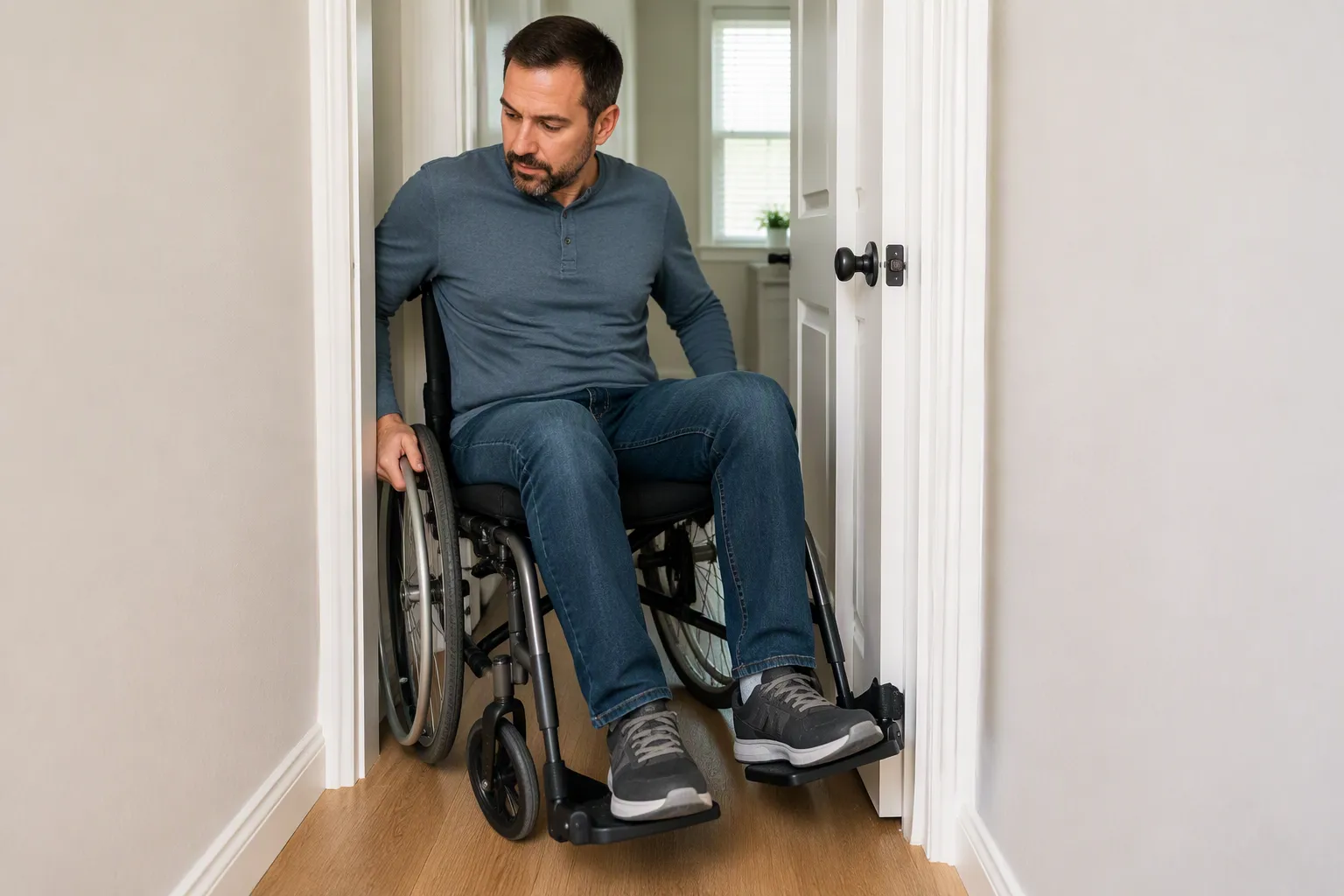
Wheelchair footrests make doorways harder to turn through. They add length and width to the wheelchair, which increases its turning radius. The extra forward projection makes the front end sweep a wider arc during a turn. Footrests often hit door frames or walls before the wheels clear the opening.
Even a few added inches can mean the difference between gliding through a doorway and getting stuck. Understanding how footrests change the radius helps users move through openings with more confidence.
How Wheelchair Footrests Extend the Wheelchair’s Footprint

A wheelchair’s footprint is the total space it occupies on the floor. This footprint includes the rear wheels, the frame, the seat, the armrests, and the wheelchair footrests. Each component adds to the overall dimensions. Footrests play a major role because they project forward from the frame. They extend the front of the chair well beyond the front casters. This extra projection changes how the wheelchair moves through tight spaces.
What Footrests Add to Length and Width
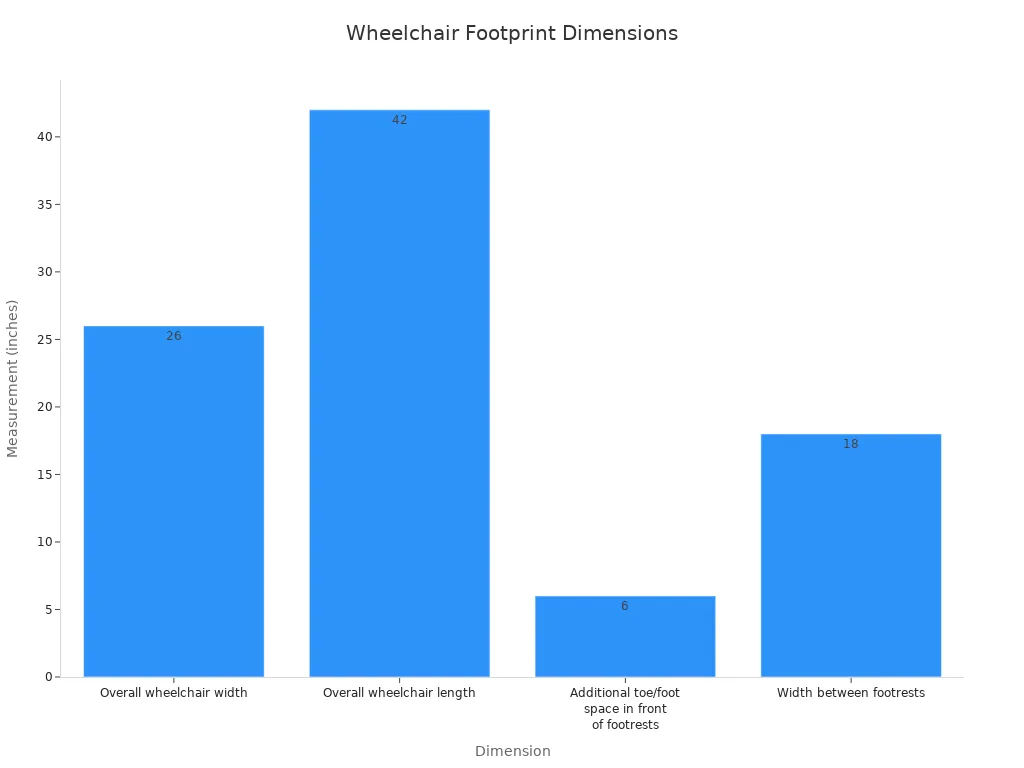
Footrests add both length and width to a wheelchair. The length increase comes from the forward projection of the footplates and their supporting hardware. The width increase comes from the space between the two footrests and the hardware that mounts them to the frame. A standard adult wheelchair often measures about 26 inches wide at the rear wheels. The same chair can measure 42 inches long from the back of the rear wheels to the front of the footrests. These numbers show how much space a wheelchair needs in a doorway.
Many wheelchairs have features such as armrests, footrests, and additional seating adjustments that can increase the overall width. In such cases, doorways must be wide enough to accommodate these modifications, providing seamless mobility throughout a living or working space.
Fixed vs. Swing-Away Footrests
Fixed footrests stay in one position. They bolt directly to the frame and do not move. These footrests offer strong support and stable positioning for the feet. They also add the most length to the chair because they always project forward. Swing-away footrests rotate outward to the sides. A user can push them aside to reduce the front projection. This design helps with transfers and tight turns. Swing-away models still add length when they sit in the forward position. The difference between fixed and swing-away models matters most in narrow spaces.
Elevating Leg Rests and Their Extra Length
Elevating leg rests support the legs in a raised position. They help users with swelling, circulation problems, or post-surgery recovery. These leg rests extend farther forward than standard footrests. The extra length comes from the reclined angle and the additional support structure. An elevating leg rest can add several inches to the front of the chair. This extra length increases the turning radius and makes tight maneuvers harder. Users who need elevating leg rests often face more challenges in narrow doorways.
Measuring the Extra Inches
Precise measurements help users understand their chair’s real footprint. A tape measure and a flat floor provide the basic tools. The user measures from the back of the rear wheels to the front of the footrests. This distance gives the overall length. The user also measures the width at the widest point. The widest point is often the rear wheels or the footrest hardware. These measurements reveal the true space the chair needs.
| Dimension | Measurement (inches) |
|---|---|
| Overall wheelchair width (to outside of rear wheels) | 26 |
| Overall wheelchair length (back of rear wheels to front of footrests) | 42 |
| Additional toe/foot space in front of footrests | 6 |
| Width between footrests | 18 |
Footrest Projection Beyond the Front Casters
Front casters sit under the frame and support the front of the chair. Footrests project beyond these casters by several inches. A typical footrest extends 6 to 10 inches past the front casters. This projection creates a longer front end. The front end swings wide during a turn. A longer front end needs more space to complete the same turn. Users often underestimate this projection. They focus on the wheels and forget the footrests.
How Footrest Angle Changes Clearance
The angle of the footrest affects clearance. A footrest angled downward projects farther forward at the bottom. A footrest angled upward tucks the footplates closer to the frame. Small angle changes can shift the front projection by an inch or more. An inch of extra projection can mean the difference between clearing a door frame and hitting it. Users should check the footrest angle as part of their regular setup. A proper angle balances comfort and maneuverability.
Why Footprint Size Matters in Doorways
Doorways restrict movement in two directions. The sides of the frame limit side-to-side space. The frame and threshold limit front-to-back space during a turn. A larger footprint reduces the room available for both. The clear width of a doorway must exceed the widest part of the chair. The clear opening must also allow the front end to sweep through without contact. Footprint size directly determines whether a wheelchair fits through a given opening.
Standard Doorway Widths vs. Wheelchair Width
Standard interior doorways in many homes measure 30 to 32 inches wide. The clear opening is smaller than the nominal size. A 32-inch door often provides only 29 to 30 inches of clear width after the frame and hinges take their space. A wheelchair with a 26-inch width leaves only 3 to 4 inches of total clearance. That space splits between both sides of the chair. The user has about 1.5 to 2 inches on each side. This margin leaves almost no room for error.
How Little Clearance You Actually Have
The usable doorway width shrinks further during a turn. The chair cannot stay parallel to the frame. The front end swings toward one side as the rear end swings toward the other. The footrests trace a wider arc than the wheels. This arc needs extra space beyond the chair’s static width. A chair that fits straight through a doorway may still catch its footrests during a turn. The gap the footrests need to clear is often the deciding factor. Users should measure this gap before attempting a tight turn.
How Wheelchair Footrests Increase Turning Radius
What Turning Radius Means for a Wheelchair
Turning radius describes the circular area needed for a direction change. A compact frame produces a short turning radius. Footrests extend the frame. They enlarge the turning radius. Users must plan for a wider arc in tight spaces.
The Space Needed to Complete a 360-Degree Turn
A 360-degree turn demands an open circular floor area. The chair sits at the center of the circle. Every attached component travels around the pivot point. Footrests trace the widest arc of all. Users must clear the entire path first. Then they plan the turn.
How Turning Radius Is Measured
Manufacturers calculate this value from the pivot center to the outer edge. The measurement must include every attached component.
- Footrests and leg rests protrude beyond the nominal frame.
- Armrests add width to the side profile.
- Front wheels can swing wider than the chassis.
A published figure excludes these parts. Such a figure understates the true requirement. Users should confirm the included components.
A published value is only one input. The occupied wheelchair envelope determines real fit.
How Footrests Change Turning Radius
Footrests move the front boundary of the chair. The shift changes the rotation pattern.
The Front Pivot Point Shift
A wheelchair rotates around a pivot point near the rear wheels. The front casters follow an arc around that pivot. Footrests extend beyond those casters. The footrests sweep a wider path than the wheels. Swing-away footrests alter the effective length when rotated aside. Elevating leg rests add more forward reach. This turning behavior becomes critical near door frames.
Why a Longer Chair Needs More Room
A longer chair requires more room. The front edge sits farther from the pivot center. The distance controls the swept path. Added footrest length expands that distance. A chair may pass a circular turning test. The same chair can still need extra space at a 90-degree corridor. The wheelchair turning space includes the full swept path. Protruding foot supports count in this calculation. A long chair consumes the turning space in front of the opening.
Users must account for the turning path during every move. The turning movement requires precision inside a narrow hall. Users should test a tight maneuver with leg rests installed. The front-wheel swing deserves close attention.
Turning Radius vs. Doorway Clearance
Doorways present a fixed boundary. The opening size sets the limit. Users must fit the chair within that boundary.
Comparing Wheelchair Radius to Standard Doorways
A standard interior opening provides roughly 29 to 30 inches of clear width. A chair measuring 26 inches wide rolls straight through. The required circle changes the equation. The chair must rotate within the combined hallway and opening. Hallways rarely offer a full circle for a long chair. The sweep extends past the frame. The wheels have not yet aligned with the opening.
The Gap the Footrests Need to Clear
Footrests need a gap between their edge and the frame. The gap must stay open during the entire maneuver. Users need enough turning space to clear the frame. A projection of 6 to 10 inches past the front casters demands extra clearance. Users should approach slowly. They should observe the footrest path. Old buildings rarely provide enough space to turn near a doorway.
The Turning Problem in Tight Doorways
Why Doorways Make Turning Difficult
Doorways impose rigid limits on movement. The frame creates fixed boundaries on both sides. A wheelchair must pass through this opening without contact. The challenge grows when the user needs to change direction within or near the opening.
Limited Side-to-Side Clearance
A standard doorway offers roughly 29 to 30 inches of clear width. A wheelchair measuring 26 inches wide leaves only 3 to 4 inches of total space. This gap provides little clearance on each side. The user has approximately 1.5 to 2 inches per side. Any slight drift causes contact with the frame. This margin leaves no room for error during a turn.
The Need to Pivot Without Hitting the Frame
A user must pivot the chair to change direction. The pivot motion swings the front and rear ends in opposite directions. The frame limits this movement. The chair cannot rotate freely within the opening. The user must coordinate the pivot with forward motion. This maneuver demands precision and spatial awareness.
How Footrests Increase the Sweep Arc
Footrests extend the front of the chair. This extension enlarges the path the front end travels during rotation. The sweep arc grows with every added inch of projection.
Why the Front of the Wheelchair Hits First
The front end sits farthest from the pivot point. It travels the widest path during any turn. Footrests project beyond the front casters by 6 to 10 inches. This projection means the footrests lead the sweep. They reach the door frame before the wheels do. The front of the wheelchair hits first in almost every tight turn.
Door Frames and Thresholds That Catch Footrests
Door frames and raised thresholds create physical barriers. Footrests sit low to the ground. They catch on these obstacles easily. A threshold adds height that footplates cannot clear. A door frame adds a vertical edge that catches the footrest edge. These contact points stop forward motion instantly.
Center of Gravity and Balance While Turning
Footrests affect more than geometry. They also shift the chair’s weight distribution. This shift changes how the chair behaves during a turn.
Forward Weight Shift From Footrests
Legs and feet carry significant weight. Footrests support this weight at the front of the chair. This placement moves the center of gravity forward. A forward center of gravity reduces rear stability. The chair becomes more prone to tipping backward during sudden movements.
Risk of Tipping or Losing Control
A forward weight shift increases tip risk. The user may lose control during a sharp turn. Rear wheels can lift off the ground. This risk grows on ramps or uneven surfaces. Users should test balance with footrests installed. They should practice turns in safe environments first.
Moving Wheelchair Footrests for Tight Doorways
Swing-Away and Removable Footrests
Reducing Length in Seconds
Swing-away footrests rotate outward with a simple push. This motion removes several inches from the front of the chair in seconds. Removable footrests lift off the frame entirely. Both options shrink the chair’s effective length before the user enters a tight space. A study on wheelchair dimensions supports this practice. The authors noted that their measurements did not account for the ability of some individuals to swing legrests and footrests out of the way. They acknowledged that their data may overestimate the occupied length for short durations. This finding confirms that swinging footrests aside reduces the effective length during a doorway approach.
When Removal Is Not Practical
Removal does not work in every situation. Some users need continuous leg support for medical reasons. Others cannot reach down to detach the footrests without help. Losing a footrest in a public space creates a replacement problem. Users should weigh these factors before choosing removal as a routine strategy.
Adjusting Footrest Height and Angle
Tucking Footrests Closer to the Wheelchair
Height and angle adjustments offer a middle ground. A user can raise the footplates or change their tilt. This change tucks the footrests closer to the frame. The front projection shrinks by an inch or more. The chair becomes shorter without losing foot support.
Finding the Sweet Spot for Clearance
The best setting balances comfort and clearance. A footrest angled too far down projects forward and catches on frames. A footrest angled too far up strains the legs and feet. Users should test different positions in a safe space. They can measure the front projection at each setting. The ideal angle keeps the feet supported and the front end compact.
Comfort vs. Maneuverability Trade-Offs
Leg Support vs. Turning Ease
Every adjustment involves a trade-off. Full leg support improves comfort during long sits. A compact front end improves turning in tight spaces. Users must decide which need matters more at a given moment. A short trip through narrow halls may favor maneuverability. A long day in the chair may favor support.
Temporary vs. Permanent Adjustments
Some changes last only for a single doorway. A user swings the footrests aside, passes through, and swings them back. Other changes become permanent parts of the chair’s setup. A permanent angle adjustment or a switch to swing-away wheelchair footrests changes daily use. Users should treat temporary fixes as quick solutions and permanent changes as long-term decisions.
Practical Wheelchair Turning Tips for Doorways
Navigating doorways begins with preparation. A user must align the chair, use the environment, and set up the wheelchair correctly. These steps reduce the likelihood of footrests catching on frames.
Position Yourself Before You Turn
Lining Up Straight at the Doorway
A user should approach the doorway straight on. The front casters point directly into the clear opening. The wheelchair should roll perpendicular to the frame. This alignment maximizes the effective clear width. It also gives the footrests a direct path through the opening. A user can avoid turning too early by waiting until the front casters clear the frame.
Using a Three-Point Turn Strategy
Narrow openings often prevent a single pivot. A three-point turn breaks the maneuver into small steps. The user rolls forward until the footrests reach the far side of the frame. Then they stop, rotate the front end, and reverse. They repeat the process until the chair aligns with the hallway. This strategy increases the turning space for a wheelchair or power chair inside a tight corridor.
Use the Environment to Help You Turn
Leveraging Door Frames and Walls
Walls and door frames offer useful reference points. A user can lightly touch the frame with a hand to judge distance. They can use the wall behind them to guide a reversal. These cues keep the footrests away from the frame. The environment becomes a tool rather than an obstacle.
Choosing Wider Entry Points When Possible
Some buildings provide multiple entrances. A wider doorway, an automatic door, or a ramp with extra clearance saves effort. Users should scan their surroundings for these options. Selecting a wider route avoids a difficult turn altogether.
Wheelchair Setup That Makes Turning Easier
Keeping Footrests Properly Adjusted
Footrests should sit close to the frame without sacrificing leg support. Swing-away models should rotate inward when the user enters a tight space. The footplate height should allow the feet to rest evenly. Proper adjustment reduces the front projection and lowers the risk of hitting frames.
Considering a Narrower Wheelchair Model
Some chairs handle tight spaces better than others. Front caster size and rear axle position influence maneuverability. Smaller casters make the chair more responsive; larger casters handle rough terrain better.
If we choose a very small caster, it allows someone to turn more readily, but a larger one makes it easier to manage varied terrain.
| Caster Size | Maneuverability & Response | Best Use |
|---|---|---|
| Small (3–4 in) | Best maneuverability; allows tighter turns and more responsive feel | Indoor environments, tight spaces, sports |
| Large (5–8 in) | Less maneuverable in tight indoor spaces | Outdoor/uneven terrain |
Smaller front casters improve performance during tight maneuvers. Rear axle position also matters. Moving the rear axle forward improves maneuverability but adds tipping risk. Moving it backward increases stability but reduces responsiveness.
| Rear Axle Position | Effect on Maneuverability | Effect on Stability |
|---|---|---|
| Forward | More responsive; easier tighter turns; less rolling resistance on front casters | More tippy |
| Backward | Harder to push; less maneuverable | More stable; harder to tip backward |
A user should measure the doorway width before attempting any maneuver. The chair’s overall length, including footrests, must fit within the available room to turn. A clinician or mobility specialist can help adjust the axle position safely. Every inch of adjustment changes the turning radius. Users who understand these settings can navigate doorways with greater confidence.
When to Ask for Help
Some doorways demand more than technique and preparation. A user should recognize when a situation exceeds their ability to navigate safely alone. Asking for help protects both the user and the wheelchair from damage.
Recognizing High-Risk Doorways
Certain doorways present obvious hazards. A narrow frame with less than two inches of clearance on each side leaves no margin for error. Raised thresholds catch footrests and stop forward motion. Sharp turns immediately after an opening force the user to pivot in a confined space. Heavy doors that swing inward push the chair backward during entry. Slick floors near entryways reduce traction and control. A user should assess these features before attempting passage. If two or more risk factors appear together, the user should seek assistance. A second person can hold the door, guide the chair, or spot the footrests during the turn. This support prevents injury and equipment damage.
Communicating Your Needs to Others
Clear communication makes assistance effective. A user should tell the helper exactly what they need. Specific instructions work better than general requests. For example, a user might say, “Please hold the door open and watch my left footrest.” This direction tells the helper where to stand and what to monitor. The user should also explain their preferred approach. Some users want a push through the doorway. Others want a spotter who watches for contact points. A user should speak up if a helper’s actions feel unsafe. They can pause the maneuver and reset. Building a shared understanding takes only a moment. That moment prevents accidents and builds confidence for future trips.
Common Myths About Wheelchair Footrests and Doorways
Myth: Footrests Only Add Length
Many people assume wheelchair footrests only extend the front of the chair. This belief overlooks a critical dimension.
The Overlooked Width Factor
Footrests add width as well as length. The mounting hardware and the space between the two footplates create a wider profile. A chair that measures 26 inches at the rear wheels may measure 28 inches or more across the footrest assembly. This extra width reduces the side-to-side clearance in a doorway. A user who only measures length will misjudge the fit.
Why Both Dimensions Matter
Both length and width determine whether a wheelchair passes through an opening. Length affects the turning radius and the sweep arc. Width affects the straight-line fit. A chair must satisfy both constraints at once. Ignoring either dimension leads to contact with the frame. Users should measure the full footprint before attempting a tight passage.
Myth: Any Wheelchair Fits Through Any Door
This myth causes frequent frustration. Many people believe standard doorways accommodate all wheelchairs. Reality tells a different story.
The Reality of Standard Doorway Sizes
Standard doorway widths in many buildings range from 30 to 32 inches. The clear opening after the frame and hinges often measures only 29 to 30 inches. A wheelchair with a 26-inch width leaves just 3 to 4 inches of total clearance. This margin splits between both sides. A wider chair or a chair with protruding footplates and armrests may not fit at all.
Why Personal Measurements Matter
Every wheelchair and every user has unique dimensions. A chair that fits one person may not fit another. Users should measure their own chair and their common routes. They should record the clear width of each doorway they use. These personal measurements prevent surprises and reduce the risk of getting stuck.
Myth: Removing Footrests Is Always the Answer
Some users believe removing footrests solves every tight-space problem. This approach carries real risks.
Safety and Comfort Considerations
Footrests support the legs and feet during long periods of sitting. Removing them shifts the weight of the legs downward. This shift increases pressure on the seat and the lower body. It also raises the risk of the feet catching on the floor or the frame. A user may lose balance during a turn without foot support.
Situations Where Footrests Should Stay On
Footrests should stay on during long trips, outdoor travel, and any situation that demands leg support. Users with circulation problems, swelling, or post-surgery needs should keep them in place. A better strategy involves swinging the footrests aside or adjusting their angle. These actions reduce length without sacrificing safety. Users should reserve full removal for short, controlled maneuvers in narrow doorways.
How Wheelchair Design Improves Turning in Doorways
Modern designers solve the footrest problem by making the front end retract. Retractable footrest mechanisms pull the footplates under the seat. Researchers found that knees flexed at 120 degrees reduce overall length by 39% compared with fully extended legs. The center of mass shifts backward by 38%, rolling resistance falls by 21%, and moment of inertia drops by 42%. A user can complete a zero-radius turn with 40% more angular velocity. These gains make turning easier and reduce the sweep near door frames.
Space-saving materials reinforce this effect. Aluminum and composite frames maintain strength with a slim profile. The lighter frame lowers rolling resistance further. A compact front end allows the chair to navigate hallways without scraping walls.
Compact and Foldable Footrest Innovations
Retractable Footrest Mechanisms
Retractable mechanisms tuck the footplates away during passage. They preserve leg support while shortening the chair. The user can extend the footrests after the maneuver.
Space-Saving Materials
Materials such as carbon fiber and aircraft-grade aluminum reduce weight and structure thickness. These materials permit lower-profile hinges and rails, which create extra clearance.
Wheelchairs Built for Tight Turns
Narrow-Frame Models
A narrow-frame model brings the base width to 24 inches. The Merits Velocity, for instance, combines a 24-inch base with a seat adjustable from 16 to 22 inches. This narrow profile fits most standard home interiors.
Mid-Wheel Drive and Its Advantages
Mid-wheel drive models position the drive wheel near the chair’s center. The Merits Vision Sport with Lift offers a 20-inch radius. That short distance from the drive wheel to the front end lets the chair rotate within its own footprint. Footrests stay closer to the rotation center, so they no longer force a wide arc.
What to Look for in a New Wheelchair
Key Specs to Compare
The minimum doorway width for wheelchair access is not the same as the overall clear width. Users must measure each clear opening in their home. A standard 25-inch-wide chair fits through many common openings, but wheel placement and armrests alter the clear path. This dimension alone does not predict a successful turn.
| Specification to Compare | Why It Matters |
|---|---|
| Base width | A 24-inch base fits more door frames |
| Seat width range | Must match hip width and thigh length |
| Footrest mechanism | Retractable or swing-away options reduce front projection |
| Drive configuration | Mid-wheel drive shortens the pivot footprint |
| Frame material | Lighter materials reduce rolling resistance |
Balancing Portability and Function
Users also need good turning space for a wheelchair or power chair in each hallway. A hallway should measure at least 36 inches wide. A narrower chair folds more easily and fits into vehicles. It may offer less stability on rough terrain. Indoor users should prioritize footrest retraction and compact width. Outdoor users may accept a longer front end for a stronger frame. The right chair combines a manageable radius with dependable foot support.
Wheelchair footrests make doorways harder to turn through. They extend the wheelchair’s length and width. This extra size increases the turning radius and the space needed to rotate. Footrests also shift the front pivot point forward. The chair sweeps a wider arc and hits door frames first. Swinging away, removing, or adjusting footrests improves maneuverability in tight spaces. A user should check the approach angle and the clear opening before entering. The turning space must accommodate the full sweep. A proper setup gives the user more room to turn inside any doorway. With the right adjustments, a difficult turn becomes a simple move.
FAQ
Do footrests really make that much of a difference in doorways?
Yes. Footrests extend the front of the wheelchair by 6 to 10 inches beyond the front casters. This projection increases the turning radius. The front end sweeps a wider arc during any turn. A chair that fits straight through a doorway may still catch its footrests during rotation.
Can a person remove footrests to get through a narrow doorway?
Removal works for short, controlled maneuvers. Users should keep footrests on during long trips or outdoor travel. Removing them shifts leg weight downward and increases seat pressure. A better option involves swinging footrests aside or adjusting their angle. These actions reduce length without sacrificing safety.
What is the minimum doorway width for a wheelchair with footrests?
A standard wheelchair measures about 26 inches wide. A typical doorway provides 29 to 30 inches of clear width. This leaves only 3 to 4 inches of total clearance. The footrests need additional space during a turn. Users should measure their specific chair and doorway before attempting passage.
How does turning radius affect doorway navigation?
Turning radius describes the circular space needed for a direction change. Footrests enlarge this radius because they extend the front boundary. The chair sweeps a wider arc during rotation. A longer chair needs more room to complete the same turn. Users must account for this sweep near door frames.
Do swing-away footrests solve the doorway problem?
Swing-away footrests help significantly. They rotate outward to reduce front projection in seconds. This design shrinks the chair’s effective length before entering a tight space. However, swing-away models still add length when positioned forward. Users should swing them aside before attempting a narrow turn.
Why do footrests hit door frames before the wheels do?
Footrests sit farthest from the pivot point near the rear wheels. They travel the widest path during any turn. This projection means footrests lead the sweep. They reach the door frame before the wheels clear the opening. The front of the wheelchair hits first in almost every tight turn.
Can adjusting footrest angle improve doorway clearance?
Yes. A footrest angled downward projects farther forward at the bottom. A footrest angled upward tucks the footplates closer to the frame. Small angle changes can shift front projection by an inch or more. Users should test different positions and measure the front projection at each setting.
When should a wheelchair user ask for help in a doorway?
Users should seek assistance when two or more risk factors appear together. Narrow frames, raised thresholds, sharp turns, and heavy doors create hazards. A second person can hold the door, guide the chair, or spot the footrests. Clear communication makes assistance effective and prevents injury.