
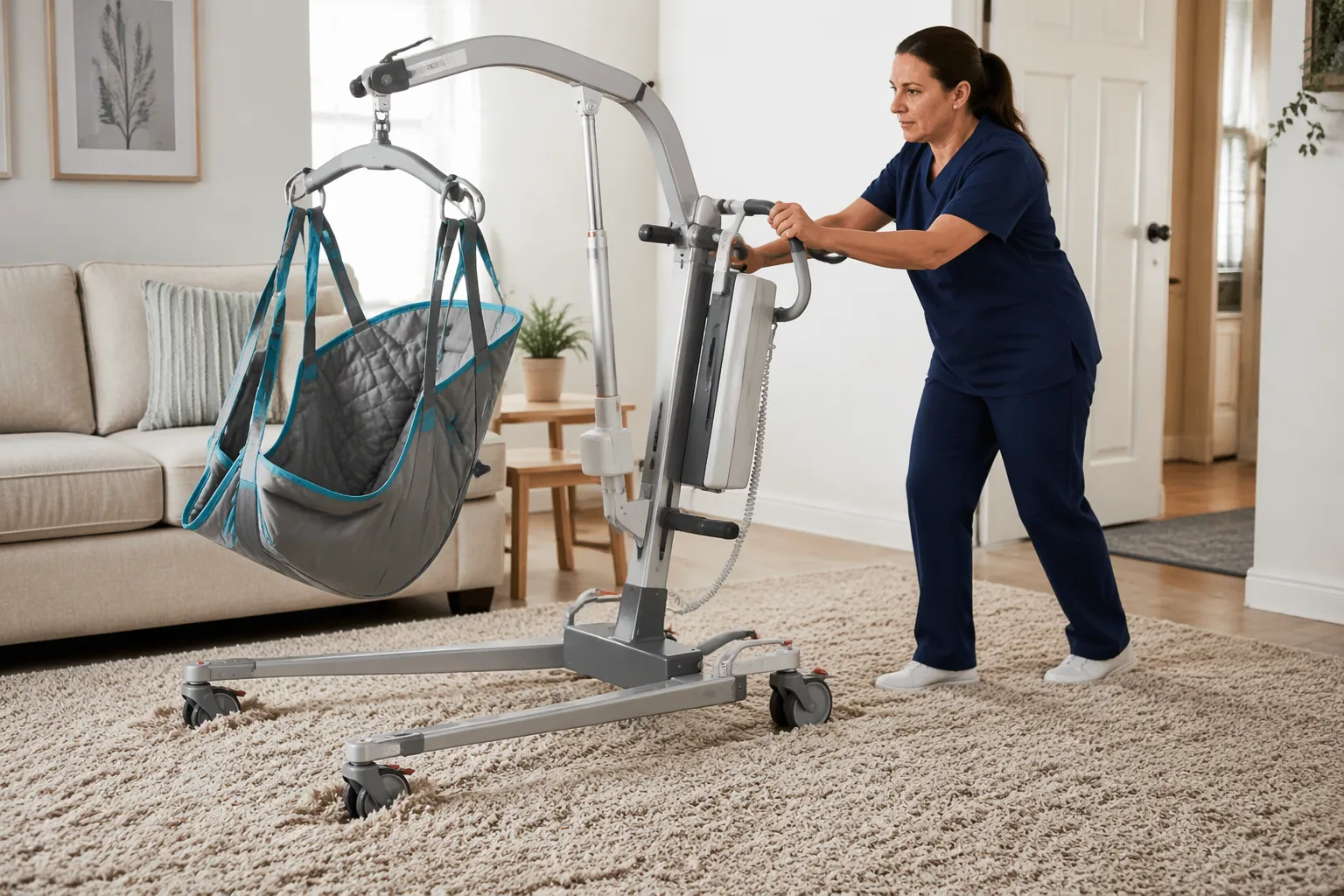
Carpet creates far more rolling resistance than hard flooring. A patient lift not roll easily on carpet usually works as designed. Four culprits drive this problem: carpet fibers and padding, caster and wheel design, lift weight and load distribution, and environmental factors. The issue involves force, friction, and drag, not a defective lift. Excess resistance makes the lift difficult to maneuver and can strain caregiver safety. Most causes have simple, low-cost fixes.
Carpet Fibers Create Drag on Every Wheel

Carpet fibers touch every wheel of a patient lift. Each fiber bends, compresses, and springs back as a caster passes over it. This constant deformation consumes energy and converts it into resistance. The effect multiplies across four casters at once. Caregivers feel the combined force as a heavy push.
How Pile Depth Increases Drag
Low Pile vs. Plush Carpet
Pile height changes the rolling experience dramatically. Low pile carpet keeps fibers short and upright. Wheels stay close to the backing and roll with modest effort. Plush carpet tells a different story. Long fibers wrap around wheel edges and pull the caster downward. The lift feels anchored rather than mobile.
Why Deep Pile Acts Like Sand
Deep-pile carpets behave much like loose sand under a wheel. Each caster sinks into the fiber layer and pushes material forward. The wheel creates a small bow wave of compressed fibers. This bow wave produces significant drag with every inch of travel. Caregivers often describe the sensation as pushing through wet cement.
The Hidden Role of Carpet Padding
Thick Padding and Wheel Sink
Padding sits beneath the carpet and absorbs downward force. Soft or thick padding allows casters to sink deeper into the surface. A sunken wheel must climb out of its own depression with each rotation. Thick carpet combined with soft underlay creates the worst-case scenario. The lift feels glued to the floor.
Carpet Underlay Materials Compared
Underlay materials vary widely in firmness and rebound speed. Foam padding compresses easily and returns slowly. Rubber padding offers firmer support and faster recovery. Felt padding sits in the middle for firmness. Dense padding limits wheel sink and reduces rolling resistance on carpeted floors. Homeowners can test underlay firmness by pressing a thumb into an inconspicuous corner.
Carpet Age and Matting
When Worn Carpet Becomes Stickier
Old carpet loses its resilience over time. Fibers mat together and form a compacted layer. Matted fibers create more friction against wheel treads. The carpet no longer springs back after compression. Worn sections develop a tacky feel that grabs rubber wheels. This stickiness adds resistance that caregivers notice immediately.
High-Traffic Paths and Grooved Lanes
Repeated traffic carves shallow lanes into the pile. These grooved lanes trap casters and steer them off course. A wheel riding in a groove fights the sides of the channel. Thicker pile in untouched areas creates a ridge beside the lane. The lift rocks between the groove and the ridge. Caregivers must correct the path constantly. Rotating furniture or adding a runner breaks this pattern.
Caster and Wheel Design on Carpet
Caster and wheel design determines how a patient lift performs on soft flooring. A caster built for tile or linoleum behaves very differently on carpet. The right design reduces effort for the caregiver. The wrong design multiplies resistance with every push. Understanding these design differences helps caregivers match equipment to the home environment.
Caster Size Matters
Caster diameter directly affects rolling effort on soft flooring. A larger wheel bridges over small obstacles and spreads weight across a wider contact patch. A smaller wheel sits deeper in the pile and fights every fiber. Size alone does not guarantee easy rolling, but it sets the foundation for everything else.
Small Casters and Carpet Fibers
Small casters typically measure two to three inches in diameter. These compact wheels work well on hard, smooth flooring. On carpet, they sink into the pile and push fibers forward like a plow. Each rotation compresses a fresh patch of fiber. The caster must climb out of its own depression with every turn. Small casters also catch on carpet edges and transition strips. Caregivers feel every fiber through the handle. The lift seems to fight each inch of forward motion.
Large Casters and Better Flotation
Large casters measure four to five inches or more in diameter. The bigger circumference rolls over carpet fibers instead of pushing through them. A wider contact patch distributes weight across a broader area. This flotation effect helps prevent wheels from digging in to soft padding. Large casters also roll more easily over thresholds and carpet edges. The trade-off comes in tighter spaces. Large casters need more room to swivel and turn. Caregivers should measure doorway widths and room layouts before choosing a lift with oversized casters.
Wheel Material and Tread
Wheel material changes how a caster interacts with carpet fibers. Hard materials slide across the surface. Soft materials grip and compress the pile. Neither option is universally better. The right choice depends on the flooring type and the caregiver’s typical routes.
Hard Plastic vs. Rubber Treads
Hard plastic wheels offer durability and low maintenance. They roll easily on hard flooring and resist wear over time. On carpet, hard plastic tends to slide rather than grip. This sliding motion can actually reduce drag on low-pile carpet. However, hard plastic transmits more vibration to the lift frame. Caregivers feel every bump and fiber transition through the handle. Rubber treads offer a softer ride and better traction. They grip carpet fibers and compress the pile slightly. This grip provides stability but adds rolling resistance. Rubber also wears faster than plastic on abrasive surfaces. Each material suits different environments. Plastic works well for low-pile carpet and mixed flooring. Rubber suits high-pile carpet where traction matters more than easy rolling.
Why Soft Treads Grip Carpet Too Well
Soft rubber treads conform to carpet fibers under pressure. The tread material presses into the pile and creates a mechanical lock. This grip prevents slipping and improves control during patient transfers. The same grip creates turning difficulty on plush carpet. A soft tread resists lateral movement because fibers cling to the rubber surface. Caregivers must apply extra force to rotate the lift. Over time, this extra effort strains wrists and shoulders. Soft treads also collect more debris and fiber. The tread surface acts like a magnet for lint, hair, and carpet fuzz. Regular cleaning becomes essential for maintaining maneuverability.
Caster Type and Swivel Behavior
Caster configuration affects how a lift turns and tracks on carpeted surfaces. Twin-wheel and single-wheel designs behave differently under load. Lock features add control but can also add drag when misused. Caregivers should understand these differences before selecting or adjusting equipment.
Twin-Wheel vs. Single-Wheel Casters
Twin-wheel casters feature two wheels mounted side by side on a single axle. The design spreads weight across four contact points instead of two. This wider stance improves stability and reduces sink into soft carpet. Twin-wheel casters also track straighter on uneven surfaces. The dual-wheel design creates a larger effective contact patch. This patch helps prevent wheels from digging in to thick padding. Single-wheel casters offer simpler construction and easier cleaning. They pivot more freely in tight spaces. However, single wheels sink deeper into plush carpet and create more drag. Twin-wheel casters generally perform better on carpet, while single-wheel designs suit hard flooring and tight quarters.
Swivel Lock and Directional Lock Features
Swivel locks stop caster rotation and force the wheel to roll in a fixed direction. Directional locks allow forward and backward rolling while preventing side-to-side swivel. Both features improve control during straight-line transport. On carpet, locked casters can increase resistance because the wheel cannot adjust to fiber direction. A locked caster pushes through pile rather than rolling with it. Caregivers should engage locks only when needed. Leaving locks partially engaged creates drag and uneven wear. Directional locks help on long carpet runs by keeping the lift tracking straight. Swivel locks help during patient transfers on stable flooring. Matching lock use to the task preserves easy rolling and reduces strain.
Brakes and Locking Mechanisms
Brakes serve a critical safety function on any patient lift. They hold the lift steady during patient transfers and prevent unwanted movement on sloped surfaces. A brake system in good working order should release fully and allow the casters to spin freely. When a caregiver reports that the lift will not roll easily on carpet, the brake system deserves a close look. A brake that fails to disengage completely adds hidden resistance to every push.
Partially Engaged Brakes
A partially engaged brake is one of the most overlooked causes of poor rolling performance. The brake pedal may appear fully released to the eye. Internally, the brake mechanism may still contact the wheel or the caster housing. This contact creates constant friction during movement. Caregivers often describe the lift as feeling heavy or sluggish without knowing why. The problem grows worse on carpet, where the pile already adds its own drag to the rolling effort.
Several conditions produce a partially engaged brake. Dirt and lint can pack into the brake linkage and prevent full release. A bent pedal or a stretched cable may limit the travel of the brake mechanism. Wear on the brake pad or the actuator arm can leave a small gap that never fully opens. Caregivers should test each brake individually by engaging and releasing it several times. They should then push the lift a short distance and listen for scraping or rubbing sounds. A brake that does not click firmly into its released position needs adjustment or cleaning.
Carpet fibers compound this problem in a subtle way. Loose fibers work their way into the brake mechanism and jam the release travel. The same fibers collect around the casters and add friction at the wheel axle. A caregiver who notices that one caster rolls harder than the others should inspect that brake first. A simple visual check and a firm press on the release pedal often reveal the issue. Regular cleaning of the brake area keeps the mechanism moving freely.
Brake Drag and Roller Resistance
Brake drag refers to the friction a brake applies when it should be fully off. Even a small amount of drag multiplies across four casters and becomes noticeable to the caregiver. The effect is especially pronounced on carpet, where the baseline resistance is already higher than on hard flooring. A lift that rolls smoothly on tile may feel stuck on plush carpet because the brake drag pushes the total effort past a comfortable threshold.
Roller resistance is the term for the force a wheel must overcome to rotate. A properly released brake adds almost nothing to this force. A dragging brake adds a constant load that the caregiver must push through with every step. Over a long hallway, this extra effort strains the arms, shoulders, and lower back. Caregivers should treat brake drag as a maintenance issue rather than a flooring problem. The fix is usually simple: clean the brake mechanism, lubricate the pivot points, and confirm that each brake releases with a firm click.
Some lifts use a central brake bar that locks all four casters at once. A bent bar or a worn linkage can leave one or two casters partially braked while the others roll free. This uneven braking creates a pulling sensation to one side. The lift veers off course and forces the caregiver to correct the path constantly. A quick test on a hard floor reveals the problem before it becomes a safety concern. The caregiver engages the brake, releases it, and pushes the lift in a straight line. Any pull to one side points to a brake that is not fully disengaging.
Routine inspection prevents most brake drag issues. Caregivers should check the brake action at the start of each shift. They should clear lint and fiber from the brake area and confirm that the pedal travels through its full range. A brake that feels soft or spongy needs professional attention. A brake that clicks firmly and releases cleanly protects both the patient and the caregiver. Matching brake maintenance to the home’s flooring conditions keeps the lift rolling smoothly for years.
Wheel Condition and Maintenance Problems
Wheel condition often explains why a patient lift struggles on carpet. Even a well-designed caster loses performance when debris, wear, or damage interferes with free rotation. Caregivers should inspect wheels regularly to keep rolling effort low.
Hair, Thread, and Fiber Wrapped Around Axles
How Carpet Fibers Collect in Casters
Carpet fibers break loose with normal foot traffic. These loose fibers migrate toward the lift’s casters during use. The axle area acts as a collection point. Fibers wrap around the axle and pack into the space between the wheel and the fork. Hair and thread from clothing add to the buildup. This wrapped material creates friction that slows rotation. The problem grows worse over weeks of daily use.
Signs Your Caster Is Clogged
A clogged caster announces itself through several clear signals. The lift pulls to one side during movement. One wheel stops swiveling while the others turn freely. Caregivers hear a grinding or squeaking sound with each rotation. The caster leaves a visible track pattern in the carpet pile. A simple lift-and-spin test confirms the diagnosis. A clogged wheel spins slowly or stops quickly after a push.
Worn Bearings and Stiff Casters
How to Test a Caster for Free Spinning
A free-spinning test takes only seconds. Caregivers should tip the lift and spin each wheel by hand. A healthy caster continues spinning for several seconds. A worn bearing stops almost immediately. The test also reveals rough spots or grinding sensations. Caregivers should repeat the test on all four casters. Comparing results identifies the problem wheel quickly.
Lubrication Do’s and Don’ts
Proper lubrication extends bearing life and reduces rolling resistance. Caregivers should apply a few drops of light machine oil to the axle points. They should wipe away excess oil to prevent carpet staining. Heavy grease attracts lint and fiber, so avoid thick lubricants. Never spray lubricant directly onto the carpet surface. Manufacturers specify approved lubricants in the lift manual. Following those recommendations protects the warranty and the flooring.
Loose or Damaged Wheels
Wobble, Flat Spots, and Cracks
A damaged wheel creates uneven rolling and poor caster alignment. Caregivers should check each wheel for side-to-side wobble. Flat spots develop when a lift sits loaded in one position for long periods. Cracks appear in hard plastic wheels after years of impact. Any of these conditions increases drag on carpet. Damaged wheels also damage the carpet backing beneath them.
When to Replace Rather Than Repair
Minor debris removal and lubrication count as routine maintenance. Cracked wheels, bent axles, and seized bearings require replacement. A wheel with a flat spot never rolls smoothly again. Caregivers should replace damaged casters in matched pairs to maintain balance. New wheels restore easy rolling and protect the carpet from further wear.
Lift Weight and Load Distribution
Weight plays a direct role in how a patient lift performs on soft surfaces. A heavier lift presses its casters deeper into the pile. That extra depth increases drag and makes every push harder. Caregivers should understand how lift weight, patient weight, and base geometry work together before blaming the carpet alone.
Heavier Lifts Sink Deeper
Manual vs. Powered Lift Weight
Manual lifts typically weigh less than powered models. Their lighter frames place less downward force on each caster. Powered lifts carry batteries, motors, and reinforced frames. This added mass pushes wheels deeper into soft padding. A powered lift may need larger casters or firmer underlay to roll well on plush carpet. Neither design is superior. Each suits different care settings and patient needs.
How Patient Weight Shifts the Load
The lift carries the patient, not just its own frame. A heavier patient multiplies the force on every caster. Weight shifts during lifting as the patient swings from bed to chair. This movement changes the load on each wheel moment by moment. Caregivers feel the lift grow heavier mid-transfer. Planning the path before lifting reduces strain and improves safety.
Where the Weight Sits on the Base
Leg Spacing and Base Width
A wide base spreads weight across a larger footprint. Wider leg spacing reduces sink into soft flooring and lowers rolling resistance. A narrow base concentrates force on fewer contact points. Caregivers should adjust leg spacing to match the room layout. Wider spacing works well in open rooms. Narrow spacing helps in tight bathrooms and doorways.
Center of Gravity During Lifting
The center of gravity moves as the boom raises and lowers. A raised boom shifts weight forward and toward the mast. This shift loads the front casters more heavily. Caregivers should keep the patient close to the mast during transport. A centered load keeps all four wheels engaged and rolling evenly.
Pushing vs. Pulling Technique
Body Mechanics for Caregivers
Good technique reduces the force a caregiver must apply. Caregivers should push with both hands and keep the load close to the body. They should bend slightly at the knees and avoid twisting the spine. Pushing uses stronger muscle groups than pulling. Proper body mechanics protect the caregiver and support patient safety during every transfer.
Using Handles and Mast for Leverage
Handles and the mast offer natural leverage points. Caregivers should grip the handles at waist height and steer with small corrections. The mast provides a stable surface for guiding the lift through doorways. Caregivers should never pull the lift sideways by the boom. Sideways pulling strains the frame and misaligns the casters.
Environmental Factors That Add Resistance
The room itself adds hidden forces that make a patient lift harder to move. Caregivers often overlook these environmental factors. A careful look at transitions, moisture, and debris reveals simple solutions.
Carpet Transitions and Thresholds
Room-to-Room Height Changes
Carpet rarely meets other flooring at the same height. A carpeted room often sits a fraction of an inch above a hard hallway. Each caster must climb this small step during transport. The lift slows, and the caregiver feels a sudden jolt. Repeated climbs strain the wheels and the caregiver’s arms. A gradual ramp or a low-profile strip smooths the transition.
Doorway Strips and Saddles
Doorway strips and saddles create raised bumps across the carpet. These metal or wooden strips protect the carpet edge. They also catch small casters and stop forward motion. A caster that hits a saddle square may stall completely. Caregivers should approach these strips at a slight angle. A gentle push carries the wheel over the bump with less effort.
Moisture, Humidity, and Static
Damp Carpet and Fiber Swelling
Humid air leaves carpet fibers slightly damp. Damp fibers swell and pack more tightly under a wheel. This swelling raises the resistance across the entire carpet surface. Basements and bathrooms suffer most from this effect. A dehumidifier keeps the air dry and the fibers firm. Dry fibers compress and rebound with less drag.
Static Buildup on Synthetic Fibers
Synthetic fibers generate static electricity during dry weather. Static makes light lint and dust cling to wheels and axles. This cling adds friction at the caster fork. Grounding mats and a humidifier reduce static buildup. Caregivers should wipe wheels with a damp cloth to release the charge.
Debris and Surface Contamination
Pet Hair and Dust in the Pile
Pet hair settles deep in the pile and wraps around axles. Dust mixes with hair and forms a gritty paste. This paste grinds against bearings and slows rotation. Regular vacuuming removes the loose material before it reaches the casters. Caregivers should inspect wheels weekly in homes with pets.
Spills and Sticky Residue
Spilled drinks leave sticky residue on carpet surfaces. This residue grabs wheel treads and adds drag. Dried residue acts like glue against rubber wheels. Caregivers should blot spills immediately and clean the area thoroughly. A clean carpet protects both the lift and the home.
Practical Fixes for a Patient Lift Not Rolling Easily
Most rolling problems on carpet have practical solutions. Caregivers can solve many issues without professional help. The fixes range from simple cleaning routines to equipment adjustments. A systematic approach saves time and money.
Quick Wins at Home
Clearing and Cleaning Casters
Caster cleaning is the first step in any troubleshooting routine. Caregivers should tip the lift and inspect each wheel closely. Hair, thread, and carpet fibers wrap around axles and pack into fork spaces. A pair of tweezers or a small pick removes this debris effectively. Caregivers should spin each wheel by hand after cleaning. A clean caster spins freely and stops slowly. Regular cleaning prevents debris from hardening into stubborn deposits. Caregivers should make caster inspection a weekly habit in homes with pets or heavy foot traffic. This simple routine keeps the lift rolling smoothly and protects the wheels from premature wear.
Rearranging Furniture and Paths
Furniture placement affects how easily a lift moves through a room. Tight corners force caregivers to make sharp turns. Sharp turns increase lateral force on casters and add resistance. Caregivers should clear a wide path between the bed, bathroom, and living areas. They should remove small rugs and obstacles that catch wheels. A clear path reduces the number of direction changes during transport. Fewer turns mean less strain on the caregiver and the lift. Rearranging furniture takes an afternoon and costs nothing. The result is a safer, more efficient care environment.
Carpet-Friendly Adjustments
Carpet Runners and Rigid Mats
Carpet runners create a smooth track over soft carpet. A rigid runner distributes weight across a wider area. This distribution prevents casters from sinking into thick carpet. Runners also protect the carpet beneath from wheel marks and wear. Caregivers should choose runners with a firm backing and low-profile edges. A beveled edge lets casters roll onto the runner without catching. Runners work best along fixed transport routes. They suit hallways and paths between rooms. Caregivers should secure runner edges with double-sided tape to prevent slipping. A quality runner reduces drag significantly and makes daily transport easier.
Temporary Floor Boards Over Carpet
Temporary floor boards offer another solution for problem areas. Rigid boards placed over carpet create a hard, smooth surface. Casters roll easily across the board surface. Caregivers can remove the boards when guests visit or when the patient moves. Plywood or hardboard panels work well for this purpose. Caregivers should choose boards thick enough to support the lift’s weight. They should tape edges down to prevent tripping hazards. Floor boards suit small areas where a permanent change is not practical. This approach protects both the lift and the carpet. It provides a stable surface for patient transfers in bedrooms and bathrooms.
When to Call for Service or Upgrade
Signs the Lift Needs Professional Attention
Some problems exceed the scope of home fixes. Caregivers should watch for warning signs that require professional service. A caster that wobbles after cleaning needs bearing replacement. A brake that fails to hold under load demands immediate attention. Cracks in the lift frame compromise safety for both patient and caregiver. Strange noises during operation suggest internal wear. A lift that pulls consistently to one side points to alignment problems. Caregivers should stop using the lift and call for service when these signs appear. Professional technicians have the tools and parts to restore proper function. Early intervention prevents small problems from becoming costly repairs.
Choosing Carpet-Ready Casters or a Different Lift
Sometimes the best solution involves an equipment upgrade. High-quality casters designed for soft flooring make a dramatic difference. These casters feature larger diameters and smooth-rolling bearings. They distribute weight evenly and roll over carpet fibers with less effort. Caregivers should look for casters with sealed bearings and firm tread compounds. Sealed bearings resist debris and last longer in carpeted environments. A different lift may suit homes with extensive carpet coverage. Lighter manual lifts place less pressure on soft surfaces. Powered lifts with wide bases offer stability but add weight. Caregivers should match the lift to the home’s flooring before purchase. The right equipment reduces resistance from the start and protects caregiver safety during every transfer.
Carpet resistance comes from four interacting factors: fibers and padding, caster and wheel design, wheel condition, and weight distribution. Caregivers should troubleshoot in easiest-first order. They clean and inspect casters, check brakes, adjust technique, then consider mats or carpet changes. The right wheel type and routine maintenance solve most complaints about a patient lift not rolling easily on carpet. Caregivers should match the lift and its casters to the home’s flooring. This approach reduces rolling resistance, protects caregiver safety, and improves patient safety during every transfer. A patient lift not roll easily on carpet no longer needs to be a daily struggle.
FAQ
Why does the lift roll fine on tile but stick on carpet?
Carpet fibers compress under each wheel and create constant drag. Tile offers a hard, smooth surface with minimal resistance. The same lift performs differently because the flooring changes the friction. This behavior reflects normal physics, not a mechanical defect.
How can a caregiver test whether a caster is the problem?
A caregiver tips the lift and spins each wheel by hand. A healthy caster continues spinning for several seconds. A clogged or worn caster stops quickly or grinds. Comparing all four wheels identifies the problem caster immediately.
Do larger casters always solve carpet rolling problems?
Larger casters improve flotation and roll over fibers with less effort. They also need more clearance in tight spaces. Caregivers should measure doorways and room layouts first. The right caster size balances easy rolling against maneuverability.
How often should caregivers clean lift casters?
Caregivers should inspect casters weekly in homes with pets or heavy traffic. Monthly inspection suits quieter households. Visible hair or fiber buildup demands immediate cleaning. Regular cleaning prevents debris from hardening and damaging bearings.
Can carpet padding make a lift harder to push?
Soft or thick padding allows casters to sink deeper into the surface. A sunken wheel must climb out of its depression with each rotation. Dense padding limits sink and reduces resistance. Homeowners can test underlay firmness by pressing a thumb into a corner.
Does patient weight affect how easily the lift rolls?
Patient weight adds directly to the load on every caster. A heavier patient presses wheels deeper into the pile. Weight shifts during transfers change the load moment by moment. Caregivers should plan the path before lifting to reduce strain.
When should a caregiver call for professional service?
A caster that wobbles after cleaning needs bearing replacement. A brake that fails to hold under load demands immediate attention. Cracks in the frame compromise safety. Caregivers should stop using the lift and call a technician when these signs appear.
Do carpet runners really make a difference?
A rigid runner distributes weight across a wider area. This distribution prevents casters from sinking into thick carpet. Runners also protect the carpet beneath from wheel marks. Beveled edges let casters roll on without catching.